3 Essential Narcotics & Drugs Stories for Public Health Officials


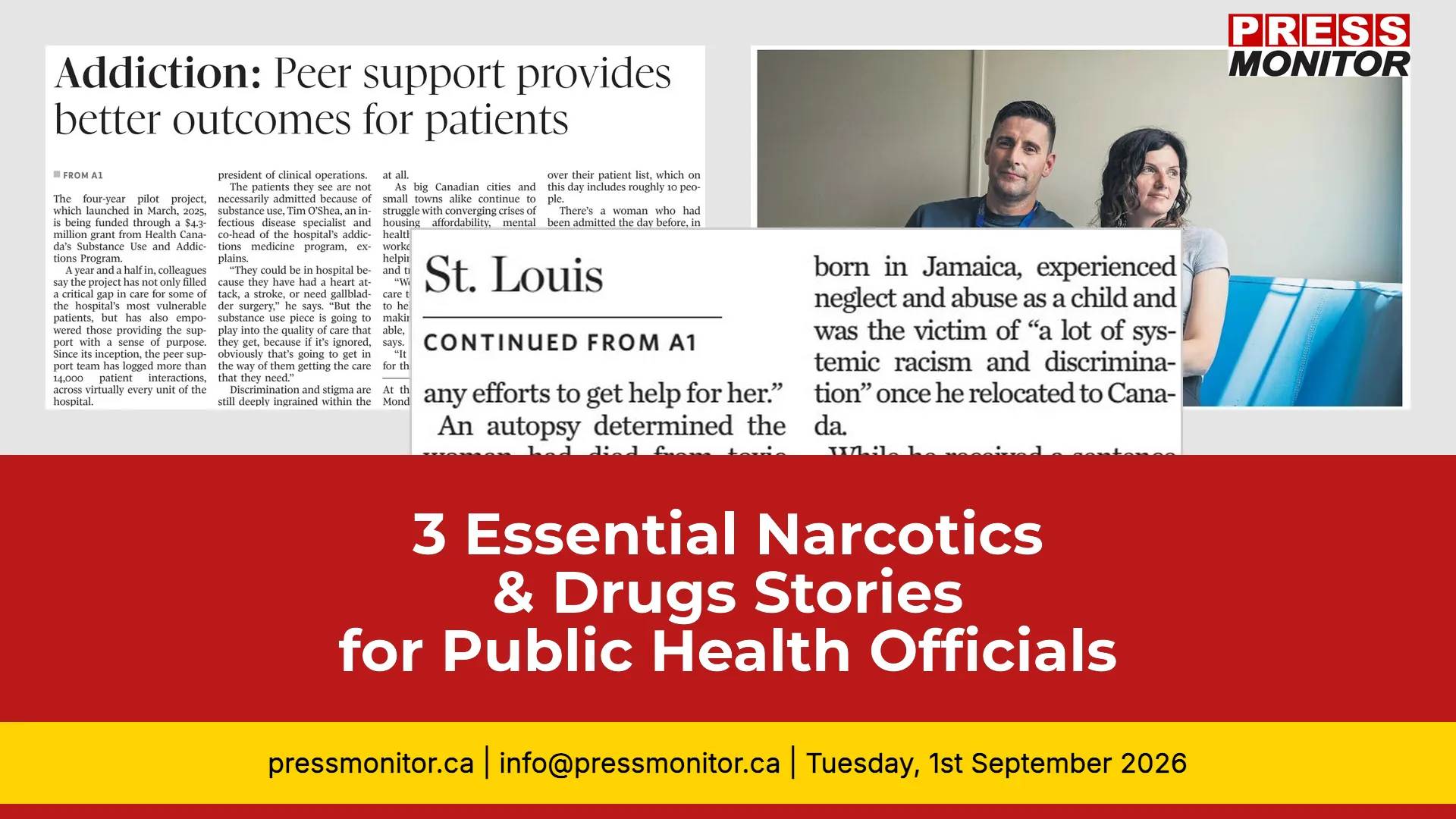
According to Press Monitor's tracking of Canadian publications, three key stories are shaping the narcotics and drugs landscape today. Here's your essential press review for September 1, 2026.
1. Hamilton Peer Support Pilot Shows Promise
The Globe and Mail reports that a new pilot project at St. Joseph’s Healthcare in Hamilton is utilizing peer support teams to improve care for patients battling substance use. Funded by a $4.3 million grant from Health Canada, the initiative has logged over 14,000 patient interactions since its launch in March 2025.
Why it matters: A new approach to addiction treatment using peer support workers is gaining traction.
Key detail: The pilot at St. Joseph's Healthcare, funded by a $4.3 million Health Canada grant, has logged over 14,000 patient interactions since March 2025.
Source: The Globe and Mail, reported by Molly Hayes.
Next step: Consider how peer support could be integrated into your own programs.
2. Peer Support Workers Bring Lived Experience to Healthcare
The Globe And Mail reports that Matt Cheeseman and Madison Tatlock are part of a peer support worker program at St. Joseph's Healthcare in Hamilton, employing people with lived experience with addictions to support patients in the hospital who use drugs.
Why it matters: People with lived experience are becoming frontline caregivers.
Key detail: Matt Cheeseman and Madison Tatlock are part of the peer support worker program, helping patients who use drugs.
Source: The Globe and Mail.
Next step: Evaluate the impact of hiring peer support workers in your organization.
3. Co-Accused in Overdose Body Dumping Sentenced to Time Served
“Selon The Welland Tribune," a man who helped dump the body of a woman in a parking lot after the 22-year-old died of a drug overdose in a Niagara Falls apartment has been sentenced to time served. Judge Cameron Watson stated that ‘there can be no greater loss than the loss of a human life…’, emphasizing that immediate medical attention may have saved the victim’s life. Christopher St. Louis, 43, and his co-accused, Ryan Maeder, 39, both received twelve months of time served and were placed on probation for eighteen months.
Why it matters: The case highlights the legal consequences of failing to seek medical help for overdose victims.
Key detail: Christopher St. Louis received 12 months time served and 18 months probation for indignity to a human body. Judge Cameron Watson noted that immediate medical attention may have saved the victim's life.
Source: The Welland Tribune, reported by Alison Langley.
Next step: Review your organization's protocols for overdose response.
This media intelligence roundup is powered by Press Monitor's print media monitoring across Canadian publications. Stay informed with the latest news on narcotics and drug policy.