3 Essential Water Stories for Canadian Municipalities


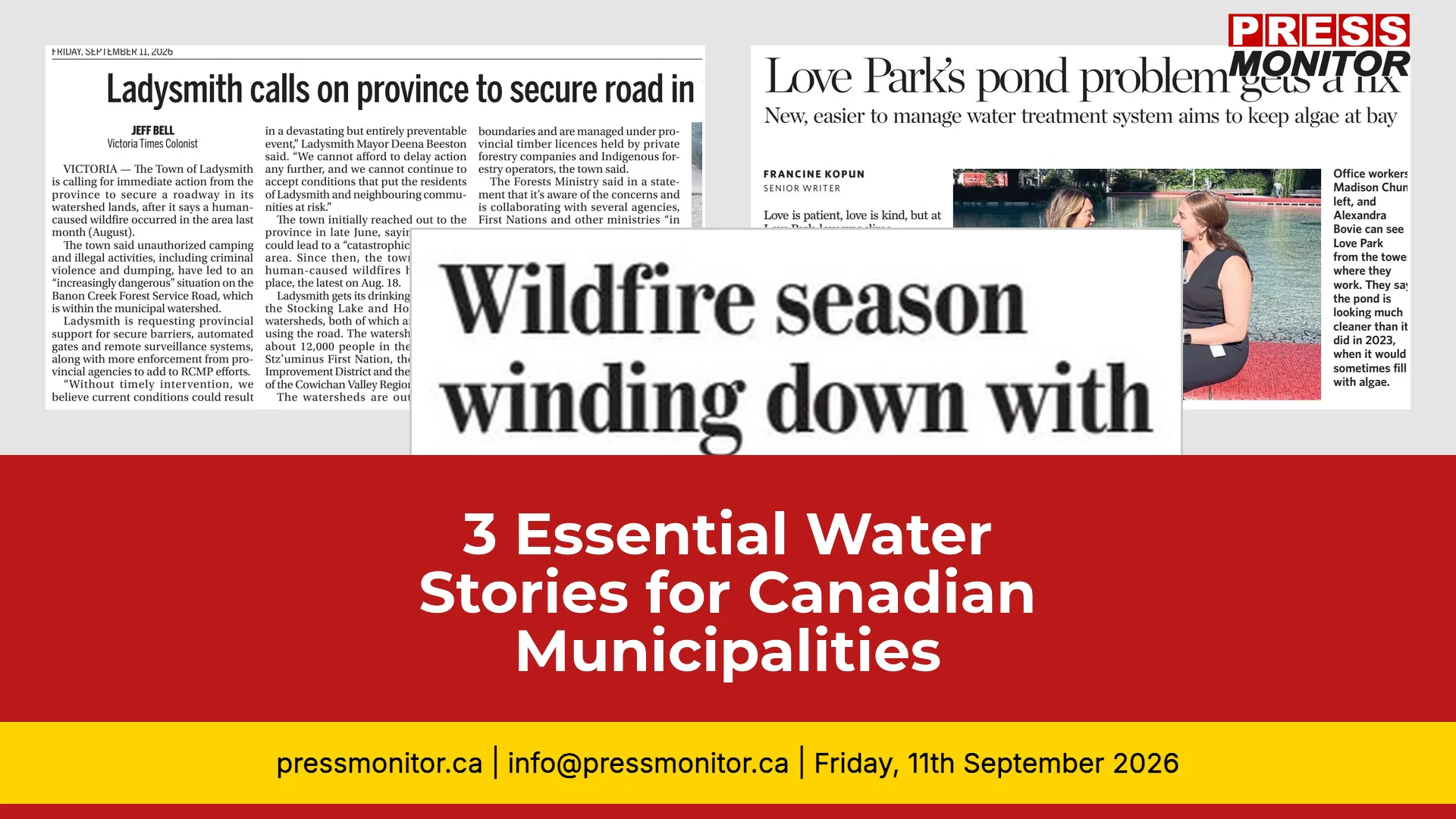
Media monitoring of Canadian print publications reveals three essential stories shaping water infrastructure and wastewater management. This press review delivers media intelligence and print media monitoring insights on news on water infrastructure, from watershed security to urban water treatment innovations.
1. Ladysmith Demands Action On Watershed Road
The Province reports that the Town of Ladysmith is demanding immediate provincial action to secure the Banon Creek Forest Service Road in its watershed, following two human-caused wildfires in the area, the most recent on August 18. Mayor Deena Beeston says unauthorized camping, illegal dumping, and criminal violence have created increasingly dangerous conditions, with gate locks cut at least six times since a temporary closure on May 19. The watershed supplies drinking water to approximately twelve thousand people, including the Stz'uminus First Nation and surrounding communities.
The Town of Ladysmith is demanding immediate provincial action to secure the Banon Creek Forest Service Road in its watershed after two human-caused wildfires. Mayor Deena Beeston says unauthorized camping, illegal dumping, and criminal violence have created increasingly dangerous conditions, with gate locks cut at least six times since a temporary closure on May 19. The watershed supplies drinking water to approximately twelve thousand people, including the Stz'uminus First Nation.
Why it matters: Water infrastructure security directly affects community health. Ladysmith's call for action highlights the intersection of wildfire risk and drinking water safety.
Key detail: The watershed serves approximately 12,000 residents across multiple communities.
Source: The Province, Jeff Bell, September 11, 2026.
Next step: Residents and stakeholders should contact provincial representatives to demand watershed road protection. Tag your local MLA in the comments.
2. Love Park Pond Switches to Regenerative System
The Toronto Star reports that the city has replaced the high-maintenance ozone water treatment system at Love Park with a regenerative system to keep algae at bay. The pond, located at the corner of York Street and Queens Quay West, opened in 2023 but experienced green algae issues within two weeks and again during the World Cup. The city says the new system uses less water and fewer chemicals.
Toronto has replaced the high-maintenance ozone water treatment system at Love Park with a regenerative system to keep algae at bay. The pond, at the corner of York Street and Queens Quay West, opened in 2023 but experienced green algae issues within two weeks and again during the World Cup. The city says the new system uses less water and fewer chemicals.
Why it matters: Urban water management innovations like this regenerative approach offer a model for other Canadian municipalities dealing with algae and water quality challenges.
Key detail: The new system reduces chemical usage and water consumption compared to the previous ozone treatment.
Source: Toronto Star, Francine Kopun.
Next step: City planners and environmental advocates should monitor the pond's water quality over the coming months. Share this with your city council representative.
3. BC Wildfire Season Winding Down
Times Colonist reports that British Columbia's wildfire season is winding down with over 60 fires declared out in the last week. Four blazes remain out of control out of 115 total across the province, though severe drought is still a concern for fire risk in parts of the Cariboo region and the southern Interior. This year has seen 1,380 fires scorch about 4,750 square kilometres of land, a marked decrease from totals over the last three years.
British Columbia's wildfire season is winding down with over 60 fires declared out in the last week. Four blazes remain out of control out of 115 total across the province, though severe drought is still a concern for fire risk in parts of the Cariboo region and the southern Interior. This year has seen 1,380 fires scorch about 4,750 square kilometres of land, a marked decrease from totals over the last three years.
Why it matters: As the fire season closes, the impact on watershed health and water quality across BC communities remains a critical concern for water utilities and regulators.
Key detail: 1,380 fires burned approximately 4,750 square kilometres this season, down significantly from the past three years.
Source: Times Colonist, The Canadian Press.
Next step: Water utilities in affected regions should assess post-fire watershed conditions. Tag BC water authorities in the comments.
Closing: These stories reflect the ongoing challenges and innovations in Canadian water management. Stay informed with Press Monitor's print media monitoring for the latest developments in water infrastructure, wastewater treatment, and environmental policy across Canada. What water issue matters most to your community?