3 Key Women's Issues Stories for Professionals


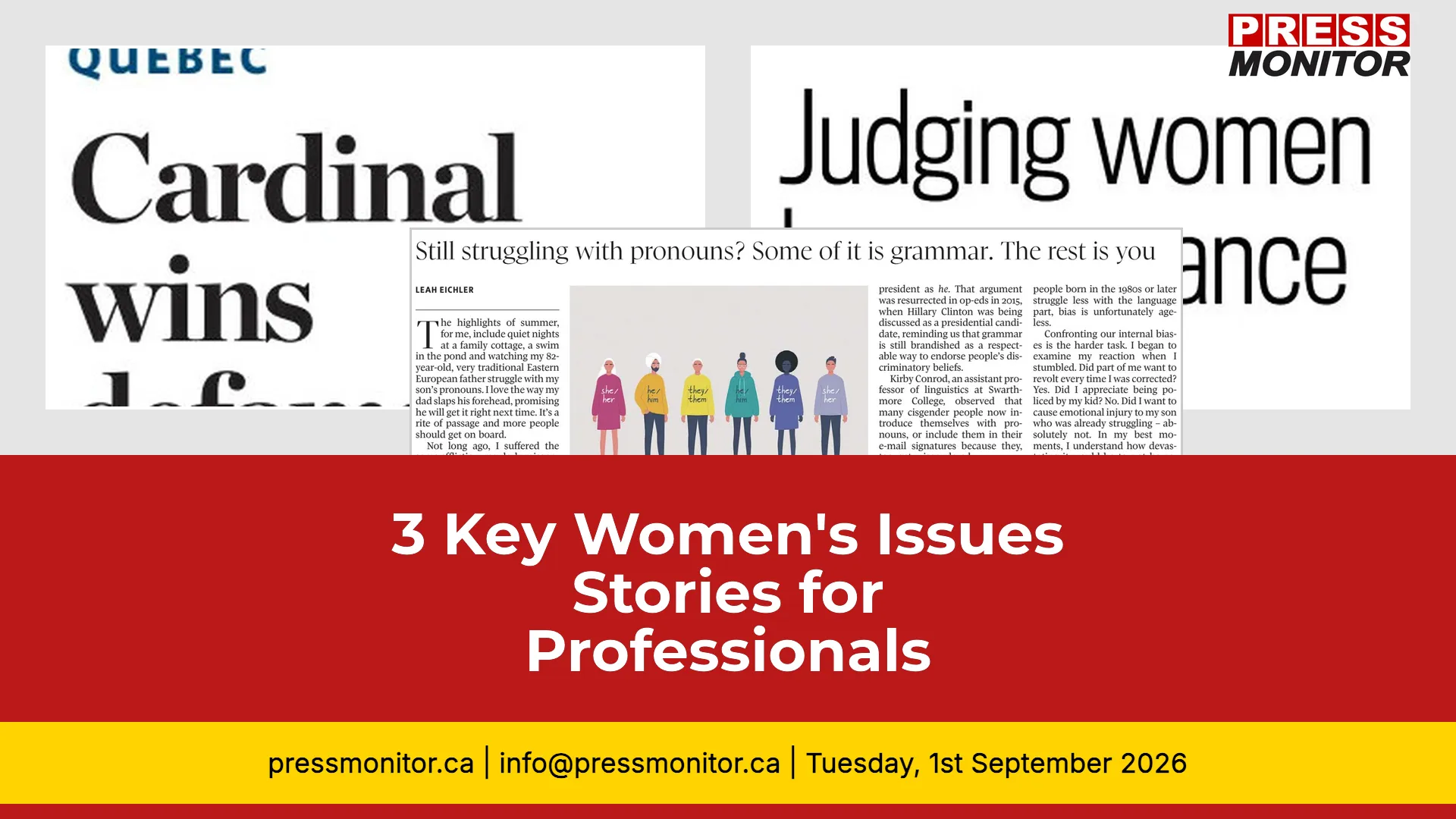
According to Press Monitor's tracking of Canadian publications, news on women's issues is shaped by legal battles, political statements, and personal narratives. Here are three essential stories from Canadian print media that highlight the current landscape of gender equality, media monitoring reveals shifts in public discourse.
1. Quebec Cardinal Marc Ouellet Wins Defamation Suit
The Canadian Press reports that Quebec Cardinal Marc Ouellet has won his civil defamation suit against a woman who accused him of sexual misconduct as part of a class-action lawsuit. Superior Court Justice Martin Castonguay ruled that Paméla Groleau’s accusations against Ouellet are unfounded and ordered her to pay him $100,000.
Why it matters: This ruling sets a precedent in defamation law regarding sexual misconduct accusations. The court's decision to award $100,000 underscores the legal stakes for both accusers and accused.
Key detail: Superior Court Justice Martin Castonguay found Paméla Groleau's accusations unfounded.
Source: The Canadian Press, via Toronto Star.
Next step: Legal experts analyze impact on future class-action lawsuits.
Question: How does this affect the balance between protecting victims and ensuring fair process?
2. Mette Frederiksen Clashes with Plastic Surgeon
"Selon The Daily Press, Mette Frederiksen, Danish Prime Minister, responded forcefully to unsolicited comments about her appearance from a plastic surgeon, demanding he focus on more meaningful topics. The exchange resonated with many women who feel subjected to impossible double standards, highlighting the ongoing debate about the boundaries of commentary on women’s appearance. Frederiksen’s decision to share the exchange on Instagram has received widespread attention, with some viewing it as a vote of support for embracing one’s features without seeking intervention."
Why it matters: The Danish Prime Minister's response to unsolicited comments on her appearance resonates globally, challenging double standards for women in leadership.
Key detail: Frederiksen shared the exchange on Instagram, sparking widespread support.
Source: The Daily Press (Timmins).
Next step: Watch for similar public figures speaking out.
Question: What does this say about the boundaries of commentary on women's appearances?
3. Pronouns and Underlying Bias
The Globe and Mail reports that Leah Eichler discusses her struggles with using correct pronouns, both as someone who initially misgendered her trans son and as someone whose father is still learning his grandson’s pronouns. The article explores the grammatical challenges and deeper biases at play when it comes to pronoun usage.
Why it matters: Leah Eichler's personal story about learning her son's pronouns reveals the grammatical and emotional challenges families face.
Key detail: The article explores how bias manifests in language, even among well-meaning individuals.
Source: The Globe and Mail.
Next step: Consider how inclusive language training can address these biases.
Question: How can we normalize pronoun education in workplaces?
These stories are part of a broader media intelligence effort to track gender-related narratives. Share your thoughts in the comments.