3 Pivotal Indigenous Affairs Stories for Policy Leaders


Navigating Indigenous affairs news requires sharp print media monitoring to separate signal from noise. This press review distills today’s critical developments into actionable insights for executives and policymakers. According to Press Monitor's tracking of Canadian publications, here are the three defining stories shaping the landscape this week.
1. Lake America Renaming Proposal Sparks Backlash
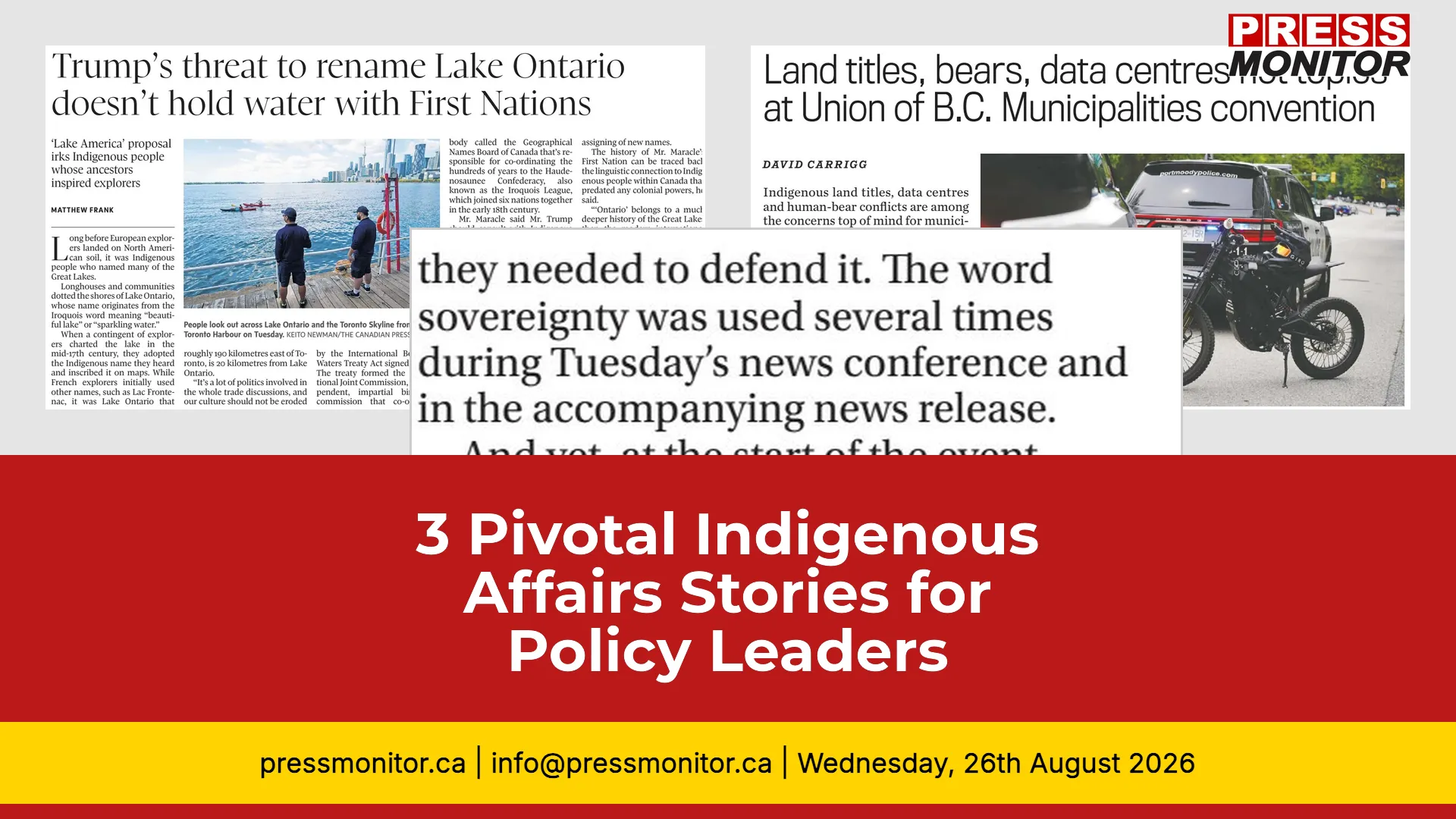
{source_name} reports that U.S. President Donald Trump's proposed renaming of Lake Ontario to 'Lake America' as a political maneuver has drawn sharp criticism from Indigenous leaders and experts. Canada and the U.S. share the lake via the 1909 International Boundary Waters Treaty Act, governed by the International Joint Commission. Despite Trump's executive order last year renaming the Gulf of Mexico to 'Gulf of America,' Canada refuses to recognize the change, with Ontario Premier Doug Ford calling the proposal 'a lot of rhetoric.'
Why it matters: Toponymic sovereignty remains a flashpoint in cross-border relations and Indigenous cultural preservation.
Key detail: U.S. President Donald Trump’s proposed renaming of Lake Ontario to 'Lake America' has triggered sharp criticism from Indigenous leaders and legal experts. The lake is governed under the 1909 International Boundary Waters Treaty Act, and Ontario Premier Doug Ford dismissed the move as mere rhetoric amid ongoing disputes over the Gulf of Mexico renaming.
Source: The Globe And Mail (ottawa/quebec Edition)
Next step: Track diplomatic responses through the International Joint Commission and monitor provincial statements for policy shifts.
2. Municipal Leaders Prioritize Indigenous Land Titles & Data Centres
Vancouver Sun reports that indigenous land titles, data centres, and human-bear conflicts are among the concerns top of mind for municipal politicians, as they gather for their annual fall convention and attempt to influence the provincial government’s agenda.
Why it matters: Local governance is increasingly intersecting with resource development and reconciliation mandates.
Key detail: At the annual fall convention, municipal politicians highlighted indigenous land titles, data centre regulation, and human-bear conflicts as top agenda items. These priorities signal a shift toward integrating Indigenous rights into regional infrastructure planning.
Source: Vancouver Sun
Next step: Engage with municipal policy committees to align corporate expansion strategies with local land claim frameworks.
3. Federal MP Formalizes Land Acknowledgment Protocol
Calgary Sun reports that Liberal MP Mona Fortier acknowledged the gathering on the traditional and unceded territory of the Algonquin Anishinaabe at the start of an event.
Why it matters: Institutional recognition practices are evolving from ceremonial gestures to structured accountability measures.
Key detail: Liberal MP Mona Fortier opened an event by formally acknowledging the gathering on the traditional and unceded territory of the Algonquin Anishinaabe, reflecting broader federal trends toward standardized territorial acknowledgments.
Source: Calgary Sun
Next step: Review your organization’s public engagement protocols to ensure alignment with emerging best practices in territorial recognition.
Tracking news on First Nations & Indigenous affairs demands reliable print media monitoring and advanced media intelligence. How is your team adapting to these shifting governance and cultural landscapes? Share your approach below.