3 Pivotal Supply Chain Stories for Procurement Leaders


Get the latest news on supply chain from Canada's print media — this press review, powered by Press Monitor's media monitoring, gives procurement leaders the stories that matter today. Trade wars, global conflict, and a quiet manufacturing pivot are reshaping supply chains from coast to coast.
1. Canada's Long Road to Trade Diversification
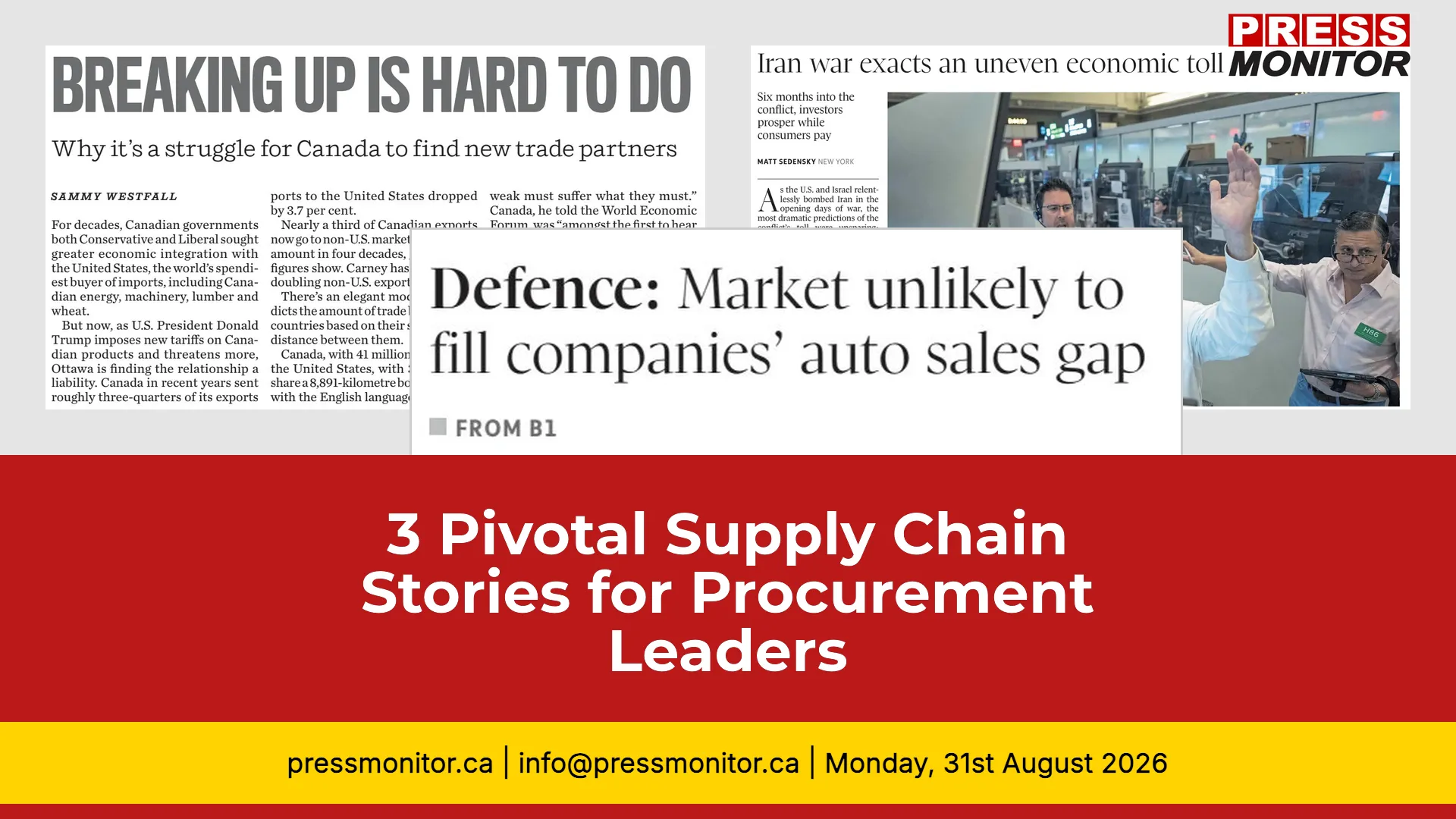
"Selon le Calgary Herald, le Canada est confronté à un défi majeur pour diversifier ses partenaires commerciaux en raison des nouvelles tarification et des menaces de représailles du gouvernement américain. Le Premier ministre Mark Carney a intensifié ses efforts en visitant des pays comme la Chine et l’Arabie saoudite, mais la dépendance historique envers les États-Unis représente un obstacle conséquent. L’article souligne l’importance des infrastructures, comme les ports et les pipelines, pour faciliter l’exportation de produits canadiens au-delà du marché américain."
Why it matters: Canada's economy remains tightly bound to U.S. markets, and new tariffs expose the cost of that dependency.
Key detail: Prime Minister Mark Carney has visited China and Saudi Arabia to court new buyers, but infrastructure gaps at ports and pipelines remain a major barrier to real diversification.
Source: Calgary Herald, Montreal Gazette, Ottawa Citizen — tracked by Press Monitor.
Next step: Evaluate your supply chain's exposure to U.S.-only routes and model scenarios for tariff escalation.
2. The Iran War's Uneven Toll on Global Supply Chains
Selon The Globe And Mail, six months into the conflict, investors prosper while consumers pay. Despite predictions of surging oil prices and a global recession, the U.S. economy has weathered the storm surprisingly well. While Main Street faces higher fuel and food costs, Wall Street has seen significant gains, driven by the artificial intelligence boom. However, the war’s impact on oil prices and the global supply chain has hurt airlines and farmers, exacerbating economic challenges for those most vulnerable.
Why it matters: Oil price swings and disrupted shipping lanes are hitting airlines, farmers, and logistics budgets while investors capitalize on AI-driven gains.
Key detail: Six months in, the U.S. economy has avoided recession, but the war's supply chain damage is far from over.
Source: The Globe and Mail.
Next step: Stress-test freight and fuel assumptions in your cost model.
3. Tool-and-Die Makers Pivot to Defence Procurement
{source_name} reports that Canadian tool and machining manufacturers are pivoting their operations toward the defence sector, hiring consultants to navigate complex new requirements to serve a government customer base. However, industry experts say this shift will not fully offset the massive losses of revenue from the stalled automotive industry.
Why it matters: As automotive demand stalls, Canadian precision manufacturers are chasing defence contracts — a complex but potentially lucrative shift.
Key detail: Firms are hiring consultants to navigate government procurement requirements, though experts warn this won't fully offset lost auto revenue.
Source: The Globe and Mail.
Next step: Explore defence supply chain registrations if you have machining or tooling capacity.
According to Press Monitor's tracking of Canadian publications, these are the conversations shaping procurement decisions. This media intelligence is built for leaders who need signal before noise. What did we miss? Tell us in the comments.
