3 Pivotal Workplace Stories for HR Leaders


Navigating today’s evolving workplace landscape requires more than intuition—it demands precise media monitoring to track regulatory shifts, union movements, and safety mandates before they impact your bottom line. This press review distills three high-impact developments shaping Canadian workplaces right now. Leveraging advanced media intelligence, we’ve filtered the noise to surface actionable news on workplace trends. According to Press Monitor's tracking of Canadian publications, here is what leadership needs to know.
1. WorksafeBC Outlines Four Steps to Managing Workplace Risks
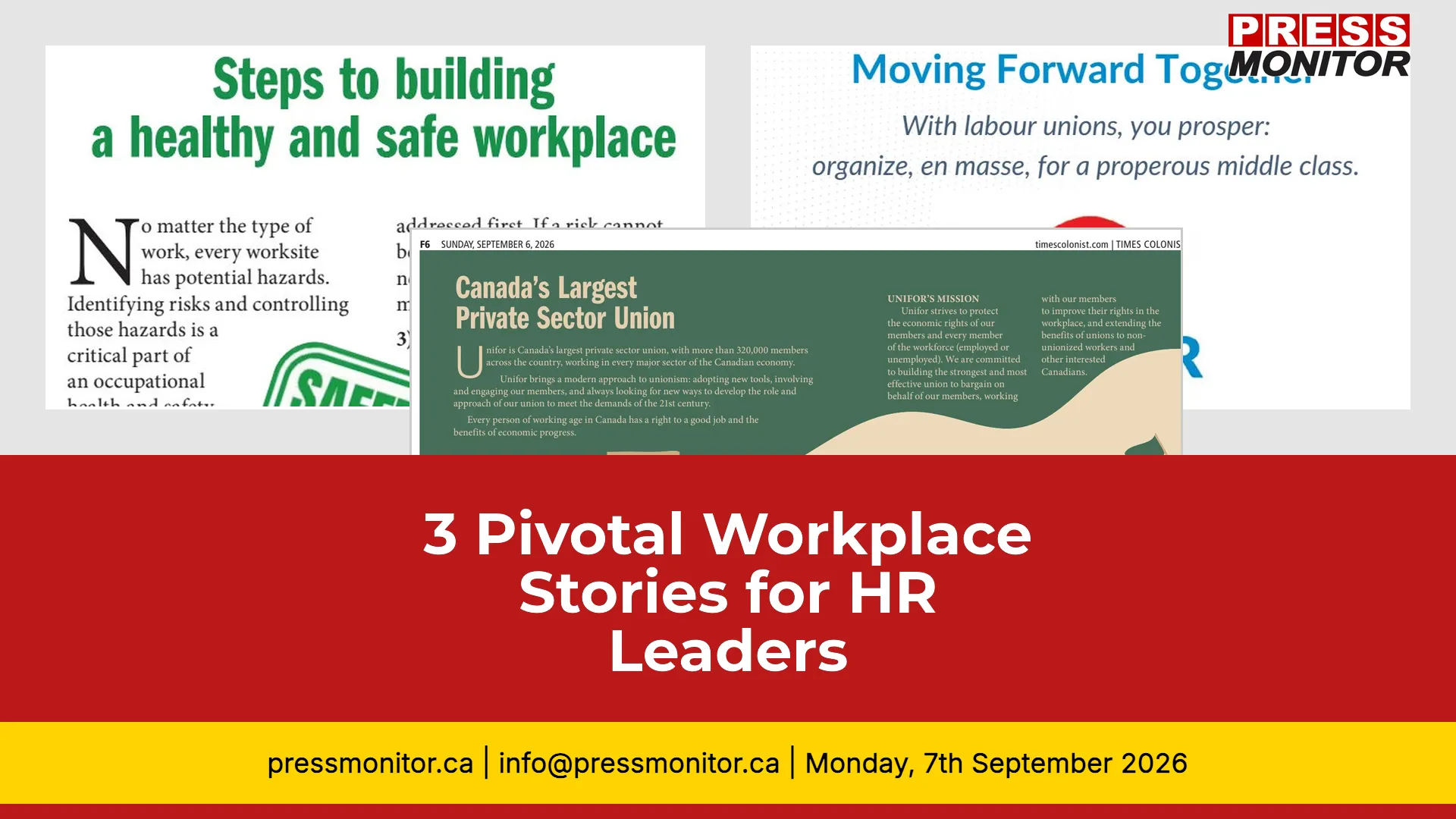
Times Colonist reports that identifying and controlling hazards is a critical part of an occupational health and safety program tailored to each workplace. Employers and workers must collaborate to identify risks, implement control measures, communicate them, and monitor effectiveness. WorksafeBC states that improving health and safety does not have to be costly while offering a huge return on investment.
Why it matters: Proactive hazard identification isn’t just compliance; it’s a strategic advantage that reduces liability and boosts morale.
Key detail: WorksafeBC emphasizes that employers and workers must collaborate to identify risks, implement controls, communicate protocols, and monitor effectiveness—proving that robust safety programs deliver a massive ROI without breaking budgets.
Source: Times Colonist
Next step: Audit your current hazard communication workflows against these four pillars.
2. Unifor Celebrates Labour Day with Focus on Collective Safety
Times Colonist reports that Unifor celebrated Labour Day with a message of moving forward together with labour unions. The ad emphasizes organizing en masse for a prosperous middle class and identifying health and safety risks together as a team to create a safer workplace for everyone.
Why it matters: Labour relations directly influence workplace stability and employee retention during peak seasonal transitions.
Key detail: Unifor’s Labour Day messaging highlights organizing en masse to build a prosperous middle class while identifying health and safety risks together as a unified team.
Source: Times Colonist
Next step: Review upcoming collective bargaining timelines and schedule joint safety committee meetings.
3. Unifor Solidifies Position as Canada’s Largest Private Sector Union
Times Colonist reports that Unifor is Canada's largest private sector union, with more than 320,000 members across Canada, and outlines its mission to protect economic rights and improve workplace rights for members and non-unionized workers. Unifor was officially formed on August 31, 2013, at a founding convention in Toronto, Ontario, bringing together the Canadian Auto Workers union and the Communications, Energy and Paperworkers Union of Canada.
Why it matters: Understanding the scale and history of major labour organizations helps predict industry-wide policy shifts and negotiation leverage.
Key detail: Formed in 2013 through a historic merger, Unifor now represents over 320,000 members nationwide, actively protecting economic rights and advancing workplace standards for both unionized and non-unionized workers.
Source: Times Colonist
Next step: Benchmark your compensation packages against current private sector union benchmarks.
Tracked by Press Monitor. For leaders relying on print media monitoring to stay ahead of compliance deadlines and labour negotiations, consistency is key. How is your organization adapting its safety and labour strategies for Q4? Share your approach below.