4 Critical Water & Wastewater Stories for Infrastructure Leaders


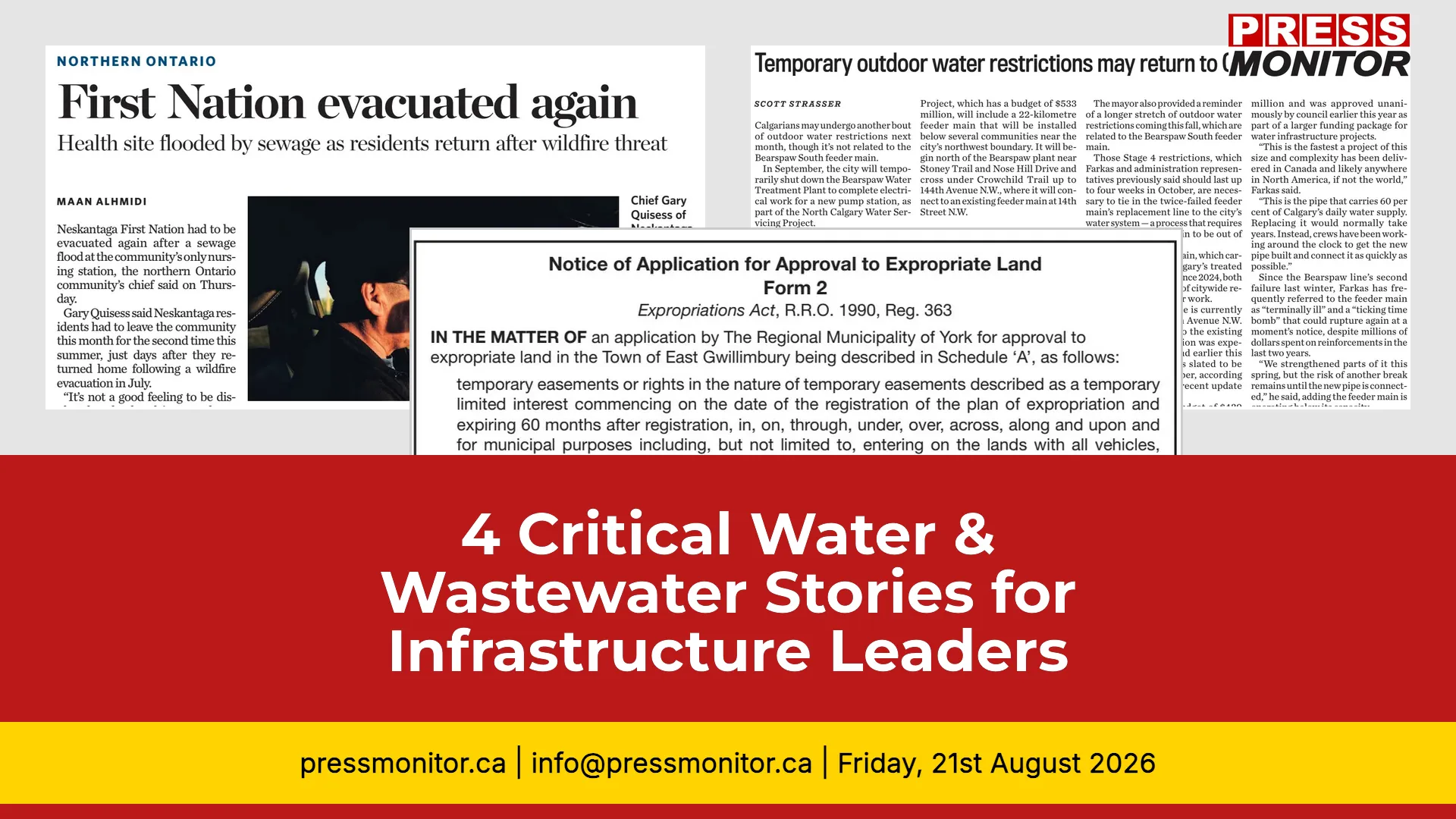
Stay ahead of the curve with this curated press review from Press Monitor. According to our media monitoring of Canadian publications, these four stories demand attention from anyone involved in water and wastewater infrastructure.
1. Neskantaga Evacuation: Sewage Flood Forces Community to Flee Again
The Toronto Star reports that Neskantaga First Nation had to be evacuated again after a sewage flood at the community’s only nursing station, the northern Ontario community's chief said on Thursday.
Why it matters: This recurring crisis highlights systemic infrastructure failures in remote First Nations communities, where basic water and wastewater services remain inadequate.
Key detail: A sewage flood at the community’s only nursing station forced Neskantaga First Nation to evacuate. The Toronto Star reports that this is a repeated emergency.
Source: Toronto Star (also covered by The Hamilton Spectator).
Next step: Monitor federal and provincial announcements on water infrastructure funding for Indigenous communities.
2. Calgary Faces Possible Outdoor Water Restrictions in September
“Selon le Calgary Herald, Calgarians may undergo another bout of outdoor water restrictions next month, though it’s not related to the Bearspaw South feeder main. In September, the city will temporarily shut down the Bearspaw Water Treatment Plant to complete electrical work for a new pump station, as part of the North Calgary Water Servicing Project. Mayor Jeromy Farkas said the restrictions would depend on weather and Calgarians’ water demand at the time. Ifthey are necessary, the restrictions shouldbe in place for less thana week and are part of ‘planned work,’ rather than a system failure, he said. ‘Our water supply is strong but I want to give you an early heads-up that we might need temporary outdoor water restrictions for less than a week in September,’” he said in a social media video. “Tf restrictions are needed, we expect some outdoor water use would still be allowed.”
Why it matters: Planned upgrades to the Bearspaw Water Treatment Plant may impact residents and businesses, showing the balance between maintenance and service continuity.
Key detail: The shutdown is for electrical work on a new pump station, not a system failure. Mayor Jeromy Farkas warns restrictions could be needed for less than a week.
Source: Calgary Herald (also covered by Calgary Sun).
Next step: Calgary residents should prepare for potential outdoor water use limits.
3. York Region Expropriates Land for Sewage Expansion
Toronto Sun reports that The Regional Municipality of York has applied for approval to expropriate temporary easements in the Town of East Gwillimbury. The land is required for the North York Durham Sewage System Expansion Program to install a new trunk sewer and connection chambers.
Why it matters: Growing population demands expanded wastewater capacity; this expropriation enables a new trunk sewer in East Gwillimbury.
Key detail: Temporary easements are required for the North York Durham Sewage System Expansion Program.
Source: Toronto Sun.
Next step: Landowners can request hearings on the expropriation.
4. Peel Region Expropriates Land for Stormwater Infrastructure
“According to a notice from The Regional Municipality of Peel, published on August 7, 2026, the municipality is seeking approval to expropriate land in Brampton for a permanent drainage easement and the widening of Mississauga Road. The expropriation is related to the construction of storm sewer infrastructure and facilitates improvements to the road, including tree removal and grading appurtenances,” the notice states. Property owners within the affected area have 30-80 days to request a hearing to assess the fairness and necessity of the proposed taking. The approving authority is the Council of The Regional Municipality of Peel.
Why it matters: Proactive stormwater management is crucial for flood mitigation in rapidly urbanizing Brampton.
Key detail: Permanent drainage easement and widening of Mississauga Road, including tree removal.
Source: Toronto Sun.
Next step: Property owners have 30-80 days to request a hearing.
Closing thought: These stories underscore the importance of proactive water and wastewater planning. How is your organization preparing for these infrastructure shifts? Tracked by Press Monitor — the definitive source for print media monitoring in Canada.