4 Essential Transportation & Logistics Stories for Industry Leaders


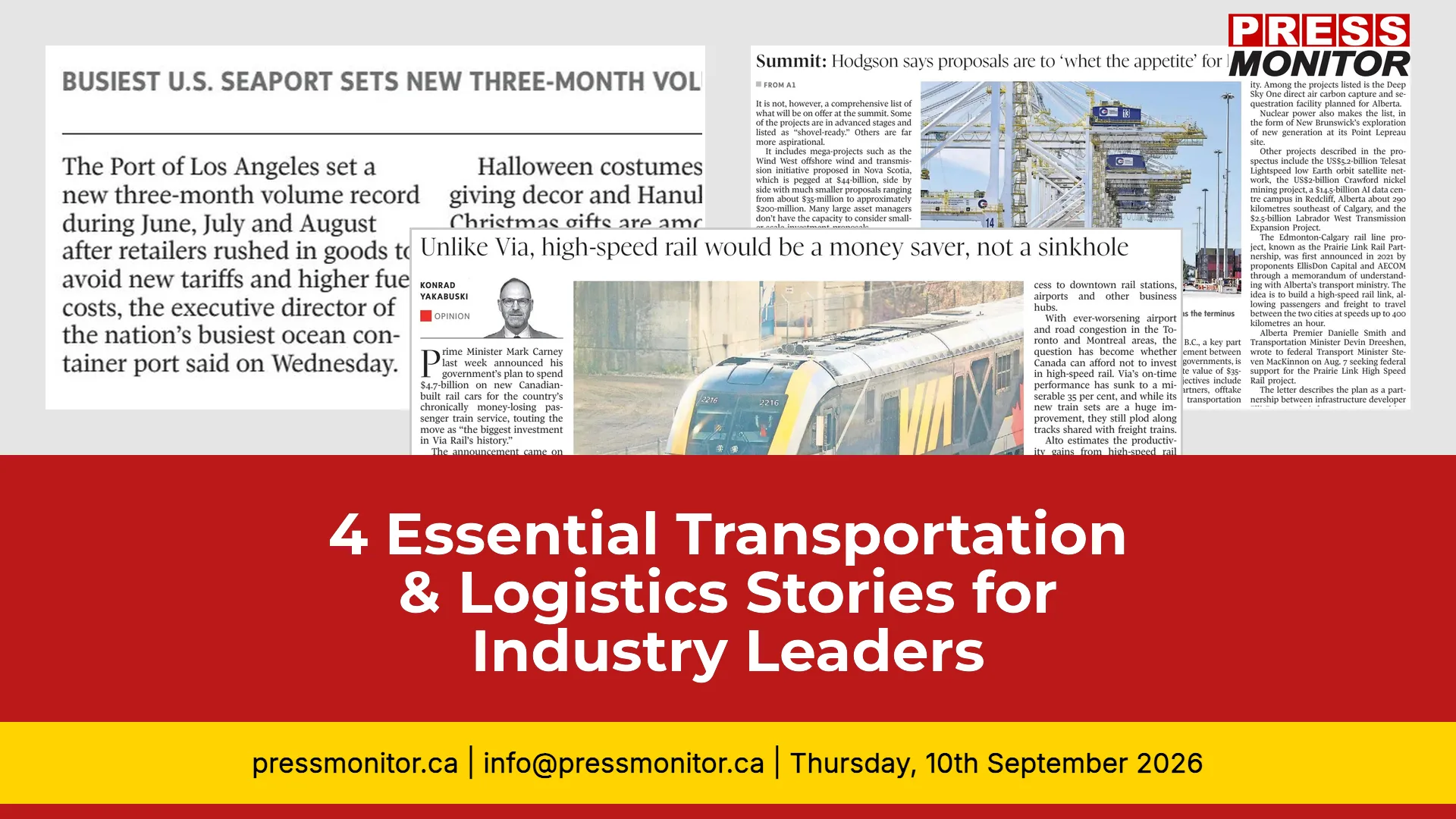
This press review, grounded in Press Monitor's media monitoring and print media monitoring of Canadian publications, delivers essential media intelligence and the key news on transportation and logistics shaping Canada's economy today. From a massive investment summit in Toronto to a record-breaking port in Los Angeles, these stories define the sector's trajectory.
1. Port of Los Angeles Sets Volume Record
The Globe And Mail (ottawa/quebec Edition) reports that the Port of Los Angeles set a new three-month volume record during June, July and August after retailers rushed in goods to avoid new tariffs and higher fuel costs. Waterfront workers handled 955,907 TEUs in August, taking the three-month total to 2.9 million units as importers front-run President Donald Trump's tariffs and shipping contract fuel cost increases tied to the Iran war.
Why it matters: The Port of Los Angeles hit a three-month volume record, signaling how tariff-driven front-loading is reshaping global trade flows and pressuring North American supply chains.
Key detail: Waterfront workers handled 955,907 TEUs in August alone, pushing the three-month total to 2.9 million units — surpassing the previous record set during the COVID-19 shipping boom. Importers are racing to beat President Donald Trump's tariffs and fuel cost increases tied to the Iran conflict.
Source: The Globe and Mail (ottawa/quebec Edition)
Next step: Industry leaders should reassess inventory strategies and explore alternative routing through Canadian ports to mitigate tariff exposure.
2. Ottawa Pitches C$500B Investment Portfolio
The Globe and Mail reports that officials organizing Prime Minister Mark Carney’s showcase Canada Investment Summit have identified more than 160 projects open for investment, aiming to bring in at least C$500 billion in new private-sector capital over five years. The September 14-15 event in Toronto will feature proposals across energy, transportation, and technology to soften the impact of an expanding tariff war with the United States. A detailed prospectus outlining these opportunities was shared with global executives and major pension funds ahead of the conference.
Why it matters: Prime Minister Mark Carney's Canada Investment Summit positions the federal government to attract hundreds of billions in private-sector capital, with transportation and energy projects at the forefront.
Key detail: Officials have identified more than 160 projects open for investment, targeting at least C$500 billion over five years. The September 14-15 event in Toronto will showcase proposals across energy, transportation, and technology to offset the impact of an expanding tariff war with the United States.
Source: The Globe and Mail, by James Bradshaw, Emma Graney, Bill Curry
Next step: Logistics firms and infrastructure developers should prepare proposals aligned with the summit's focus areas to capture a share of this capital.
3. Via Rail's $6.6 Billion Investment Questioned
The Globe And Mail reports that Ottawa is investing $6.6 billion in new rail cars and locomotives for Via Rail’s long-distance routes, prompting questions about the wisdom of spending on lines that carry less than 5 per cent of ridership and lose over $150 million annually. Critics suggest cheaper alternatives like used equipment or privatizing the Toronto-Vancouver route, while advocacy for high-speed rail through Alto argues the project could eventually be self-sustaining and save taxpayer money.
Why it matters: Ottawa's commitment to $6.6 billion in new Via Rail equipment raises critical questions about return on investment for routes with less than 5 percent ridership and annual losses exceeding $150 million.
Key detail: Critics are advocating for cheaper alternatives such as used equipment or privatizing the Toronto-Vancouver corridor, while supporters of high-speed rail through Alto argue the project could eventually become self-sustaining and save taxpayer money.
Source: The Globe and Mail, by Konrad Yakabuski
Next step: Decision-makers should weigh the long-term strategic value of rail infrastructure against short-term fiscal pressures as the debate over public spending intensifies.
4. Man Accused Hiding 115 Kg Meth in Pickle Jars
The Vancouver Sun reports that Dmytro Nikolaiev of Kelowna is accused of hiding 115 kilograms of meth in pickle jars and attempting to ship the cargo via the Port of Vancouver to Australia. The drugs were intercepted at the Tsawwassen container terminal in January after a joint investigation involving the Mounties and the Australian Federal Police.
Why it matters: A major meth smuggling attempt intercepted at the Port of Vancouver highlights the ongoing vulnerability of Canadian border infrastructure to drug trafficking via container shipping.
Key detail: Dmytro Nikolaiev of Kelowna is accused of hiding 115 kilograms of methamphetamine in pickle jars, attempting to ship the cargo to Australia via the Port of Vancouver. The drugs were intercepted at the Tsawwassen container terminal in January following a joint investigation by the Mounties and the Australian Federal Police.
Source: Vancouver Sun
Next step: Transportation and logistics operators must strengthen cargo screening protocols and collaborate with law enforcement to safeguard supply chain integrity.
Closing: Which of these stories will have the greatest impact on your supply chain strategy in the coming quarter? Press Monitor's media intelligence continues to track the developments that matter most to Canadian industry.