5 Critical Environment and Conservation Stories for Sustainability Leaders


In this edition of Press Monitor's media monitoring roundup, we highlight five key environment and conservation stories from across Canadian print media. These developments—spanning air quality regulations, wildlife conflict, energy infrastructure, and corporate environmental responsibility—demand the attention of sustainability leaders, policymakers, and industry executives. According to Press Monitor's tracking of Canadian publications, these stories reveal emerging trends in regulatory pressure and public accountability.
1. Ontario Air Pollution Regulations Under Fire
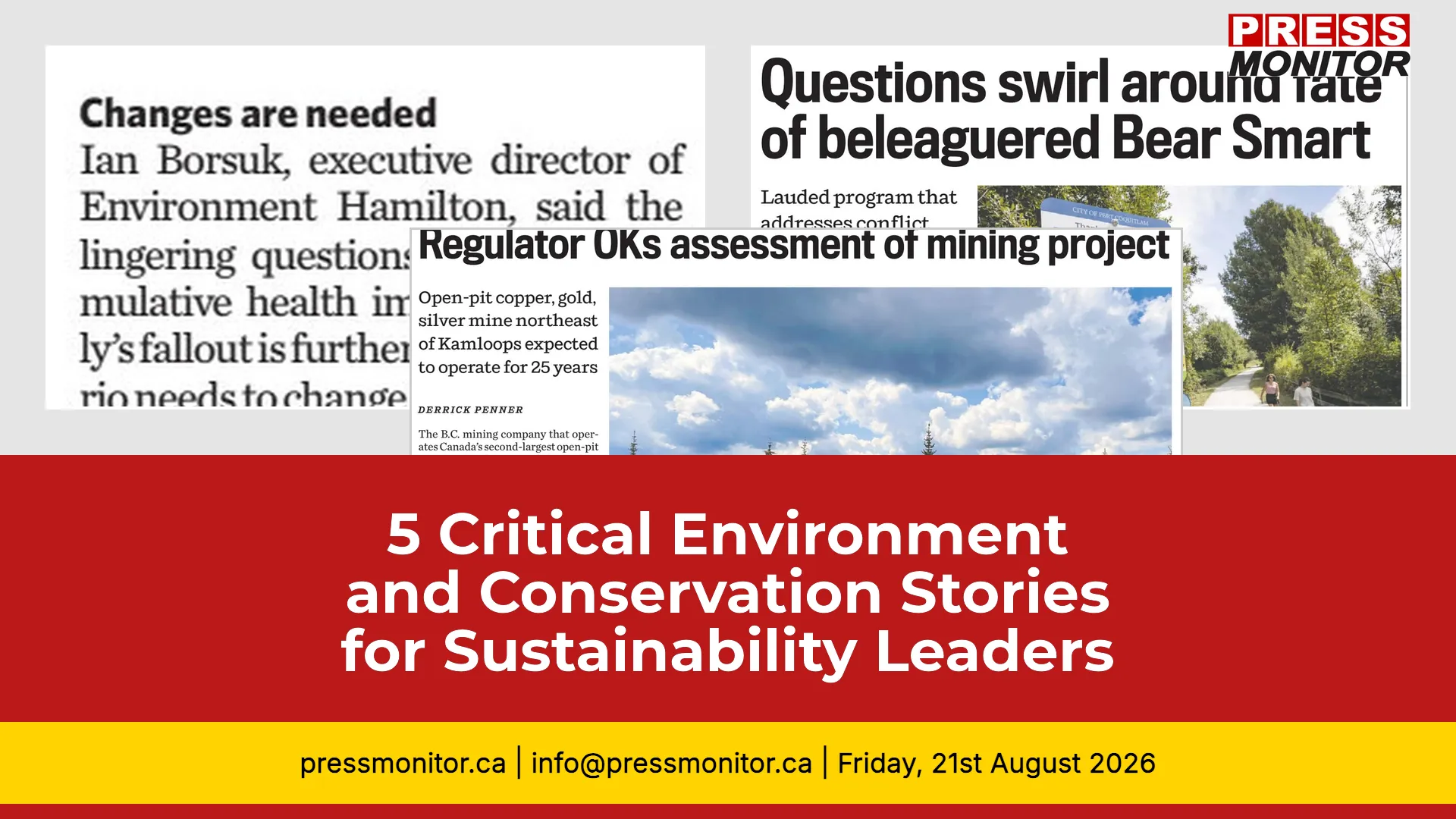
Jan Borsuk, executive director of Environment Hamilton, stated that lingering questions about the cumulative health impacts from July’s fallout is further evidence Ontario needs to change how it regulates industrial air pollution. Currently, the province largely controls emissions on a facility-by-facility basis. This means that any approvals for new or expanding plants doesn’t consider how much pollution is already in the air. "The ministry is only looking at would this be impactful in the immediate term from the single source, and that is the regime we have set up in Ontario," Borsuksaid. "So, its very frustrating for people when they start thinking about Borsuk, alongside member of the Aamjiwnaang First Nation, filed a challenge to this policy earlier this year and is waiting for a response from the province on whether it will launch a review.
Why it matters: Ontario currently regulates industrial emissions on a facility-by-facility basis, ignoring cumulative health impacts. A challenge filed by Environment Hamilton and Aamjiwnaang First Nation seeks to change that.
Key detail: Executive director Jan Borsuk stated the province's approach frustrates communities concerned about long-term health effects from events like July's black soot fallout.
Source: The Hamilton Spectator
Next step: The province has been asked to launch a review; a response is pending.
2. B.C.'s Bear Smart Program Stalls
Vancouver Sun reports that B.C.'s Bear Smart program, designed to reduce human-bear conflicts through garbage management and public education, has stalled. The program, which began in 2002 and is now limited to its name, has no dedicated staff and is no longer accepting municipal applications.
Why it matters: This program, designed to reduce human-bear conflicts through garbage management and education, has effectively halted—no dedicated staff, no new municipal applications.
Key detail: Launched in 2002, it is now limited to its name, raising risks for both bears and communities.
Source: Vancouver Sun
Next step: Advocacy groups are calling for renewed provincial funding and staffing.
3. Trekor Metals Advances Yellowhead Copper Project
Vancouver Sun reports that Trekor Metals, formerly known as Taseko Mines, has initiated the assessment of its Yellowhead copper project, an open-pit copper, gold, and silver mine with a capacity up to 90,000 tonnes per day of ore over a 25-year mine life.
Why it matters: The open-pit mine would process up to 90,000 tonnes of ore daily over 25 years, creating economic benefits but also environmental scrutiny.
Key detail: Trekor Metals (formerly Taseko Mines) has initiated assessment for the British Columbia project.
Source: Vancouver Sun
Next step: Environmental assessment and public consultation will shape approval.
4. Herbicide Application at Nova Scotia Wind Farm
The Chronicle Herald reports that Coastal Woodlands Inc. has applied for pesticide approval from Nova Scotia Environment and Climate Change to treat 30 hectares at the Ellethouse wind farm in Hants County. The program, using Roundup WeatherMax, is scheduled to control vegetation at turbine pads and under powerlines between August 15 and September 30, 2026.
Why it matters: Coastal Woodlands Inc. seeks approval to use Roundup WeatherMax on 30 hectares at the Ellethouse wind farm in Hants County.
Key detail: The treatment targets vegetation under powerlines and turbine pads between August 15 and September 30.
Source: The Chronicle Herald
Next step: Public comments on the pesticide permit are being accepted by Nova Scotia Environment.
5. Edmonton Journal's Recycling Reminder
Edmonton Journal reports that "PLEASE RECYCLE THIS NEWSPAPER". The notice appears on the paper itself, instructing readers to recycle the edition.
Why it matters: A simple but powerful call to action: the newspaper itself asks readers to recycle the edition, reinforcing the role of print media in sustainability.
Key detail: The notice appears on the front page.
Source: Edmonton Journal
Next step: Consider how your organization's communication channels promote recycling.
Which of these environment stories impacts your work most? Share your thoughts in the comments. For a deeper dive into Canada's environmental print coverage, explore Press Monitor's media intelligence tools.