5 Essential Climate Stories for Sustainability Leaders


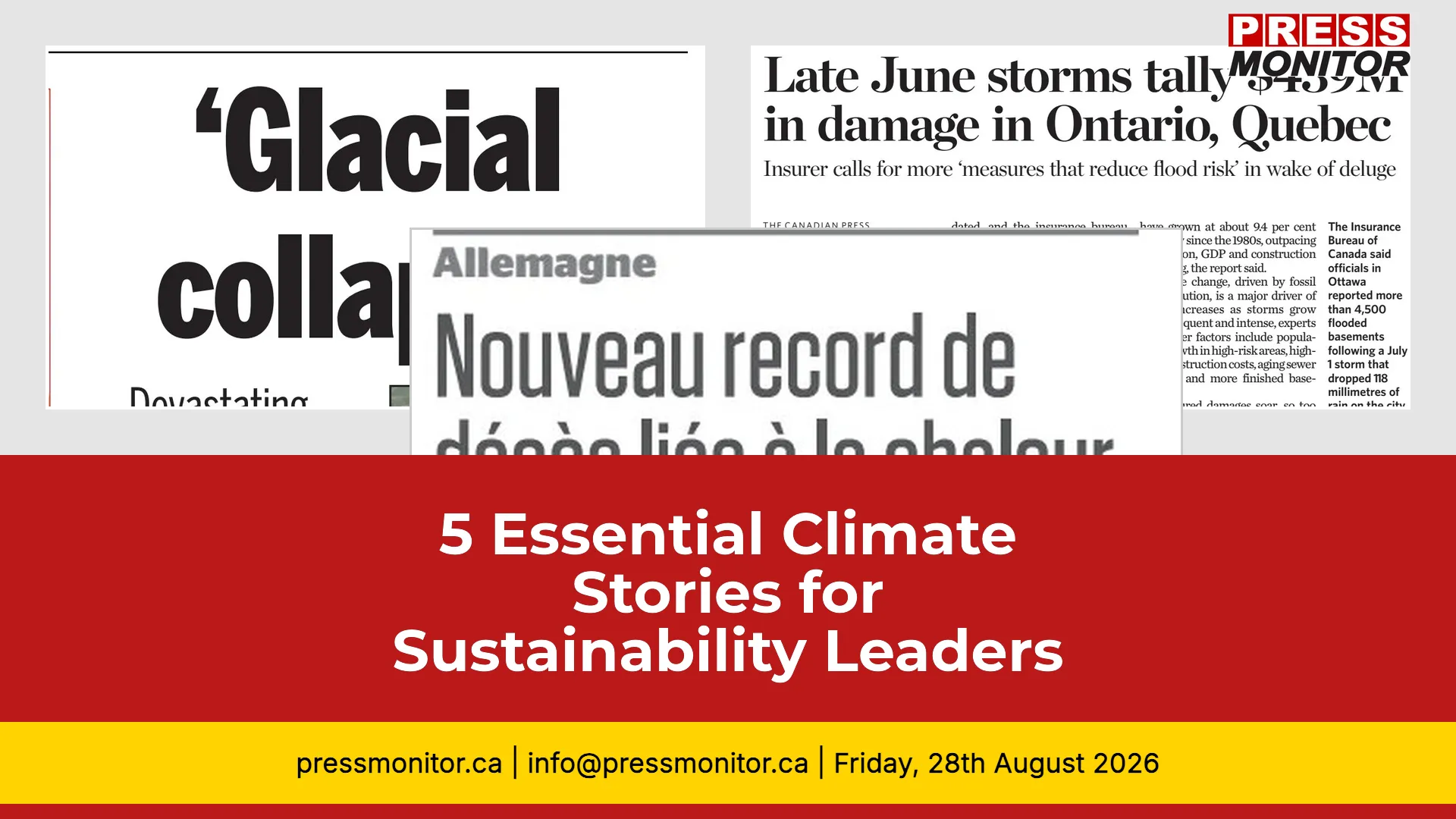
Climate change is reshaping our world faster than ever. Stay updated with news on climate change from across Canada, according to Press Monitor's tracking of Canadian publications. Today's headlines reveal a planet in crisis — from glacial collapses in the Himalayas to record heatwaves in Europe and costly storms at home. Here are the essential climate stories you need to know, powered by print media monitoring from across Canada.
1. Glacial Collapse Triggers Deadly Nepal-Tibet Floods
According to the U.S. Geological Survey, Wednesday’s Nepal-Tibet floods, resulting in at least 273 deaths, were likely caused by a glacial collapse. Seismic activity from this event, initially reported as a 4.4 magnitude earthquake, was later identified as a ‘glacial collapse and debris flow.’ Dr. Simon Cook, a glacier expert, noted a significant glacier collapse near the Langtang Lirung peak, approximately 15 kilometers from the flooding site. Rescue teams continue to search for over 1,300 missing people, including Canadian citizens, amidst devastated zones and ongoing concerns of further flash floods.
Why it matters: This disaster highlights the accelerating risks of climate change in mountain regions, where glacial instability threatens millions.
Key detail: At least 273 dead, over 1,300 missing including 30 Canadians. The U.S. Geological Survey identified a glacial collapse as the cause, with seismic activity initially mistaken for a 4.4 magnitude earthquake. Dr. Simon Cook, a glacier expert, noted a significant collapse near Langtang Lirung peak.
Source: Toronto Sun, with additional reporting from Calgary Herald, Times Colonist, Le Journal de Quebec, Toronto Star, Vancouver Sun, The Standard, Montreal Gazette, The Welland Tribune, The Province.
Next step: Global Affairs Canada is coordinating with local authorities. This underscores the need for climate adaptation funding and early warning systems in vulnerable regions.
2. Ontario and Quebec Storms Cause $439M in Insured Damage
Toronto Star reports that powerful thunderstorms across Ontario and Quebec during the week of Canada Day caused $439 million in insured damage. Ottawa broke its daily rainfall record when it was drenched by 118 millimetres on July 1. Streets and highways were inundated, and local officials reported more than 4,500 flooded basements.
Why it matters: Extreme weather events are becoming more frequent and costly in Canada, burdening insurers and taxpayers.
Key detail: Ottawa broke its daily rainfall record with 118 mm on July 1; over 4,500 flooded basements. The Insurance Bureau of Canada reported the storms between June 30 and July 3 brought wind, hail, torrential rain, and flash flooding.
Source: Toronto Star, also reported by Globe and Mail, Times Colonist.
Next step: Insurers are reassessing risk models. This is a wake-up call for infrastructure resilience and updated flood mapping.
3. Germany Records Highest Heatwave Deaths
Le Journal de Quebec reports that approximately 15,800 people died in Germany this summer due to heatwaves, surpassing previous records, according to estimates released by the Robert Koch Institute.
Why it matters: Heatwaves are the deadliest natural disaster in Europe, with elderly populations most at risk.
Key detail: Approximately 15,800 heat-related deaths in Germany this summer, surpassing previous records. The Robert Koch Institute reported that most deaths occurred during a record heatwave between June 22-28 and again from late July to mid-August.
Source: Le Journal de Quebec, also Le Journal de Montreal.
Next step: Cities need heat action plans, cooling centers, and public health campaigns to protect vulnerable populations.
4. Canada's Emissions Drop 10% Since 2005
The Hamilton Spectator reports that Canada's greenhouse-gas emissions have fallen approximately 10 per cent since 2005. This progress includes a 57 per cent reduction in electricity-sector emissions, driven largely by coal phase-outs.
Why it matters: Progress is being made, but the pace must accelerate to meet 2030 targets.
Key detail: 57% reduction in electricity-sector emissions due to coal phase-outs, as reported by Dan Santoni in the Hamilton Spectator.
Source: Hamilton Spectator.
Next step: Focus on transportation and industrial emissions, which remain the largest sources.
5. Alberta's Climate Reality Debate
Calgary Herald reports that the provincial government’s reluctance to acknowledge the effects of climate change is overshadowing the evident impacts of extreme weather events and the need for renewable energy transition.
Why it matters: Provincial policy direction affects Canada's overall climate targets and economic transition.
Key detail: Experts Sophie Keenan and Roger Gagne argue in the Calgary Herald that the provincial government's reluctance to acknowledge climate change is overshadowing evident impacts and the need for renewable energy transition.
Source: Calgary Herald, by Sophie Keenan and Roger Gagne.
Next step: Citizens and businesses are calling for action. Alberta's approach will shape national climate policy.
Stay informed with Press Monitor's daily press review. What climate story matters most to you? Share your thoughts below.