5 Essential Electricity & Power Generation Stories for Energy Executives


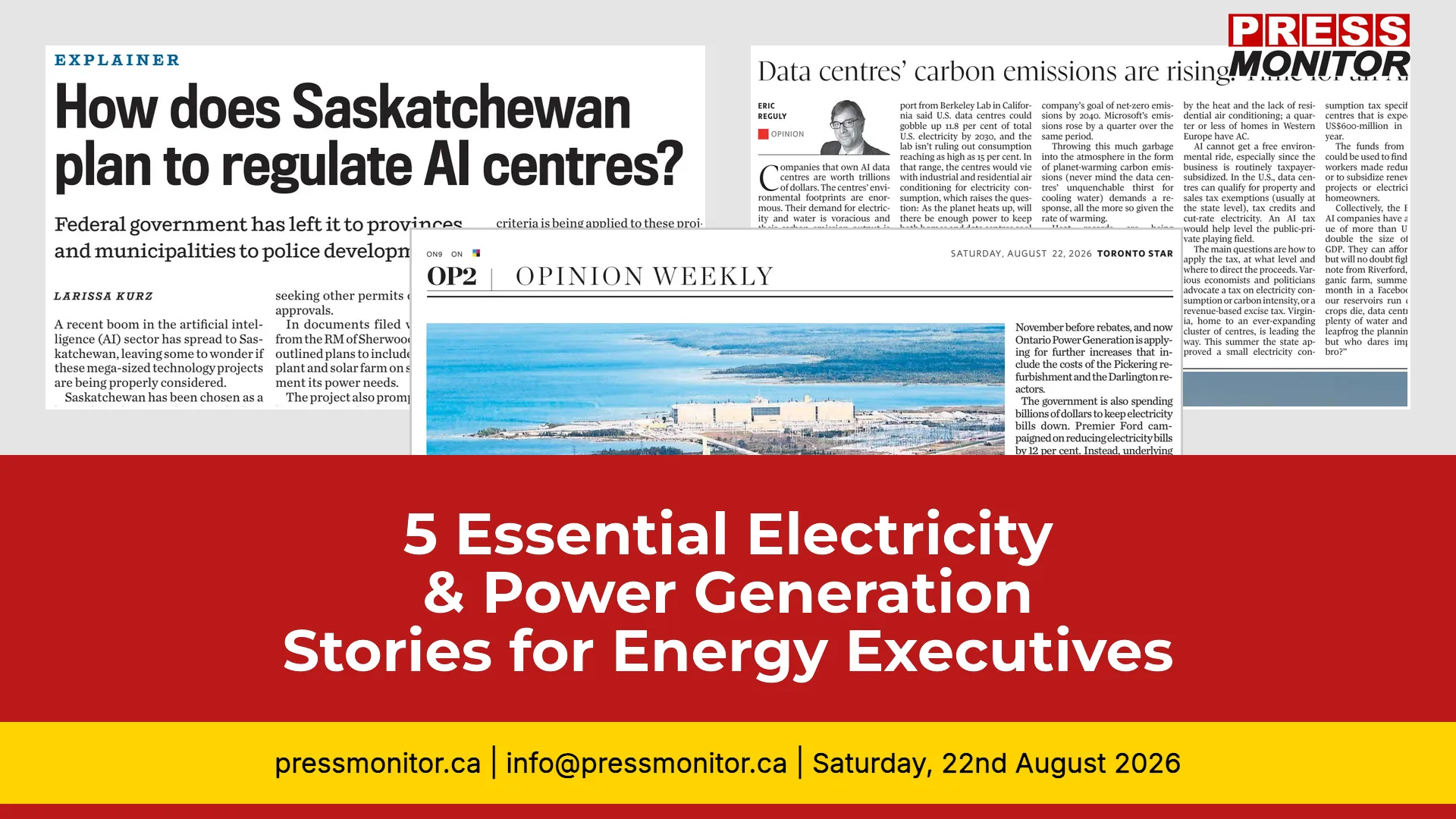
If you rely on Canadian print media for your press review, you know that the electricity and power generation landscape is shifting rapidly. From record-breaking clean energy deals to contentious debates over nuclear vs. renewables, and the surging environmental cost of AI data centres, the stories below capture the key developments tracked by media monitoring across Canada's top newspapers. Here are the five most impactful stories our media intelligence has identified for decision-makers.
1. Saskatchewan AI Data Centres Face Regulatory Gaps
Regina Leader-Post reports that a surge in large-scale artificial intelligence data centres in Saskatchewan has raised concerns over environmental oversight and a lack of federal regulatory frameworks. While projects by Bell Canada and Aztec AI Health move forward, some municipalities are implementing moratoriums to study the impacts on water and power grids.
Why it matters: As AI grows, so does the demand for power. Saskatchewan is emerging as a hub, but oversight is lacking.
Key detail: Bell Canada is building a 300-MW AI campus near Regina, while Aztec AI Health plans a 150-MW facility in Moose Jaw. Municipalities are imposing moratoriums to study impacts on water and grid.
Source: Regina Leader-Post and Saskatoon StarPhoenix (cross-source coverage).
Next step: Energy executives should monitor provincial regulatory developments as these projects set precedents.
2. AI's Climate Cost: Data Centre Emissions Rise
A front-page report in The Globe And Mail reports that data centres’ carbon emissions are rising, driven by surging electricity and water demand, fueling public opposition and calls for an AI tax. Companies like Amazon and Microsoft have seen significant increases in emissions, undermining net-zero goals. Proposed AI taxes aim to address environmental costs, with funds directed toward renewable energy or displaced workers.
Why it matters: Data centres' carbon footprints are undermining net-zero goals, sparking calls for an AI tax.
Key detail: A front-page Globe and Mail report reveals that companies like Amazon and Microsoft have seen significant emissions increases, fueling public opposition.
Source: The Globe and Mail.
Next step: Consider how your organization's AI strategy accounts for energy and emissions.
3. Ontario's Energy Dilemma: Nuclear vs. Renewables
The Toronto Star reports that Ontario faces a significant increase in electricity demand by 2050 due to data centres, population growth, new industry, and increasing electrification. Experts are divided on whether to invest in nuclear power plants or renewable energy sources like wind and solar. Chris Keefer, president of Canadians for Nuclear Energy, argues that nuclear power, though more expensive, offers a reliable service essential for critical services. Keith Brooks, programs director at Environmental Defence, believes that building additional nuclear plants would cost up to $200 billion more than a system relying on wind, solar, and batteries, which have become cheaper globally.
Why it matters: Ontario's electricity demand will double by 2050, and the choice between nuclear and renewables involves billions in cost.
Key detail: Chris Keefer (Canadians for Nuclear Energy) argues nuclear is reliable for critical services; Keith Brooks (Environmental Defence) says wind, solar, and batteries could save up to $200 billion.
Source: Toronto Star.
Next step: Evaluate your own energy sourcing against these cost projections.
4. Historic C$50 Billion Clean Energy Deal Signed in St. John's
The Toronto Star reports that Mark Carney, along with Newfoundland and Labrador and Quebec premiers, has signed a historic energy agreement. This $50-billion project includes a new hydroelectric dam, upgrades to the Churchill Falls hydroelectric station, and a new wind farm, marking the largest clean-energy investment in North American history.
Why it matters: This is the largest clean-energy investment in North American history, involving a new hydro dam, upgrades to Churchill Falls, and a wind farm.
Key detail: Prime Minister Mark Carney signed the agreement with Newfoundland and Labrador and Quebec premiers, aiming to double electricity output.
Source: Toronto Star.
Next step: This deal will reshape regional energy markets; assess potential impacts on your operations.
5. Alberta Data Centre Rejection Shows Regulatory System Works
Calgary Herald reports that a massive AI data centre project in Olds that would have put a 1,400-megawatt power plant across the road from homes has been rejected. The Alberta Utilities Commission denied Synapse Real Estate Corp.’s application this week, finding the proposed power plant was too close to the surrounding community.
Why it matters: A proposed 1,400-MW power plant near Olds was rejected due to community proximity concerns.
Key detail: The Alberta Utilities Commission denied Synapse Real Estate Corp.'s application, citing the plant's location across from homes.
Source: Calgary Herald.
Next step: This decision signals tightening scrutiny of large-scale energy projects near communities.
Which of these trends will affect your energy strategy most? Let us know in the comments — and stay ahead with print media monitoring from Press Monitor.