5 Essential Logistics Stories for Supply Chain Leaders


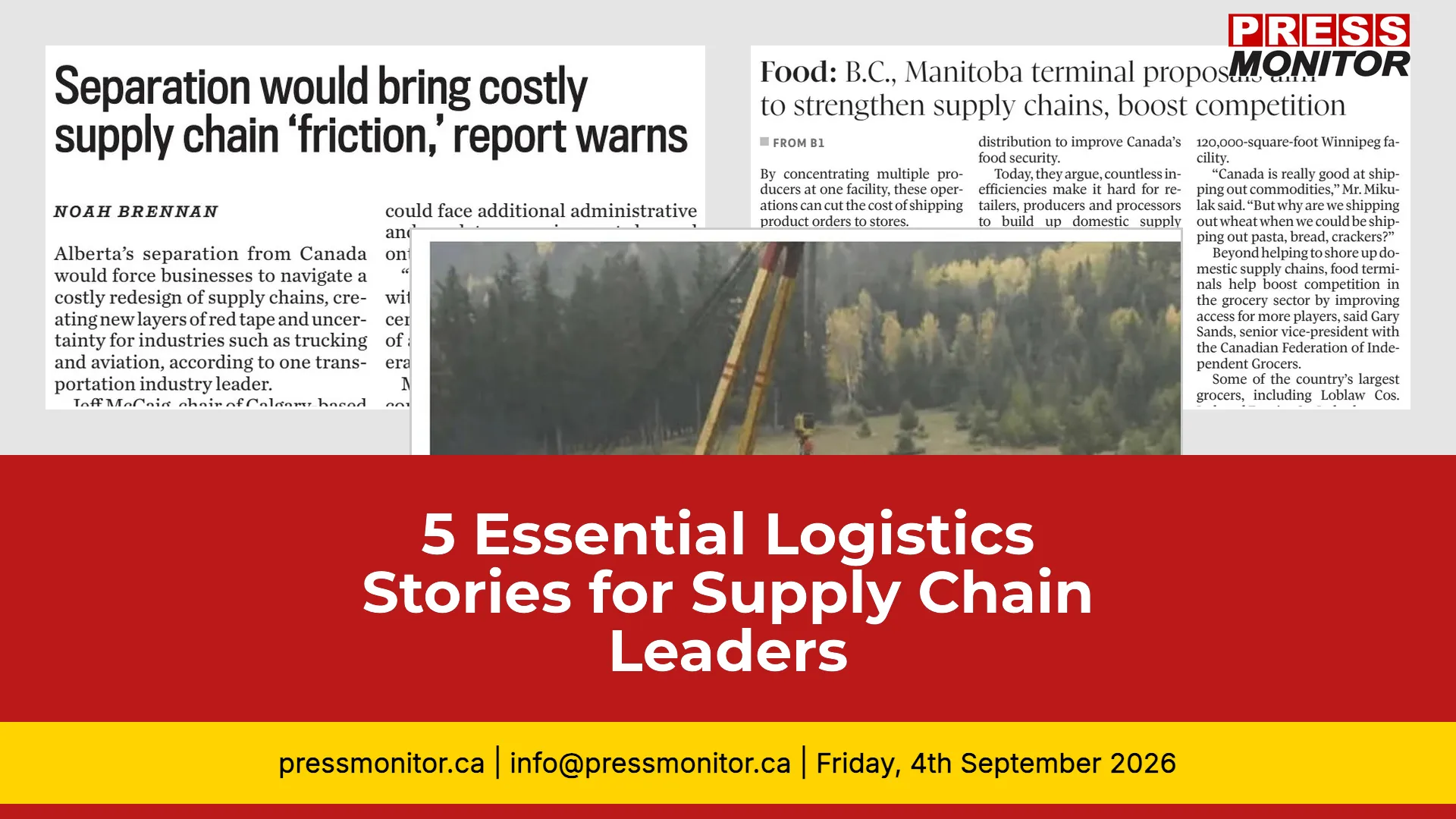
The Canadian logistics landscape is shifting fast — from cross-border tariff impacts to supply chain redesign driven by political change. According to Press Monitor's tracking of Canadian publications, this media monitoring review highlights the 5 essential stories shaping freight, supply chain, and transport today. For professionals relying on print media monitoring to stay ahead, these news on logistics developments demand attention and strategic planning.
1. Alberta Separation Sparks Supply-Chain Friction
Calgary Herald reports that Alberta’s separation from Canada could cause costly redesign of supply chains, adding transaction costs, duplicated regulations, and uncertainty for trucking and aviation industries, according to a Canada West Foundation report. Jeff McCaig of Trimac Transportation Group warned that businesses relying on provincial or federal licences would feel the effects sooner, while freight would likely keep moving but with added documentation.
Why it matters: A potential Alberta separation would force businesses to navigate costly supply chain redesign, adding transaction costs and regulatory duplication across trucking and aviation.
Key detail: Jeff McCaig of Trimac Transportation Group warned that companies relying on provincial or federal licences would feel the effects immediately. Freight would likely keep moving but with added documentation burdens.
Source: Calgary Herald, Canada West Foundation report
Next step: Monitor how provincial and federal licence frameworks evolve in response to political developments.
2. Ottawa Pledges 3 Billion for Food Terminals
The Globe And Mail (ottawa/quebec Edition) reports that British Columbia and Manitoba terminal proposals aim to strengthen supply chains and boost competition in response to Ottawa's National Food Security Strategy launched in June. The strategy pledged 3 billion over 10 years to expand domestic processing and production, make supply chains more efficient and improve grocery competition amid rising food costs and trade tensions with the U.S. James Donaldson, chief executive officer at BC Food & Beverage, said the B.C. concept, dubbed the Pacific Gateway, could become a regional trade hub leveraging international trade.
Why it matters: Canada's National Food Security Strategy aims to strengthen domestic supply chains and boost grocery competition amid rising food costs and trade tensions.
Key detail: British Columbia and Manitoba terminal proposals, including the Pacific Gateway concept led by BC Food & Beverage CEO James Donaldson, could become regional trade hubs leveraging international trade.
Source: The Globe and Mail
Next step: Watch for provincial investment matching the federal 3 billion commitment over 10 years.
3. Charles St-Arnaud Urges Export Infrastructure Investment
National Post reports that investing in export infrastructure such as pipelines, rail, and ports is necessary for Canada to reduce its dependence on the U.S. and preserve its sovereignty, according to Charles St-Arnaud.
Why it matters: Reducing dependence on the US requires strategic investment in pipelines, rail, and ports to preserve Canadian sovereignty.
Key detail: Charles St-Arnaud argues that export infrastructure investment is essential for economic independence and long-term trade diversification.
Source: National Post
Next step: Track which infrastructure projects gain political traction and funding commitments.
4. C$27.6B Canadian Tariffs Impact Key US States
National Post reports that Canada’s 27.6 billion Canadian dollar counter-tariffs on United States goods take effect on September eight, primarily targeting manufacturing and agricultural sectors in key states like Michigan, Ohio, and Iowa. The levies aim to protect domestic market share ahead of the November United States midterm elections and are expected to disproportionately impact border states with deep integration across automotive, steel, and dairy supply chains.
Why it matters: Canada's counter-tariffs on US goods take effect September 8, targeting manufacturing and agricultural sectors in border states.
Key detail: Michigan, Ohio, and Iowa face disproportionate impact due to deep integration in automotive, steel, and dairy supply chains. The levies are timed ahead of the November US midterm elections.
Source: National Post, Jane Switzer
Next step: Assess exposure for cross-border logistics and freight clients operating in affected states.
5. Franklin's Border Transport Operation Deemed Legal
National Post reports that a tribunal ruled Franklin and his associates' border transport operation was not illegal, as it amounted to facilitating travel within the United States. The asylum seekers became entitled to Canada's free health-care program and other benefits upon completing forms and making claims at official ports of entry. The tribunal found the coordinated logistics did not constitute illegal entry under Canadian law.
Why it matters: A tribunal ruling on border transport logistics has implications for asylum seeker processing and immigration-related freight operations.
Key detail: The tribunal found that Franklin's operation amounted to facilitating travel within the US, not illegal entry. Asylum seekers became entitled to Canada's health-care program upon completing forms at official ports of entry.
Source: National Post
Next step: Monitor how this ruling affects border logistics operations and related policy discussions.
Which of these developments will reshape your supply chain strategy in the next quarter? Stay informed with media intelligence that matters — Press Monitor tracks these stories daily from Canadian print publications.