5 Essential Narcotics Stories for Policy Leaders


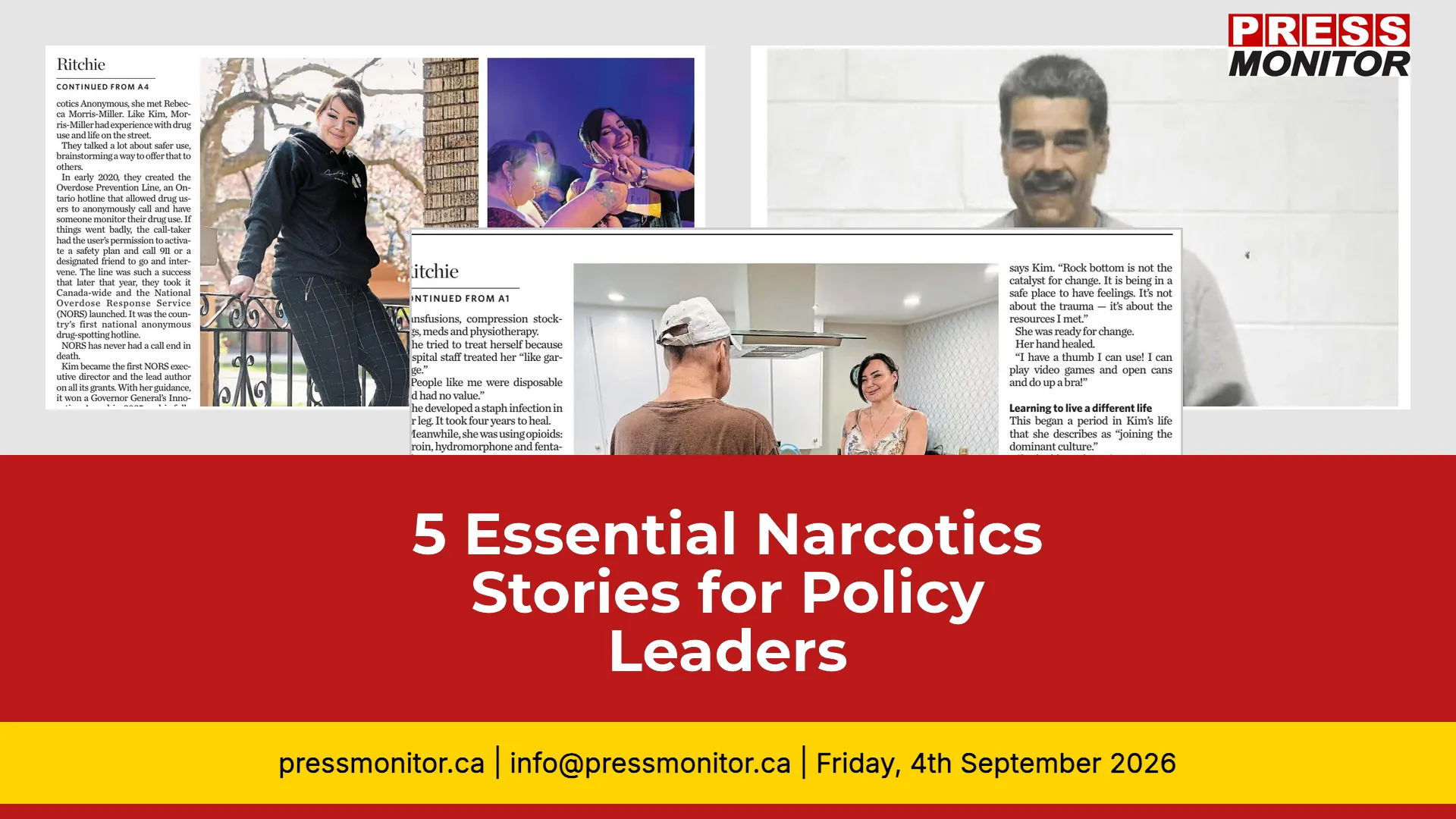
According to Press Monitor's tracking of Canadian publications, this press review delivers news on narcotics shaping Canadian policy and public health. From a national overdose hotline to international drug trafficking arrests, these stories define the landscape of drug policy and harm reduction across the country.
1. Kim Ritchie Co-Founds National Overdose Hotline
The Hamilton Spectator reports that Kim Ritchie co-founded the National Overdose Response Service, Canadas first anonymous drug monitoring hotline, after meeting another recovering addict in early two thousand twenty. Following the success of the initiative and its expansion nationwide, Ritchie now serves as executive director and peer wellness coordinator while advocating for harm reduction. She recently received a prestigious Women of Distinction award for her community leadership and continues to share her recovery journey to inspire others.
Kim Ritchie's founding of the National Overdose Response Service marks a milestone in Canadian harm reduction. The anonymous drug monitoring hotline provides a lifeline for those struggling with addiction, offering support without judgment. Ritchie's personal journey from addiction to executive leadership underscores the power of lived experience in public health.
Why it matters: Canada faces an ongoing overdose crisis, and community-led initiatives like this demonstrate how media monitoring of grassroots efforts can reveal solutions that top-down approaches miss.
Key detail: Ritchie received a Women of Distinction award for her community leadership.
Source: The Hamilton Spectator, Susan Clairmont
Next step: Follow the National Overdose Response Service for updates on expansion.
2. Maduro Detained in US on Drug Trafficking Charges
The Chronicle Herald reports that deposed Venezuelan leader Nicolas Maduro is being held in a US detention center and awaiting trial on charges related to drug and firearms trafficking. He has pleaded not guilty, while his son stated the family is working toward the speedy release of his parents. During his 2013-2026 presidency, Maduro was widely accused of using political repression to cling to power, and both his re-elections in 2018 and 2024 were rejected as fraudulent by numerous countries including the United States.
The detention of former Venezuelan leader Nicolas Maduro on drug and firearms trafficking charges sends a powerful signal about international accountability. Maduro's 2013-2026 presidency was marked by accusations of using political repression to maintain power, and both his re-elections were rejected as fraudulent.
Why it matters: High-profile drug trafficking cases involving heads of state reinforce the need for robust print media monitoring of cross-border enforcement actions.
Key detail: Maduro has pleaded not guilty; his son is working toward the speedy release of his parents.
Source: The Chronicle Herald
Next step: Monitor US-Venezuela diplomatic developments.
3. Kim Ritchie Overcomes Addiction and Disability
The Hamilton Spectator reports that Kim Ritchie survived a train accident crushing her hand, battled opioid addiction and staph infections, and rebuilt her life through detox at Womankind and social work education at Mohawk College and McMaster University. She now works as an anti-human-trafficking counsellor and advocate for marginalized people in Hamilton, Ontario.
Kim Ritchie's personal story of survival — overcoming a train accident, opioid addiction, and staph infections — highlights the intersection of disability, addiction, and resilience. Her path through detox at Womankind and social work education at Mohawk College and McMaster University reflects the importance of integrated support systems.
Why it matters: This story exemplifies how media intelligence can surface human-centered narratives that inform better drug policy.
Key detail: Ritchie now works as an anti-human-trafficking counsellor and advocate for marginalized people in Hamilton.
Source: The Hamilton Spectator
Next step: Support local harm reduction organizations in Hamilton.
4. Worthy Part Two: Just Lucky — Kim Ritchie's Near-Death Experience
The Hamilton Spectator reports that Kim survived a near-death experience on Hamilton streets after years of drug addiction and unstable living. Staff at the Wesley drop-in centre repeatedly sent her to the hospital for a non-healing wound, but she was dismissed at the Hamilton General Hospital until her condition became life-threatening with blood clots.
Kim Ritchie survived a near-death experience on Hamilton streets after years of drug addiction and unstable living. Despite repeated visits to the Wesley drop-in centre and Hamilton General Hospital, her condition worsened until it became life-threatening with blood clots.
Why it matters: This account reveals systemic gaps in healthcare access for people experiencing homelessness and addiction.
Key detail: Staff at the Wesley drop-in centre sent Ritchie to the hospital multiple times before her condition was taken seriously.
Source: The Hamilton Spectator, Susan Clairmont
Next step: Advocate for improved emergency response protocols for vulnerable populations.
5. McMaster Study Links Mood, Anxiety and Substance Use
The Welland Tribune reports that McMaster University research published in Psychiatry Research found one in six Canadians experienced a mood, anxiety or substance use disorder in 2022, with nearly half of those with a substance use disorder also having a mood or anxiety condition. The study analyzed nationally representative survey data from nearly 35,000 Canadians aged 15 and older, and researchers say there is a pressing need to integrate mental health and substance use services, especially for youth and females.
McMaster University research published in Psychiatry Research found that one in six Canadians experienced a mood, anxiety, or substance use disorder in 2022. Nearly half of those with a substance use disorder also had a co-occurring mood or anxiety condition, based on survey data from nearly 35,000 Canadians aged 15 and older.
Why it matters: The findings underscore the urgent need to integrate mental health and substance use services, particularly for youth and females.
Key detail: Researchers call for integrated care models that address the full spectrum of mental health and addiction needs.
Source: The Welland Tribune, Andrew Baulcomb
Next step: Support integrated mental health and addiction service funding at the provincial level.
Closing: As Canadian print media continues to track these developments, how will your organization stay ahead of the evolving narcotics landscape?
