5 Essential Rural Affairs & Development Stories for Community Leaders


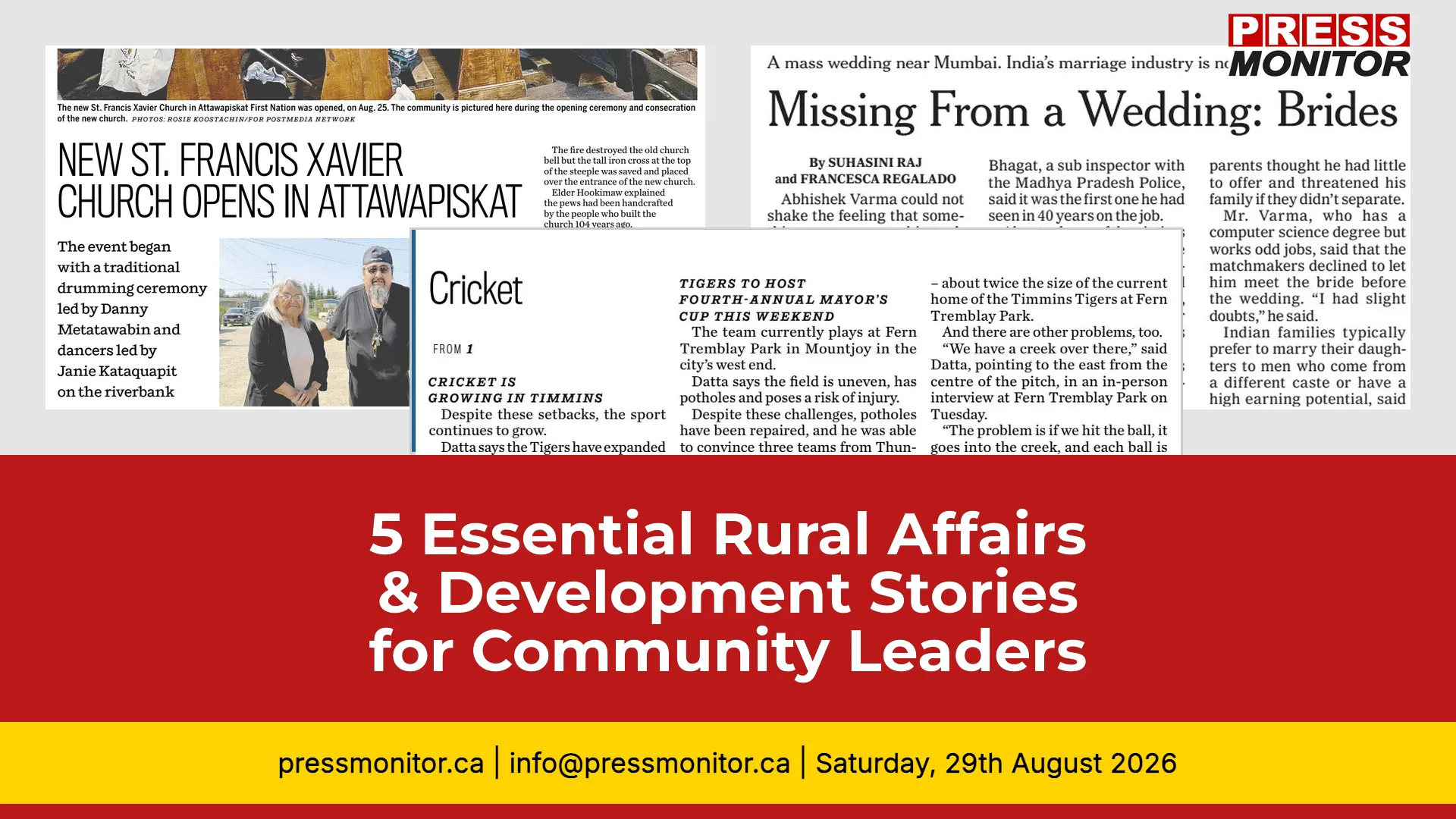
Rural communities across Canada are hubs of resilience and innovation, yet they face unique challenges that often go unnoticed by national headlines. According to Press Monitor's tracking of Canadian publications, this week's press review uncovers five stories that reveal the heart of rural life — from Indigenous faith revival to economic forestry, healthcare transitions, international fraud, and local sports infrastructure. Here's what every community leader needs to know. This media monitoring snapshot helps you stay ahead.
1. St. Francis Xavier Church Opens in Attawapiskat
The Daily Press reports that St. Francis Xavier Church opened in Attawapiskat on Aug. 25, replacing the historic church destroyed by fire in 2021. The ceremony included traditional drumming led by Danny Metatawabin and Janie Kataquapit, followed by Catholic consecration rituals attended by Bishops Tremblay and Campeau. Community elders highlighted the preservation of artifacts and the significance of the new church as a spiritual and cultural center.
Why it matters: A new spiritual and cultural centre rises in a remote Indigenous community, symbolizing resilience and preservation.
Key detail: The church opened Aug. 25, replacing the historic one destroyed by fire in 2021. Traditional drumming by Danny Metatawabin and Janie Kataquapit accompanied Catholic consecration.
Source: The Daily Press (Timmins)
Next step: Community leaders can study this model of partnership between Indigenous traditions and institutional faith.
Closing question: How can your community support cultural infrastructure renewal?
2. Mass Wedding Scam in Madhya Pradesh
A front-page report in The Hamilton Spectator says Abhishek Varma and 40 other grooms were duped by a fraudulent mass wedding scheme in Madhya Pradesh, India. The victims, rural men in their 20s to 40s, were charged around $200 to participate in a mass wedding, only to find out there were no brides.
Why it matters: Rural men from low-income backgrounds lost $200 each to a fraudulent scheme — a reminder of the vulnerability of rural populations to scams.
Key detail: Abhishek Varma and 40 others were duped; no brides existed.
Source: The Hamilton Spectator (front-page)
Next step: Rural community groups should educate on scam prevention.
3. Timmins Cricket Faces Setback Without Pro Field
{The Daily Press} reports that Timmins city council recently scrapped plans for a professional cricket field at Leo Del Villano Park due to local noise concerns. Deepak Datta, manager of the Timmins Tigers Cricket Club, is discouraged but proactive in trying to secure alternate locations. With existing issues at Fern Tremblay Park, professional-level players—currently being held back by an inadequate field—could be drafted to Cricket Canada from larger clubs in Ontario, but they won’t qualify nationally without regulation-sized facilities. Local cricket’s growth (25 to 45 players this season) and ongoing tournaments boost the community sportive economy, despite challenges deterred instates like Moneta Avenue and the unsuitable terrain (creek, proximity to homes).
Why it matters: Rural sports infrastructure is critical for youth engagement and local economic development.
Key detail: Timmins city council rejected a professional cricket field due to noise concerns. The club grew from 25 to 45 players, but lacks a regulation-sized field.
Source: The Daily Press (Timmins)
Next step: Sports planners can advocate for multi-use facilities that address community concerns.
4. Forest Ecosystem Importance
The Chronicle Herald reports that Maine’s forest products sector contributes over $11 billion annually to the state economy. Across Atlantic Canada, forestry contributes nearly $2 billion in regional economic activity and supports roughly 16,600 jobs, many of them in rural communities. A cross-border budworm containment framework is needed for a seamless regional response.
Why it matters: Forestry is a backbone of rural Atlantic Canada's economy, supporting 16,600 jobs.
Key detail: Maine's forest products contribute $11B annually; Atlantic Canada's forestry adds $2B. A cross-border budworm containment framework is needed.
Source: The Chronicle Herald
Next step: Rural economic development bodies should monitor cross-border environmental policies.
5. Sisters of St. Martha Relinquish Role
The Sisters of St. Martha have decided to relinquish their role as spiritual supervisors of St. Martha's Regional Hospital, after 120 years of service. The hospital will now be called Antigonish Memorial Regional Hospital and will no longer prohibit medical assistance in dying (MAID) and abortions.
Why it matters: A 120-year tradition ends, enabling MAID and abortion services at the renamed Antigonish Memorial Regional Hospital — a rural healthcare shift.
Key detail: The Sisters of St. Martha step down as spiritual supervisors.
Source: The Chronicle Herald
Next step: Rural health administrators should prepare for evolving service landscapes.
Closing: These stories show the breadth of rural affairs — from faith to fraud, forestry to sports. Stay informed with Press Monitor's curated media intelligence for your community. Which of these affects your region most?