5 Essential Trade Stories for Policy Leaders


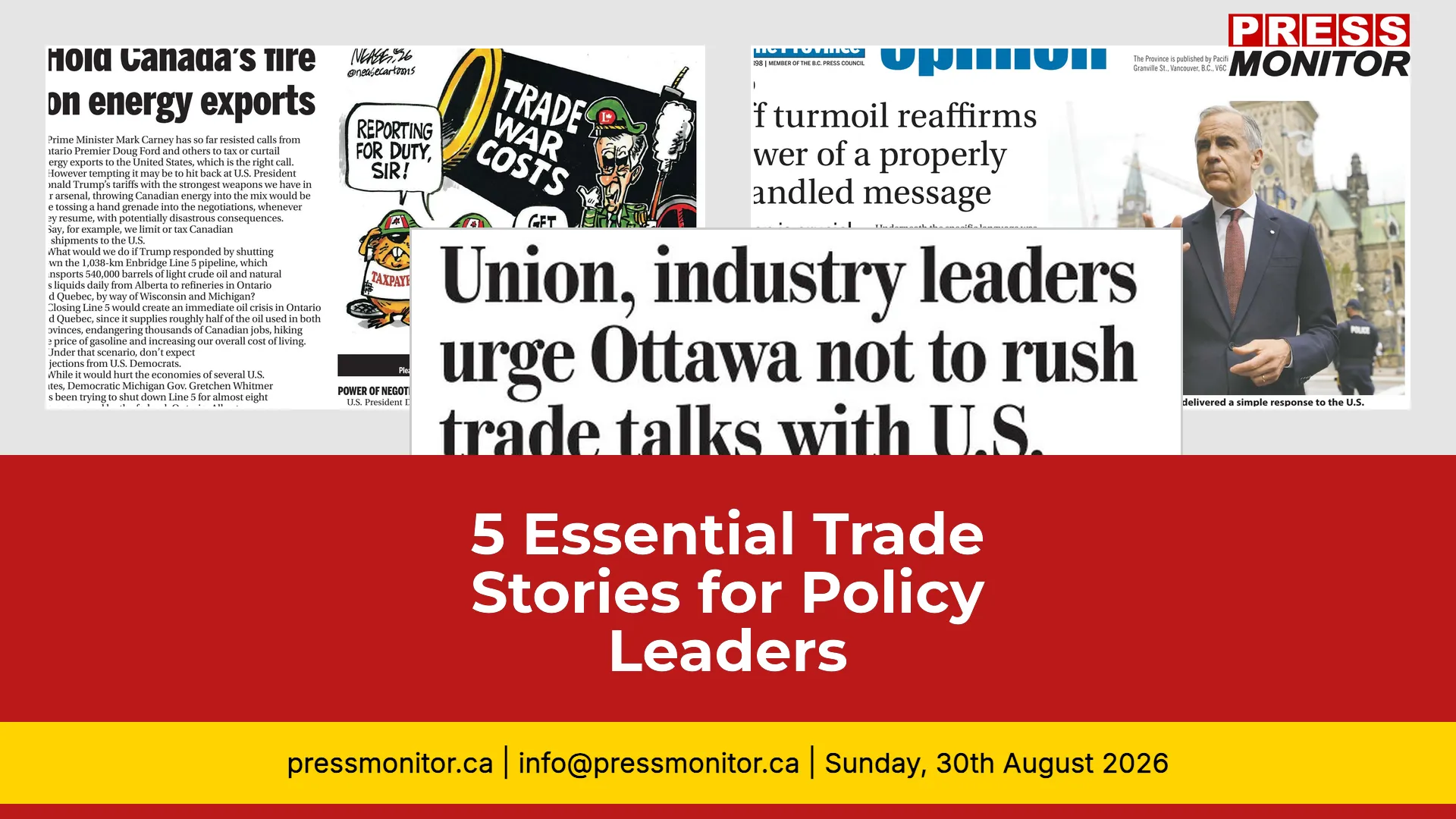
In today's fast-moving trade landscape, staying ahead means knowing what print media is covering before it hits the mainstream. According to Press Monitor's tracking of Canadian publications, here are the five most impactful trade stories from August 30, 2026 — curated through rigorous media monitoring of national and regional dailies.
1. Carney Resists Energy Tariff Retaliation
The Toronto Sun reports that Prime Minister Mark Carney has resisted calls to tax or curtail energy exports to the United States as a retaliation against U.S. President Donald Trump’s tariffs. The article discusses the potential disastrous consequences of such a move, including an oil crisis in Ontario and Quebec, and emphasizes the importance of maintaining Canada as a reliable, rules-based energy supplier.
Why it matters: Prime Minister Mark Carney has pushed back against calls from Ontario Premier Doug Ford to tax or curtail energy exports to the U.S. This decision preserves Canada's reputation as a reliable energy supplier while avoiding a potential oil crisis in Ontario and Quebec.
Key detail: The Toronto Sun reports that such a move could have disastrous consequences for domestic energy markets. Carney's stance maintains a rules-based approach amid escalating trade tensions.
Source: Toronto Sun (also covered by Calgary Sun)
Next step: Monitor how this position affects upcoming trade negotiations with the U.S.
2. Carney's 'Attacked' Message on US Tariffs
The Province reports that Prime Minister Mark Carney delivered a simple response to the U.S. imposition of fifty per cent tariffs on about twenty billion dollars worth of goods, saying Canada had been "attacked" and would respond in kind.
Why it matters: The Province reports that Prime Minister Mark Carney delivered a blunt response to the U.S. imposition of 50% tariffs on $20 billion worth of goods, stating Canada had been "attacked" and would respond in kind. This sets the tone for Canada's retaliatory strategy.
Key detail: The article by Alex Boutilier highlights the direct language used by Carney, signaling a firm stance.
Source: The Province
Next step: Track how this rhetoric influences public opinion and business confidence.
3. Auto Sector Crisis Amid Tariff Retaliation
A front-page report in Times Colonist reports that Canadian union and industry leaders urged the federal government to avoid rushing into U.S. trade negotiations, citing potential long-term costs. Flavio Volpe, president of the Automotive Parts Manufacturers' Association, emphasized the need for sustainable manufacturing deals despite current tariff-induced financial strain. The report details retaliatory tariffs against U.S. breakfast items and Trump's ongoing threats of further measures.
Why it matters: Canadian union and industry leaders are urging the federal government to avoid rushing into U.S. trade negotiations. Flavio Volpe, president of the Automotive Parts Manufacturers' Association, warns that short-term deals could have long-term costs.
Key detail: The Times Colonist front-page report details retaliatory tariffs on U.S. breakfast items and ongoing threats from Trump.
Source: Times Colonist (Canadian Press)
Next step: Watch for industry-specific impacts on automotive supply chains.
4. Maine-Canada Relations Under Trade War Pressure
The article highlights the intertwined relationship between Maine, USA, and Canada, emphasizing how President Trump's trade war is affecting both countries. It discusses the impact of tariffs on Canadian lumber on Maine's forest products industry and the broader economic repercussions across the border.
Why it matters: The Toronto Star highlights how Trump's trade war is affecting Maine's forest products industry, which relies heavily on Canadian lumber. The intertwined economies face significant disruption.
Key detail: Written by former Maine Governor Janet Mills, the piece underscores the cross-border economic pain.
Source: Toronto Star
Next step: Consider how state-level advocacy could shift U.S. trade policy.
5. New Canxport Terminal Opens at Port of Prince Rupert
The Province reports that Ray-Mont Logistics, CN Rail, and the port opened Canxport, a terminal with the capacity to trans-load commodities shipped to the port by rail into containers for shipment overseas. The new facility is designed to handle large quantities of agricultural goods, breakbulk forestry products and petrochemical products.
Why it matters: Ray-Mont Logistics, CN Rail, and the port have opened Canxport, a terminal designed to trans-load commodities into containers for Indo-Pacific markets. This expands Canada's export capacity for agricultural, forestry, and petrochemical products.
Key detail: The Province reports the facility opens a new route for shippers to reach growing Asian markets.
Source: The Province
Next step: Evaluate how this infrastructure investment strengthens Canada's trade diversification.
Closing: These stories represent just a snapshot of the day's print coverage. For a comprehensive press review tailored to your industry, Press Monitor delivers the media intelligence you need to act with confidence. What trade development are you watching most closely?