5 Pivotal Arts & Culture Stories for Heritage Leaders


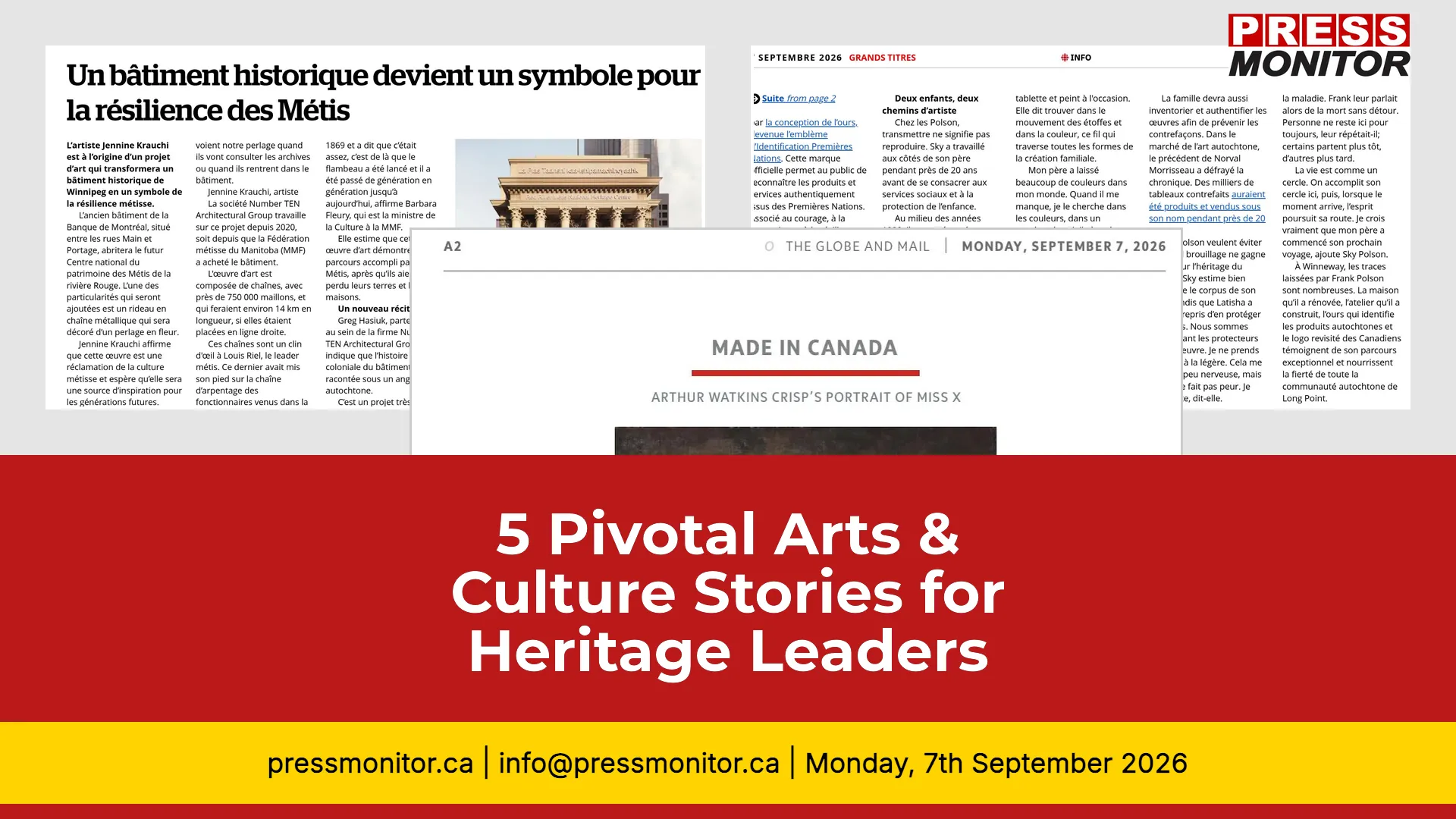
Welcome to today’s press review, where we distill critical developments using rigorous media monitoring. This week’s print media monitoring highlights pivotal shifts in Indigenous cultural preservation, archival authentication, and community history projects. According to Press Monitor's tracking of Canadian publications, these five stories offer actionable insights for cultural leaders, museum directors, and heritage professionals navigating funding landscapes and public engagement strategies.
1. Métis Heritage Centre to Open in Winnipeg Historic Building
Radio-canada Info reports that a historic former Banque de Montréal building in Winnipeg will become the future National Red River Métis Heritage Centre, featuring an art installation by artist Jennine Krauchi that includes a metal chain curtain decorated with beadwork. The project, developed by Number TEN Architectural Group since the Manitoba Métis Federation purchased the property in 2020, aims to celebrate Métis resilience by highlighting nearly lost elements of their culture, language, and beadwork. The chain installation references Louis Riel's historic act in 1869 when he stepped on a surveyors' chain to assert Métis land rights.
Why it matters: Adaptive reuse of historic properties is reshaping how Indigenous narratives are housed and presented nationally.
Key detail: Number TEN Architectural Group is transforming a former Banque de Montréal building into the National Red River Métis Heritage Centre, featuring Jennine Krauchi’s beadwork-adorned metal chain curtain referencing Louis Riel’s 1869 land rights assertion.
Source: Radio-canada Info
Next step: Review architectural grant opportunities for heritage conversion projects.
2. Frank Polson Art Legacy Preserved
Radio-canada Info reports that Frank Polson's family is preparing to preserve and authenticate his artistic legacy after a celebration of First Nations at the Centre Bell. Sky Polson, who manages his father's estate, and Latisha Gaudet Polson, who holds rights to some series and collections, want to make his work more accessible through quality prints while preventing counterfeits. The family also reflects on Frank Polson's teachings on life, art, and death, noting his lasting impact on the Indigenous community of Long Point in Ontario and on Ottawa's National Arts Centre, where a traditional Anishinabe territory sign was installed in 2024.
Why it matters: Estate management and anti-counterfeiting measures are becoming central to sustaining Indigenous artist legacies.
Key detail: Sky Polson and Latisha Gaudet Polson are authenticating prints and expanding access to Frank Polson’s work, ensuring his teachings on life, art, and death remain intact within the Long Point and Ottawa communities.
Source: Radio-canada Info
Next step: Consult copyright frameworks for posthumous artistic estates.
3. Arthur Watkins Crisp's Portrait Of Miss X
The Globe and Mail reports that Arthur Watkins Crisp's 1912 oil-on-canvas portrait of Miss X is featured at the Art Gallery of Hamilton. The painting, measuring 214.8 by 122.8 centimetres, was gifted by the artist in 1961. The work captures a confident young woman posed in a soldierly stance reminiscent of a 17th-century cavalier.
Why it matters: Early 20th-century Canadian portraiture continues to influence contemporary gallery acquisitions and exhibition curation.
Key detail: The Art Gallery of Hamilton displays Crisp’s 1912 oil-on-canvas masterpiece, gifted in 1961, capturing a soldierly-stanced young woman that bridges colonial aesthetics and modern identity.
Source: The Globe and Mail
Next step: Evaluate provenance documentation standards for historical acquisitions.
4. Calgary Gay History Project Marks 15 Years
The Calgary Sun reports that historian Kevin Allen founded the Calgary Gay History Project fifteen years ago after a conversation with his parents about queer spaces in the l95Os and l96Os. The project grew from a simple blog into a research hub documenting Calgary's LGBTQ+ community, leading Allen to write a book and produce an award-winning documentary about Everett Klippert.
Why it matters: Grassroots LGBTQ+ archival initiatives demonstrate the power of community-led historical preservation.
Key detail: Historian Kevin Allen evolved a simple blog into a comprehensive research hub, culminating in a book and award-winning documentary about Everett Klippert, preserving queer spaces from the 1950s and 1960s.
Source: Calgary Sun
Next step: Partner with local historians for oral history digitization grants.
5. Andy Donato Marks 50 Years as Editor Cartoonist
Toronto Sun reports that veteran political cartoonist Andy Donato has been with the newspaper since its inception, first designing the original Sun and later becoming its editorial cartoonist. Donato recalls starting his first cartoon in 1964 on the Canadian flag debate while working at the Toronto Telegram, and his work often satirized Prime Ministers Pierre Trudeau and Brian Mulroney. He eventually transitioned to the Toronto Sun just after Thanksgiving in 1971, producing up to five cartoons weekly when the Sunday edition launched.
Why it matters: Political satire remains a vital lens for understanding shifting national identities and policy debates.
Key detail: Veteran cartoonist Andy Donato reflects on five decades of editorial illustration, tracing his career from the 1964 Canadian flag debate through Trudeau and Mulroney eras at the Toronto Sun.
Source: Toronto Sun
Next step: Explore syndication models for legacy political illustrators.
These stories underscore how media intelligence continues to ground cultural strategy in verified, editorial-vetted reporting. Which emerging heritage initiative should we track next? Share your recommendations below.