5 Pivotal Fertilizer & Agri-Input Stories for Agribusiness Leaders


Welcome to today’s press review. According to Press Monitor's tracking of Canadian publications, our print media monitoring captures how national and regional outlets are framing the current landscape of fertilizer markets and agricultural inputs. Here are five pivotal developments you need to know before they dominate mainstream feeds.
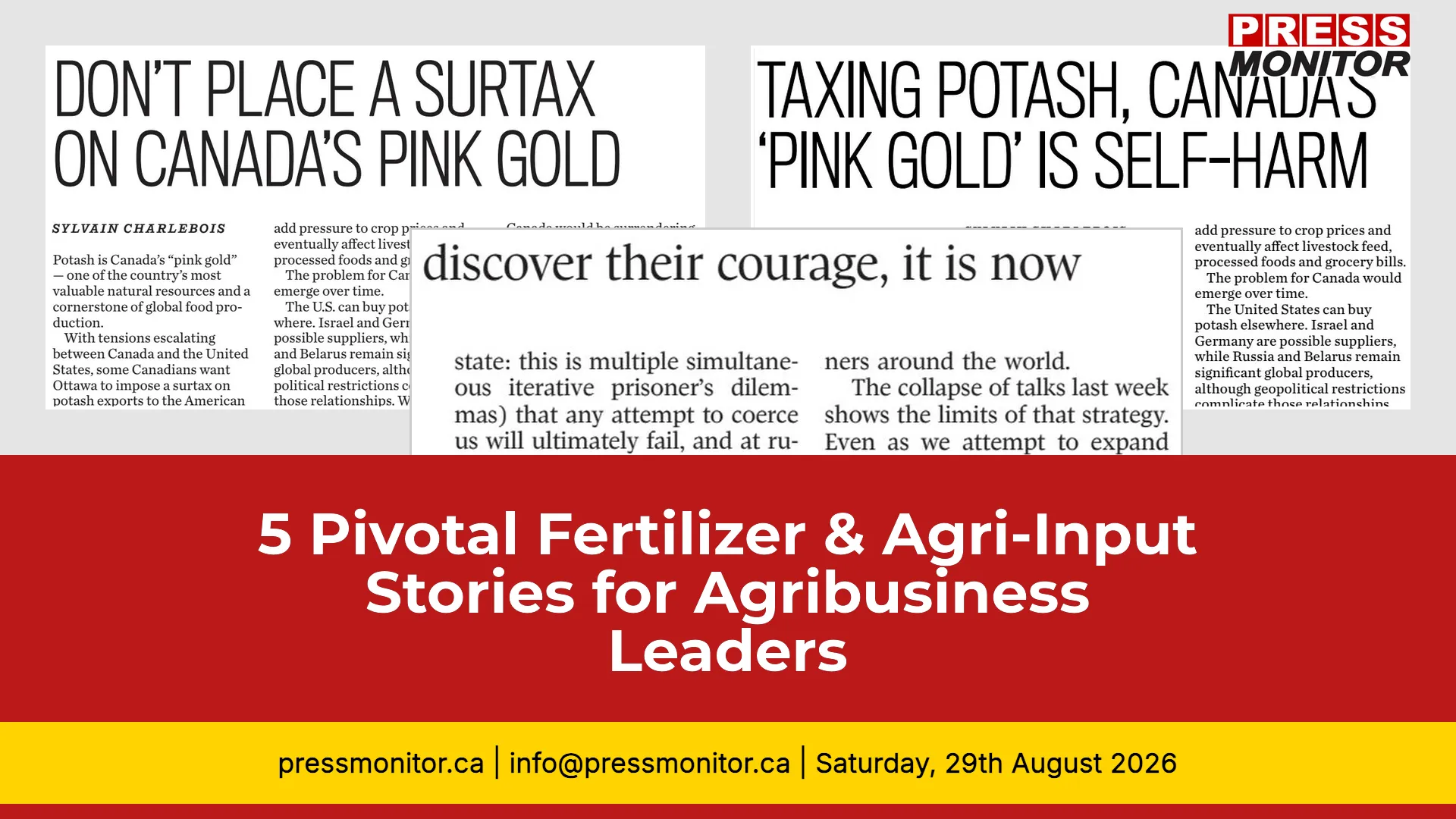
1. Don't Place a Surtax on Canada's Pink Gold
According to a front-page report in the Saskatoon Starphoenix, Canada should not impose a surtax on potash exports to the United States, despite some calls for it. The United States relies heavily on Canadian potash, a vital fertilizer, and retaliating with a resource Washington cannot easily replace would be economically self-harming. While a surtax would initially raise costs for American farmers, alternatives like Israeli, German, or Russian supplies would ultimately be more expensive, potentially encouraging shifts in global trade and impacting Canadian producer revenues, employment, and royalties.
Why it matters: Directly impacts export revenue, producer margins, and U.S. farmer relations.
Key detail: The Saskatoon Starphoenix argues against a potash surtax, noting that retaliating with a resource Washington cannot easily replace would be economically self-harming. Alternatives like Israeli or Russian supplies would ultimately cost more, shifting global trade dynamics.
Source: Saskatoon Starphoenix
Next step: Monitor USTR statements on critical mineral and fertilizer exemptions.
2. Taxing Potash, Canada's Pink Gold Is Self-Harm
The Daily Press (Timmins) reports that potash is Canada’s ‘pink gold’ and a cornerstone of global food production. With tensions escalating between Canada and the United States, some Canadians want Ottawa to impose a surtax on potash exports to the American market. The proposal appears compelling. However, it could become economic self-harm for Canada.
Why it matters: Highlights domestic political pressure versus long-term economic reality.
Key detail: Sylvain Charlebois warns that while public sentiment favors taxing exports during trade tensions, doing so would damage Canada’s own fiscal health and disrupt global food production supply chains.
Source: The Daily Press (Timmins)
Next step: Track provincial budget proposals for resource royalties and export levies.
3. Risky Strategy for Canada
The Globe And Mail (ottawa/quebec Edition) reports that escalation in trade tensions between Canada and the U.S. could lead to severe economic impacts. The article discusses potential measures Canada could take, such as imposing taxes or quantitative restrictions on exports of Canadian commodities to the U.S.
Why it matters: Signals potential escalation in cross-border commodity disputes.
Key detail: The Globe and Mail outlines how imposing taxes or quantitative restrictions on Canadian commodities could trigger severe retaliatory measures, affecting broader agri-input sectors beyond just potash.
Source: The Globe and Mail
Next step: Review corporate risk disclosures for exposure to North American trade barriers.
4. Cultus Lake Algae Concerns Urge Nutrient Management Solutions
Vancouver Sun reports that Cultus Lake stakeholders, including local stewardship organizations, are calling for proactive nutrient management solutions to combat growing algal blooms tied to climate change and land use in Fraser Valley. Small blooms in shallow areas, driven by runoff from agricultural fields and atmospheric phosphorus export, increasingly threaten the lake’s ecosystem. Experts note that anoxygenation-related nutrient pescaust troubling threats, requiring immediate ecosystem interventions like oxygenation systems to mitigate toxic bloom risks affecting wildlife and local recreational interests.
Why it matters: Links agricultural runoff directly to ecosystem costs and regulatory scrutiny.
Key detail: The Vancouver Sun reports stakeholders are calling for proactive nutrient management to combat algal blooms driven by climate change and phosphorus runoff from Fraser Valley farms. Oxygenation systems may become necessary.
Source: Vancouver Sun
Next step: Evaluate precision agriculture technology for nitrogen and phosphorus reduction.
5. Hamilton Port Authority Handles Fertilizer Cargo
The Hamilton-Oshawa Port Authority reports that for the week of August 16 to 22, the ports handled five vessels carrying bulk material related to the steel industry, five vessels carrying petroleum products, four vessels carrying agricultural products, one vessel carrying fertilizer, and one vessel carrying aggregate, with total trade estimated at 214,976 metric tons.
Why it matters: Provides real-time logistics data on supply chain movement.
Key detail: Weekly port traffic shows one dedicated vessel handling fertilizer cargo alongside steel and petroleum products, underscoring steady import/export flows despite macroeconomic headwinds.
Source: The Hamilton Spectator
Next step: Audit freight contracts and port access agreements for Q4 planning.
This media intelligence roundup demonstrates why staying ahead of print coverage is essential for strategic decision-making. How will your organization adjust its supply chain or policy advocacy based on these developments?