5 Pivotal First Nations & Indigenous Stories for Policy Leaders


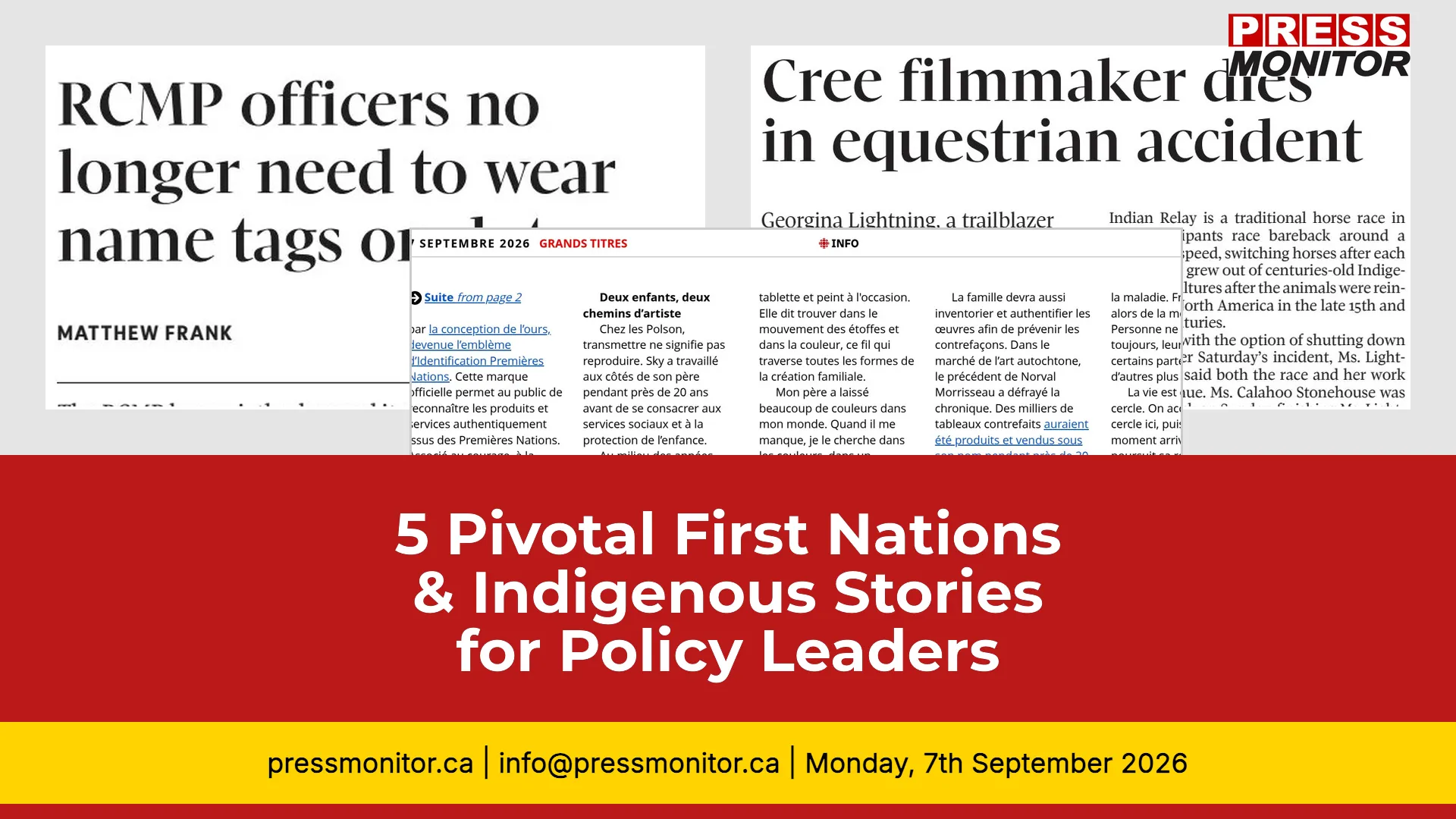
Today’s media monitoring report highlights 5 pivotal shifts in First Nations & Indigenous affairs across Canada. According to Press Monitor's tracking of Canadian publications, this edition delivers essential news on First Nations & Indigenous developments, blending policy adjustments, cultural milestones, and community initiatives into actionable media intelligence. Here are the five most impactful stories shaping the landscape today.
1. RCMP Drops Name Tags, Draws Ire
The Globe And Mail (ottawa/quebec Edition) reports that the RCMP quietly changed its uniform policy in March to no longer require officers to wear name tags, allowing them to display regimental numbers instead to address officer safety concerns and deter doxxing. Critics, including Indigenous leaders and civil liberties advocates, argue the move undermines transparency, complicates the complaints process, and fuels distrust in Indigenous communities.
Why it matters: Uniform transparency directly impacts community trust and accountability frameworks.
Key detail: The RCMP quietly updated its uniform policy in March to replace name tags with regimental numbers, citing officer safety and doxxing concerns. Indigenous leaders and civil liberties advocates warn this move complicates complaints processes and deepens historical distrust.
Source: The Globe And Mail
Next step: Monitor federal policing reform debates and track parliamentary responses to transparency demands.
2. Georgina Lightning Dies
The Globe And Mail (ottawa/quebec Edition) reports that Georgina Lightning, the Cree actor, director and screenwriter, died Saturday after a horse struck her during an Indigenous equestrian championship west of Edmonton at the Enoch Rodeo Grounds. She was 63 and was filming a documentary about the three‑day Indian Relay event.
Why it matters: Loss of a prominent Cree voice reshapes representation in Canadian screenwriting and film.
Key detail: The acclaimed actor, director, and screenwriter passed away at 63 following a horse accident during an Indigenous equestrian championship near Edmonton while filming a documentary on Indian Relay racing.
Source: The Globe And Mail
Next step: Follow industry tributes and upcoming releases honoring her legacy in Indigenous storytelling.
3. Frank Polson Art Legacy Preserved
Radio-canada Info reports that Frank Polson's family is preparing to preserve and authenticate his artistic legacy after a celebration of First Nations at the Centre Bell. Sky Polson, who manages his father's estate, and Latisha Gaudet Polson, who holds rights to some series and collections, want to make his work more accessible through quality prints while preventing counterfeits. The family also reflects on Frank Polson's teachings on life, art, and death, noting his lasting impact on the Indigenous community of Long Point in Ontario and on Ottawa's National Arts Centre, where a traditional Anishinabe territory sign was installed in 2024.
Why it matters: Authenticating and preserving Indigenous artistic heritage safeguards cultural IP and community history.
Key detail: Family estate managers are launching quality print initiatives to authenticate Polson’s work, prevent counterfeiting, and expand access to his vibrant murals and paintings created throughout Long Point First Nation and Ottawa institutions.
Source: Radio-Canada Info
Next step: Track museum acquisitions and copyright frameworks emerging around First Nations artist estates.
4. Victoria Forum Focuses on Trust Justice and Wellbeing
Times Colonist reports that this year's Victoria Forum addressed trust justice and wellbeing as society faces interconnected ecological social political economic and ethical challenges. Key themes included the need to redesign societal systems that currently produce environmental degradation and inequality and the importance of Indigenous knowledge and values. Senator Rosa Galvez a white paper calling for a new North Star to guide Canadian society based on long-term wellbeing for all within planetary limits.
Why it matters: High-level policy dialogues increasingly center Indigenous knowledge as foundational to systemic redesign.
Key detail: This year’s forum highlighted interconnected ecological and social challenges, featuring Senator Rosa Galvez’s white paper advocating a North Star framework grounded in planetary limits and long-term wellbeing for all Canadians.
Source: Times Colonist
Next step: Watch for provincial adoption of wellbeing economy metrics tied to reconciliation targets.
5. Seaweed School Inspires Island Students
Times Colonist reports that a new Seaweed School program for Grade 7, 8 and 9 students on Hornby Island offers hands-on instruction in marine biology and conservation. The program is a collaboration between the Hornby Island Community School, UBC, and the Hornby Island Natural History Museum, with funding from the Marine Environmental Observation, Prediction and Response Network. Alumna Ava Zielinski credits the program with motivating her to stay on the island and pursue marine biology and conservation studies at UBC after graduation.
Why it matters: Grassroots marine conservation programs demonstrate how local education pipelines feed Indigenous-led environmental stewardship.
Key detail: A collaborative Grade 7–9 program between Hornby Island Community School, UBC, and regional museums is equipping youth with hands-on marine biology skills, with alumni already pursuing conservation degrees locally.
Source: Times Colonist
Next step: Evaluate STEM funding models that integrate traditional ecological knowledge with modern science curricula.
Closing: These five developments underscore how print media remains the bedrock for verified, editorially vetted insights on First Nations & Indigenous affairs. How will your organization adapt to shifting transparency and cultural preservation priorities? Stay informed through disciplined print media monitoring.