5 Pivotal Human Resources Stories for Labour Leaders


Accurate media monitoring is essential for navigating today’s complex Canadian labour landscape. This press review highlights five critical developments shaping news on human resources across the country. According to Press Monitor's tracking of Canadian publications, here is what HR leaders and union representatives must know today.
1. Bargaining Fight Enters New Phase
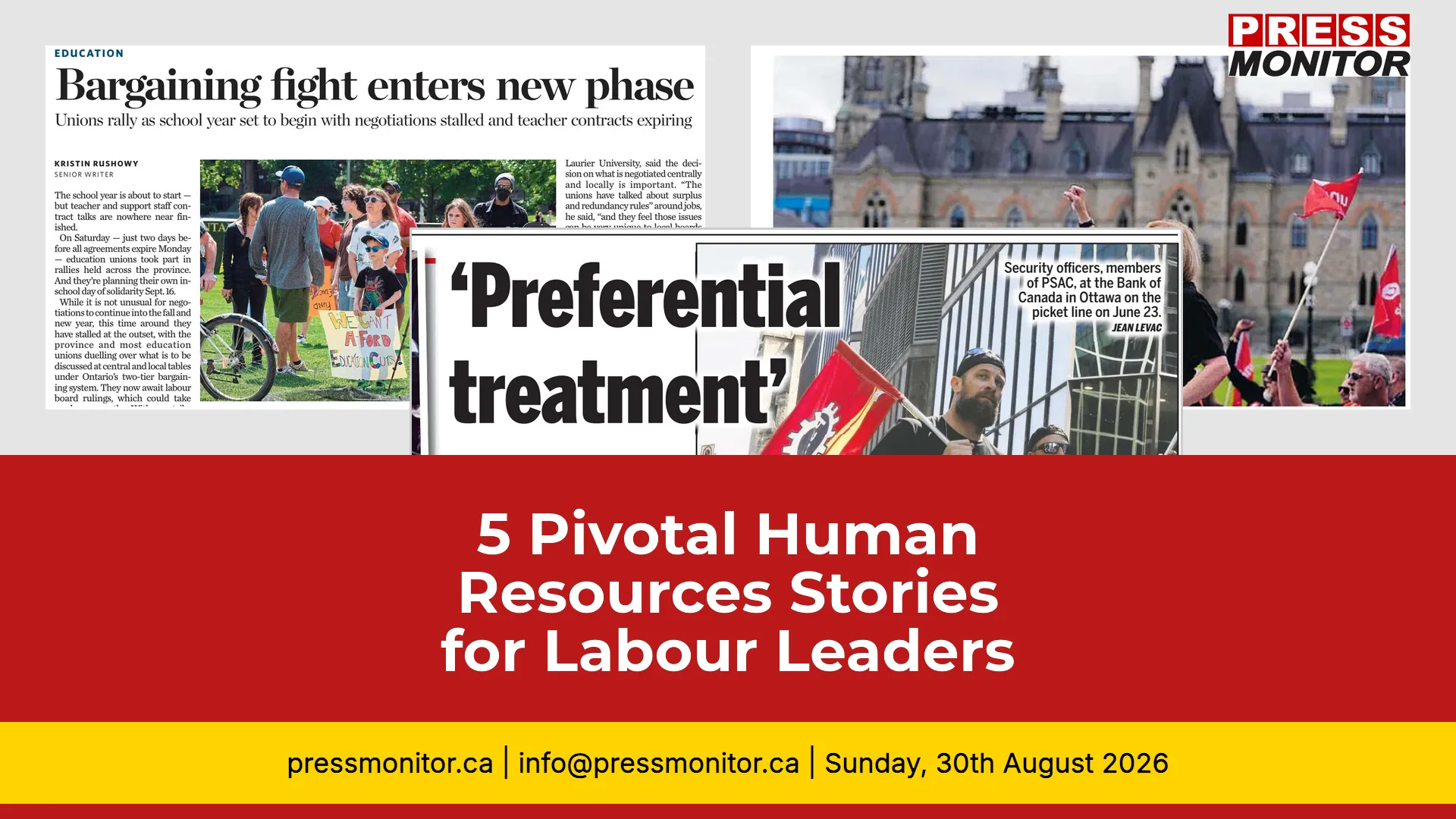
The Toronto Star reports that unions rally as school year set to begin with negotiations stalled and teacher contracts expiring. Education unions took part in rallies held across the province as collective agreements with educators were set to expire ahead of the new school year.
Why it matters: Educators and support staff face immediate contract deadlines as the new academic year approaches.
Key detail: Provincial education unions organized coordinated rallies demanding fair compensation and improved working conditions before collective agreements expire.
Source: Toronto Star
Next step: Review your district's negotiation timeline and prepare contingency communication plans for staff and parents.
2. Unifor President Speaks at Ottawa Rally
Unifor national president Lana Payne addressed a rally on Parliament Hill in Ottawa on Friday. The rally focused on labor rights and economic issues. Payne spoke passionately about the importance of collective bargaining and advocated for stronger protections for workers. The event drew a large crowd of supporters and raised awareness about Unifor's priorities.
Why it matters: National labor advocacy reaches peak visibility as federal policy discussions intensify.
Key detail: Unifor national president Lana Payne addressed Parliament Hill, championing stronger collective bargaining protections and raising awareness about worker economic security.
Source: Times Colonist
Next step: Engage with current federal labor proposals and align internal policy updates with emerging national standards.
3. Bank of Canada Strike Complaint
Ottawa Sun reports that the Public Service Alliance of Canada (PSAC) filed a fourth complaint against the Bank of Canada, claiming it continued to pay replacement workers during a months-long strike after it was ordered not to.
Why it matters: Public sector compliance and strike protocols face rigorous scrutiny from federal watchdogs.
Key detail: The Public Service Alliance of Canada filed its fourth formal complaint alleging the Bank of Canada improperly continued paying replacement workers during an active dispute.
Source: Ottawa Sun
Next step: Audit your organization's strike contingency funds and ensure strict adherence to public service labour directives.
4. Struggle in the Shad
The Toronto Sun reports that in the last two weeks, five police officers and one paramedic have died in Canada, including four in Ontario. By every account, most died by suicide, or, that operational stress injuries like PTSD played a role.
Why it matters: Workplace wellness extends beyond corporate offices into high-risk frontline professions.
Key detail: Five police officers and one paramedic have died recently in Canada, with operational stress injuries and PTSD identified as primary factors.
Source: Toronto Sun
Next step: Evaluate your EAP programs, mandate mental health training for supervisors, and normalize peer support networks.
5. Canada's Tariff Retaliation Sparks Auto Sector Crisis
A front-page report in Times Colonist reports that Canadian union and industry leaders urged the federal government to avoid rushing into U.S. trade negotiations, citing potential long-term costs. Flavio Volpe, president of the Automotive Parts Manufacturers' Association, emphasized the need for sustainable manufacturing deals despite current tariff-induced financial strain. The report details retaliatory tariffs against U.S. breakfast items and Trump's ongoing threats of further measures.
Why it matters: Trade policy directly impacts manufacturing employment and cross-border supply chain stability.
Key detail: Automotive Parts Manufacturers' Association president Flavio Volpe urged caution against rushed U.S. trade negotiations, warning of long-term job losses despite current tariff strains.
Source: Times Colonist
Next step: Stress-test your workforce planning models against potential trade disruptions and diversify supplier contracts.
Closing: These developments underscore why proactive print media monitoring remains essential for navigating complex labour landscapes. How is your organization adapting to these shifting workforce dynamics? Share your strategy below.
