5 Pivotal Timber & Lumber Stories for Forestry Executives


Welcome to today's press review on timber, lumber, and wood products. According to Press Monitor's tracking of Canadian publications, these are the five stories shaping the industry today. From legal battles over old-growth logging to cross-border pest threats, here's what you need to know.
1. Walbran Valley Logging Injunction Extended
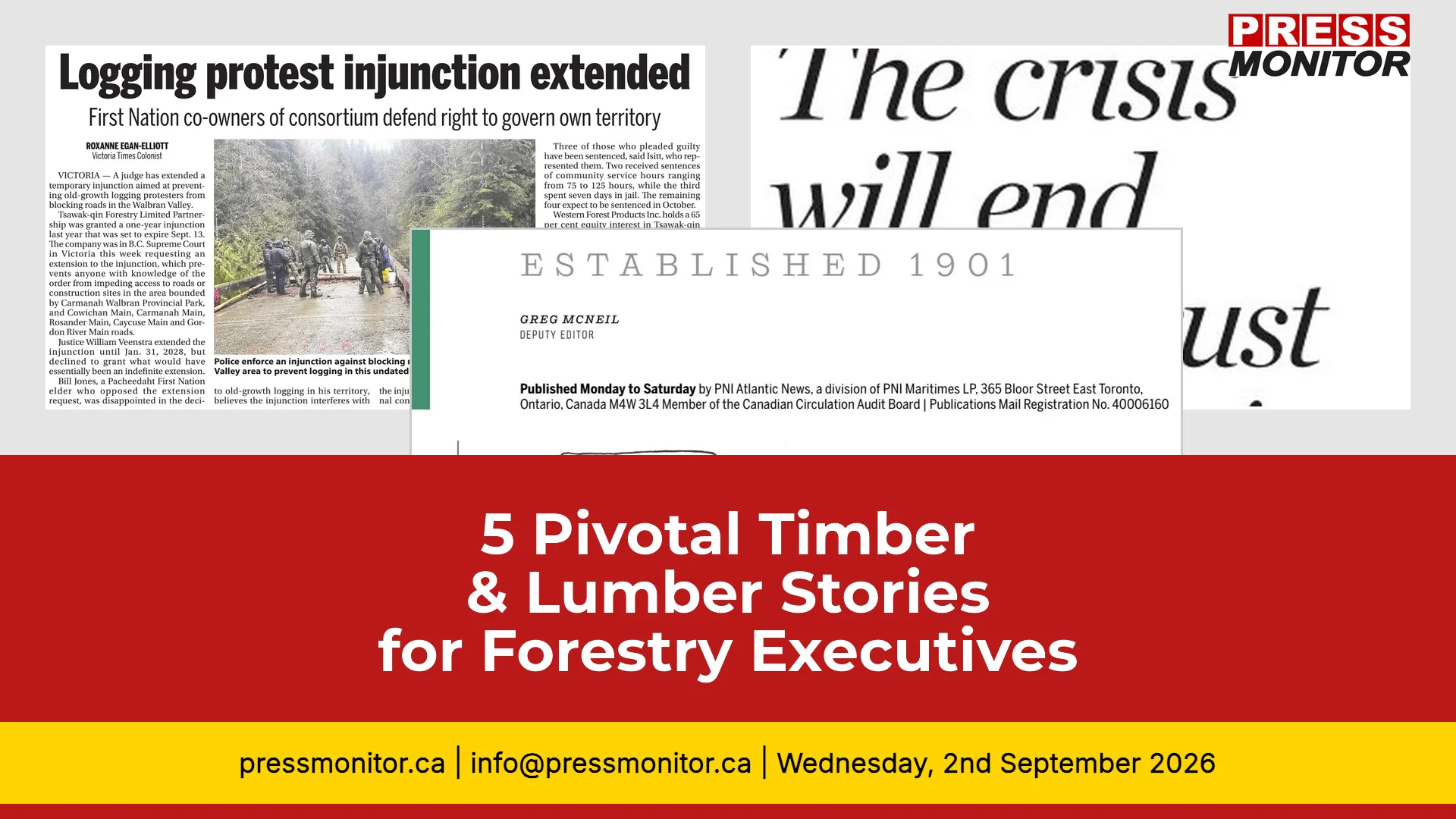
The Province reports that a British Columbia Supreme Court justice has extended an injunction preventing old-growth logging protesters from blocking roads in the Walbran Valley on Vancouver Island. Justice William Veenstra extended the order, first granted to logging company Tsawak-qin Forestry Limited Partnership, until January 31, 2028, but declined to make it indefinite. Pacheedaht First Nation elder Bill Jones, who opposed the extension, argues the injunction interferes with his nation's right to govern and access its territory.
Why it matters: The BC Supreme Court has extended an injunction blocking old-growth logging protesters from roads in the Walbran Valley until January 31, 2028. This directly impacts timber access and Indigenous governance.
Key detail: Justice William Veenstra declined to make the order indefinite, and Pacheedaht First Nation elder Bill Jones argues it interferes with his nation's rights.
Source: The Province
Next step: Forestry companies and First Nations should monitor legal developments and engage in dialogue.
2. Trump's Trade War Targets Canada
The Toronto Star reports that U.S. President Donald Trump's escalating trade war against Canada is part of a deliberate plan to absorb the country into the United States, hitting industries from Ontario steel and autos to British Columbia forest products and Quebec textiles. The August 22 tariffs also target hundreds of small and medium-sized businesses, while further escalation could affect Canadian inflation, which remains above the Bank of Canada's two per cent target. The opinion piece notes the tariffs might not survive U.S. court challenges as Trump faces midterm elections in November.
Why it matters: Escalating US tariffs hit BC forest products, among other sectors, as part of a broader annexation strategy.
Key detail: August 22 tariffs target hundreds of SMEs; further escalation could affect Canadian inflation above the Bank of Canada's 2% target.
Source: Toronto Star
Next step: Exporters should assess tariff exposure and explore non-US markets.
3. Spruce Budworm Demands Cross-Border Response
The Cape Breton Post reports that spruce budworm moths can ride the wind across long distances, allowing outbreaks in Maine and New Brunswick to threaten forests throughout Atlantic Canada. Forestry contributes nearly C$2 billion in regional economic activity and supports roughly 16,600 jobs in Atlantic Canada, while Maine's forest products sector is worth more than US$11 billion a year. University of Maine doctoral researcher Naresh Khanal is urging Maine, New Brunswick and Nova Scotia to create a cross-border containment framework with shared trapping data, satellite mapping and emergency agreements.
Why it matters: Spruce budworm outbreaks in Maine and New Brunswick threaten Atlantic Canada's C$2 billion forestry economy and 16,600 jobs.
Key detail: Researcher Naresh Khanal urges a cross-border containment framework with shared trapping data and satellite mapping.
Source: Cape Breton Post
Next step: Provincial governments should collaborate on monitoring and emergency agreements.
4. Northern Pulp Mill to Be Demolished
The Chronicle Herald reports that Nova Scotia Environment and Climate Change Minister Timothy Halman issued an amended ministerial order on August 27 allowing the half-century-old Northern Pulp mill at Abercrombie Point in Pictou County to be torn down and the site cleaned up. Northern Timber Nova Scotia Corp., the mill's current owner, has said it intends to begin demolition work as early as September and has filed a demolition application with Pictou County, subject to stringent environmental conditions.
Why it matters: The half-century-old mill at Abercrombie Point will be torn down, ending an era for Pictou County's pulp and paper industry.
Key detail: Owner Northern Timber Nova Scotia Corp. plans demolition as early as September, subject to stringent environmental conditions.
Source: The Chronicle Herald
Next step: Local businesses and environmental groups should prepare for the cleanup and potential redevelopment.
5. Second Narrows Bridge Chokes Port of Vancouver
The Globe And Mail (Ottawa/Quebec Edition) reports that the 57-year-old Second Narrows Bridge, the only rail crossing connecting the two halves of the Port of Vancouver, jammed in the down position for four days in February, practically grinding the port to a standstill. Every day C$1 billion worth of the nation's riches, from potash and grain to lumber and energy, pass through the port, and Trans Mountain loaded just 17 of its 30 monthly oil tanker capacity during the disruption. Federal pledges to expand the resource sector and double non-U.S. exports within a decade hinge on relieving the chokepoint, yet the only project underway is a small dredging job not due for completion until at least 2027.
Why it matters: The only rail crossing connecting the port's two halves jammed for four days, disrupting C$1 billion in daily trade including lumber.
Key detail: Trans Mountain loaded just 17 of 30 tankers during the disruption; federal export goals hinge on fixing this chokepoint.
Source: The Globe and Mail
Next step: Infrastructure investment is critical to avoid future bottlenecks.
Which of these stories will impact your operations most? Share your thoughts below. For deeper insights, rely on Press Monitor's media intelligence to stay ahead.