7 Defining Electricity Stories for Energy Leaders


Canada's electricity landscape is shifting rapidly — from the historic Churchill Falls deal to the first-ever net import of US power. According to Press Monitor's tracking of Canadian publications, here are the seven stories that energy leaders need to know today.
1. Newfoundland Secures $49 Billion Churchill Falls Revamp
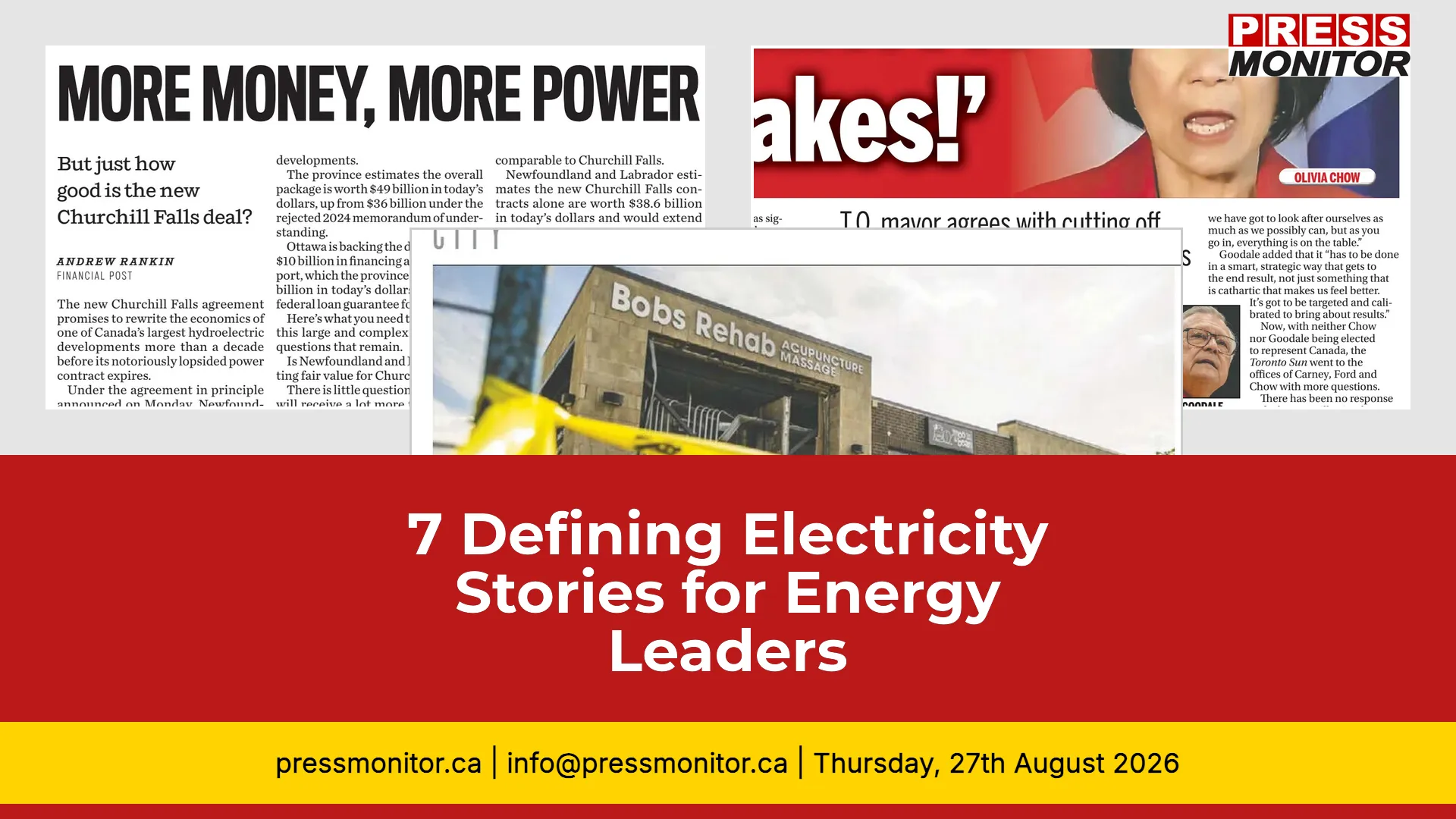
The Tribune (New Brunswick) reports that Newfoundland and Labrador secured a revised Churchill Falls hydroelectric deal worth C$49 billion in today’s dollars, accelerating new payments for power starting in 2027 as the existing contract expiries 2041. The province gains greater electricity control, export market advantages, and funding support from the federal government up to C$10 billion, valuing financial assistance at C$3.5 billion, including a federal-backed loan for Gull Island projects.
Why it matters: This revised hydroelectric deal unlocks new revenue and export capacity for Newfoundland and Labrador, reshaping Atlantic Canada's power dynamics.
Key detail: The $49 billion deal (in today's dollars) accelerates payments starting in 2027 and includes up to $10 billion in federal support, with a 2,700 MW Gull Island expansion on the horizon.
Source: The Tribune (New Brunswick) and The Chronicle Herald (provincial)
Next step: Energy buyers in Nova Scotia and beyond should watch for PPA opportunities from the expanded Gull Island output.
Question to consider: How will your organization factor in new Atlantic renewable supply?
2. Canada Becomes Net Importer of US Electricity — Tariff Threats Loom
Toronto Sun reports that Canadian officials have threatened to cut off electricity shipments to the United States as retaliation against Trump-like officials imposing tariffs. Sources include Toronto Mayor Meric Chow and former cabinet minister Ralph Goodale, who called it a 'warlike move' that Calgary and American trade relations. Goodale however emphasized strategic action: 'It’s got to be targeted and calibrated to bring about results.' The story highlights tensions over trade wars between the integrated economies with 10 times Canada's $23 billion and calls into question whether provocative measures will provoke Canada's lifeline President-elect Trudeau’s government from commenting yet.
Why it matters: After decades as a net exporter, Canada now runs a $110 million electricity deficit with the US, weakening the leverage of threats to cut off power.
Key detail: Ontario Premier Doug Ford and Toronto Mayor Olivia Chow have threatened to cut exports in response to US tariffs, but data shows Canada is no longer a critical supplier. Former minister Ralph Goodale called for "targeted and calibrated" action.
Source: Toronto Sun, syndicated across National Post, Calgary Herald, Vancouver Sun, Edmonton Journal
Next step: Decision-makers in energy policy should reassess cross-border grid reliability assumptions.
Question to consider: Is your organization prepared for a shift in Canada-US energy trade flows?
3. $1 Million Electrical Explosion in Kanata Highlights Infrastructure Risk
Ottawa Citizen reports that an electrical explosion at a commercial strip mall on Silver Seven Road caused approximately C$1 million in damage. The incident forced the closure of several businesses, including Moo & Bean Cafe, Bob's Rehab, and Strawberry Blonde Bakery, though no injuries were reported.
Why it matters: A transformer explosion at a Kanata strip mall caused $1 million in damage, closing multiple businesses. The incident underscores the fragility of urban electrical infrastructure.
Key detail: The blast on Silver Seven Road damaged Bob's Rehab, Moo & Bean Cafe, and Strawberry Blonde Bakery. No injuries were reported. Hydro Ottawa and Enbridge Gas isolated the site.
Source: Ottawa Citizen and Ottawa Sun
Next step: Municipalities and utility operators should review transformer maintenance and emergency response protocols.
Question to consider: Does your facility have a contingency plan for local grid failures?
4. Quebec's Long-Term Electricity Supply Under Debate
The Tribune (New Brunswick) reports that Quebec is securing a long-term source of relatively inexpensive, reliable electricity under the Churchill Falls agreement, despite alternatives like wind and solar being substantially more expensive. Hydro-Québec will remain the largest customer for the power produced by the existing and proposed developments.
Why it matters: Quebec is betting on Churchill Falls hydro as a low-cost, reliable baseload source, while wind and solar remain substantially more expensive.
Key detail: Hydro-Québec will remain the largest customer for power from the existing and proposed Churchill Falls developments, ensuring supply stability for the province.
Source: The Tribune (New Brunswick)
Next step: Industrial power users in Quebec should monitor Hydro-Québec's rate stability plans.
Question to consider: How do Quebec's long-term supply choices affect your energy procurement strategy?
5. NB Power at a Crossroads: Expert Panel Sees No Quick Fixes
The Tribune (new Brunswick) reports that New Brunswick is at an important moment as electricity demand grows and new opportunities emerge. Reliable electricity will play a critical role in supporting economic growth, attracting investment and helping communities thrive. A trio of energy experts reviewed NB Power and concluded that there are no quick fixes to its many problems.
Why it matters: Growing electricity demand and new opportunities in New Brunswick require major investment, but a trio of experts concluded NB Power faces deep structural challenges.
Key detail: The utility must balance reliability, economic growth, and community needs — with no easy solutions.
Source: The Tribune (New Brunswick)
Next step: Stakeholders should engage with the New Brunswick government on NB Power's investment roadmap.
Question to consider: What role will private capital play in NB Power's modernization?
6. Lori Clark Reappointed as NB Power CEO with Significant Pay Raise
The Globe And Mail (ottawa/quebec Edition) reports that today's KenKen solution is available.
Why it matters: Clark's reappointment through 2028, with remuneration rising to $623,653, signals the government's confidence in her leadership during a critical period.
Key detail: The Holt cabinet approved the reappointment in June, with a cost-of-living adjustment clause. Clark was first appointed in 2023 at $485,000.
Source: The Tribune (New Brunswick)
Next step: Industry observers should track Clark's performance against NB Power's turnaround targets.
Question to consider: How does CEO compensation tie to utility performance metrics in your province?
7. Ontario's AI Data Centre Playbook: Balancing Growth and Community Concerns
The Globe And Mail reports that Ontario just became the latest jurisdiction to take a hard look at AI data-centre development. The province’s new Data Centre Playbook seeks to offer a framework that can move such projects forward in a way that addresses the concerns of community groups, local municipalities and activists across the country.
Why it matters: Ontario's new Data Centre Playbook aims to provide a framework for AI data centre development that addresses grid capacity, water use, local jobs, and community backlash.
Key detail: The Globe and Mail reports that the province is the latest jurisdiction to grapple with data centre impacts, including power load and environmental sustainability.
Source: The Globe and Mail (Ottawa/Quebec Edition)
Next step: Energy planners and data centre developers should align with the playbook's metrics for grid and community benefit.
Question to consider: Is your organization prepared for the electricity demands of AI-driven data centres?
This press review is powered by Press Monitor — Canada's only dedicated print media intelligence service. For more context on any of these stories, reach out to your Press Monitor account team.