7 Essential First Nations & Indigenous Stories for Canadian Leaders


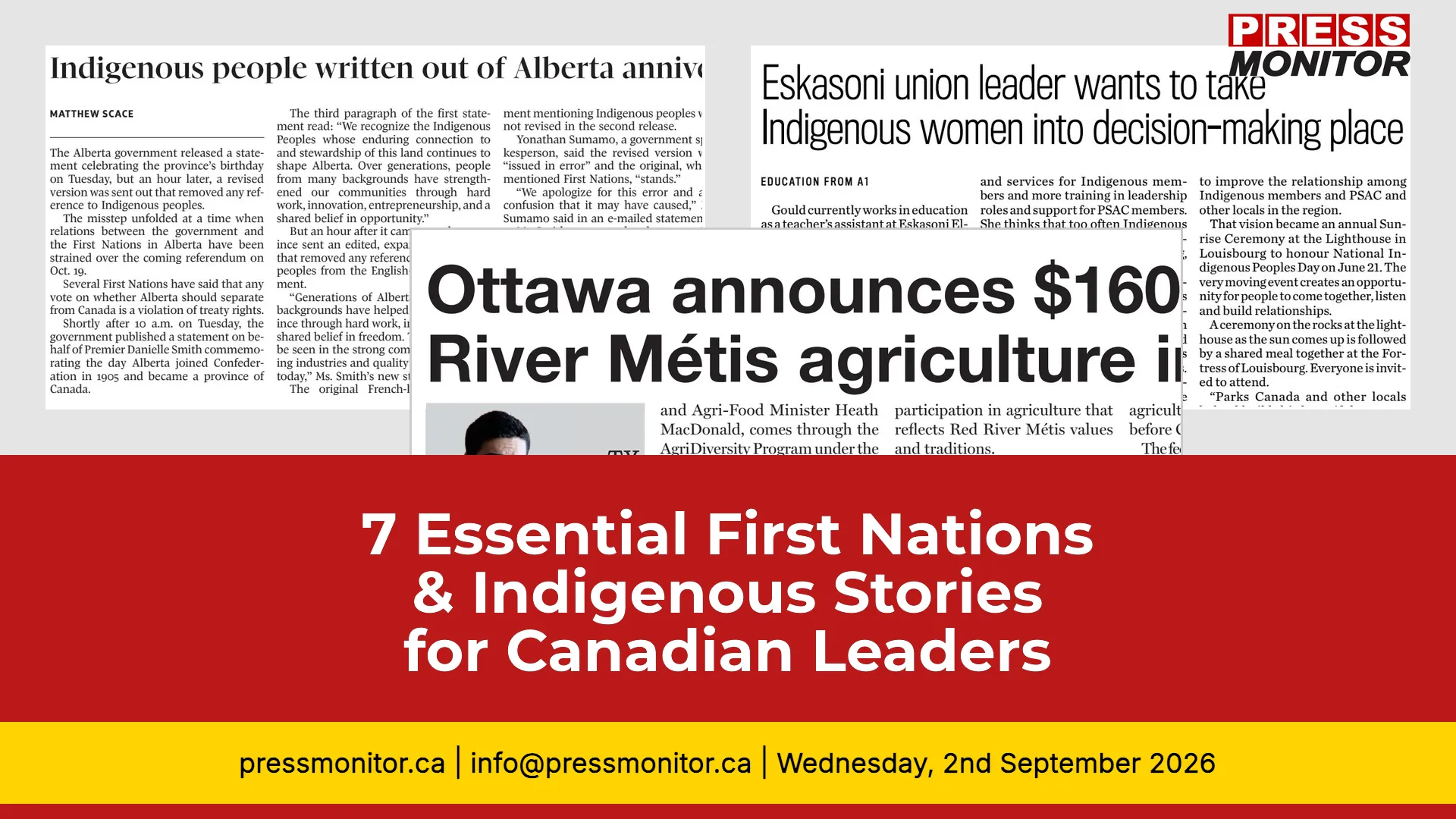
In today's press review, we bring you the most important news on First Nations and Indigenous affairs from Canadian print media. From Alberta's controversial statement to a historic union leadership win, these stories matter for anyone tracking reconciliation, governance, and community development. According to Press Monitor's tracking of Canadian publications, here are the stories you need to know.
1. Alberta erases Indigenous peoples from statement
The Globe and Mail reports that the Alberta government issued a statement on Tuesday marking the province's birthday, then sent a revised version an hour later that removed all references to Indigenous peoples. Government spokesperson Yonathan Sumamo called the edit an error and apologized, while Premier Danielle Smith blamed the public service for the glitch. Treaty 8 First Nations Grand Chief Trevor Mercredi called the change deeply troubling, noting it comes amid tensions over the October 19 referendum on Alberta's separation from Canada.
Why it matters: This incident highlights the fragility of Indigenous recognition in government communications and comes amid tensions over Alberta's separation referendum.
Key detail: The Alberta government issued a statement marking the province's birthday, then removed all Indigenous references an hour later. Premier Danielle Smith blamed the public service, while Treaty 8 First Nations Grand Chief Trevor Mercredi called it deeply troubling.
Source: The Globe and Mail
Next step: Monitor how Alberta addresses this misstep and the implications for the October 19 referendum.
2. First Mi'kmaq Woman in PSAC Leadership
Cape Breton Post reports that Terri Leigh Gould, a teacher's assistant at Eskasoni Elementary and Middle School, was elected in June as the Atlantic region's women's representative for the National Indigenous Peoples' Circle with the Public Service Alliance of Canada. She is the first Mi'kmaq woman from Unama'ki (Cape Breton) and Mi'kma'ki to hold the position, and she aims to bring the voices and lived experience of Indigenous women into spaces where decisions are made. Gould also plans to push for leadership training, stronger support for Indigenous members and continued work on reconciliation within the union.
Why it matters: Terri Leigh Gould's election as Atlantic region women's representative for the National Indigenous Peoples' Circle is a historic step for Indigenous representation in union leadership.
Key detail: Gould, a teacher's assistant from Eskasoni, is the first Mi'kmaq woman from Unama'ki to hold this position. She aims to bring Indigenous women's voices into decision-making spaces.
Source: Cape Breton Post
Next step: Watch for Gould's initiatives on leadership training and reconciliation within PSAC.
3. $160,545 for Red River Métis agriculture
Winnipeg Sun reports that the federal government is providing up to $160,545 to the Manitoba Métis Federation to identify the priorities and challenges facing Red River Métis producers and agriculture professionals. The funding was announced Monday by St. Boniface-St. Vital MP Ginette Lavack on behalf of Agriculture and Agri-Food Minister Heath MacDonald, and comes through the AgriDiversity Program under the Sustainable Canadian Agricultural Partnership. The MMF will host community meetings and surveys to develop reports guiding meaningful Red River Métis participation in the agricultural economy.
Why it matters: This federal investment supports Red River Métis producers and agriculture professionals, addressing priorities and challenges in the agricultural economy.
Key detail: The funding, announced by MP Ginette Lavack, comes through the AgriDiversity Program. The Manitoba Métis Federation will host community meetings and surveys.
Source: Winnipeg Sun
Next step: Track how this funding translates into concrete support for Métis farmers.
4. British Columbia's Regional Development Imperative
Times Colonist reports that Tamara Krawchenko, an associate professor of public administration at the University of Victoria, argues regional development matters more than ever for British Columbians facing trade conflicts, climate emergencies and affordability pressures. The commentary says resilience depends on building stronger communities and regional economies at home, with every resident, First Nation, business and local government acting as economic actors. Krawchenko urges people to move beyond the elbows up response to American trade threats and invest in local capacity, from community energy organizations to local food networks.
Why it matters: A commentary argues that regional development is crucial for BC's resilience amid trade conflicts and climate emergencies, with First Nations as key economic actors.
Key detail: Tamara Krawchenko of UVic urges moving beyond "elbows up" to invest in local capacity, including community energy and food networks.
Source: Times Colonist
Next step: Consider how regional development strategies can include Indigenous partnerships.
5. 50% of Towel Profits Donated
Times Colonist reports that Heirloom Linens will donate 50% of net profits from Zen Organic Towels sales to the Victoria Native Friendship Centre this September. The towels are made from 100% certified organic cotton with a 530 GSM rating. The donation is part of the Victoria Native Friendship Centre's Allies in Reconciliation campaign.
Why it matters: Heirloom Linens is donating half of Zen Organic Towels profits to the Victoria Native Friendship Centre, supporting reconciliation through commerce.
Key detail: The towels are 100% organic cotton, and the donation is part of the Allies in Reconciliation campaign.
Source: Times Colonist
Next step: Support businesses that give back to Indigenous communities.
6. Enbridge Line 5 sparks U.S. debate
Regina Leader-Post reports that a parked semi-truck rolled into an excavation site and struck an exposed section of Enbridge Line 5 near the Wisconsin-Michigan border, causing a natural gas leak that was quickly isolated with no injuries. The incident has intensified the political fight over the 1,038-kilometre pipeline, which carries up to 540,000 barrels per day of Alberta crude and natural gas liquids to Sarnia, Ont. Michigan Governor Gretchen Whitmer is pressing to remove an underwater section of the line through the Straits of Mackinac, and the pipeline's fate could hinge on November's midterm elections.
Why it matters: The pipeline's fate affects energy security and Indigenous land rights, with Michigan Governor Whitmer pushing to remove the underwater section.
Key detail: A truck struck an exposed section, causing a gas leak. The pipeline carries 540,000 barrels per day, and its future may hinge on midterm elections.
Source: Regina Leader-Post
Next step: Monitor the political and legal developments around Line 5.
7. 13 arrests in Abitibi-Témiscamingue
Le Journal de Montréal reports that thirteen people were arrested over three days last weekend in Abitibi-Témiscamingue in connection with organized crime and drug trafficking. Five arrests in Val-d'Or involved cocaine and a handgun, while two men in Amos were caught with about 1,500 methamphetamine pills. Quebec announced a C$2 million investment in July to improve co-operation between the Sûreté du Québec and police in eight Indigenous communities.
Why it matters: The arrests highlight organized crime and drug trafficking in the region, with Quebec investing $2M to improve police cooperation in eight Indigenous communities.
Key detail: Thirteen arrests over three days, including cocaine and methamphetamine seizures. The investment aims to enhance safety in Indigenous communities.
Source: Le Journal de Montréal
Next step: Follow the impact of this investment on community safety.
These stories underscore the importance of media monitoring for staying ahead of developments in Indigenous affairs. Which one will you track today? Let us know in the comments.