7 Essential Narcotics & Drugs Stories for Canadian Decision-Makers


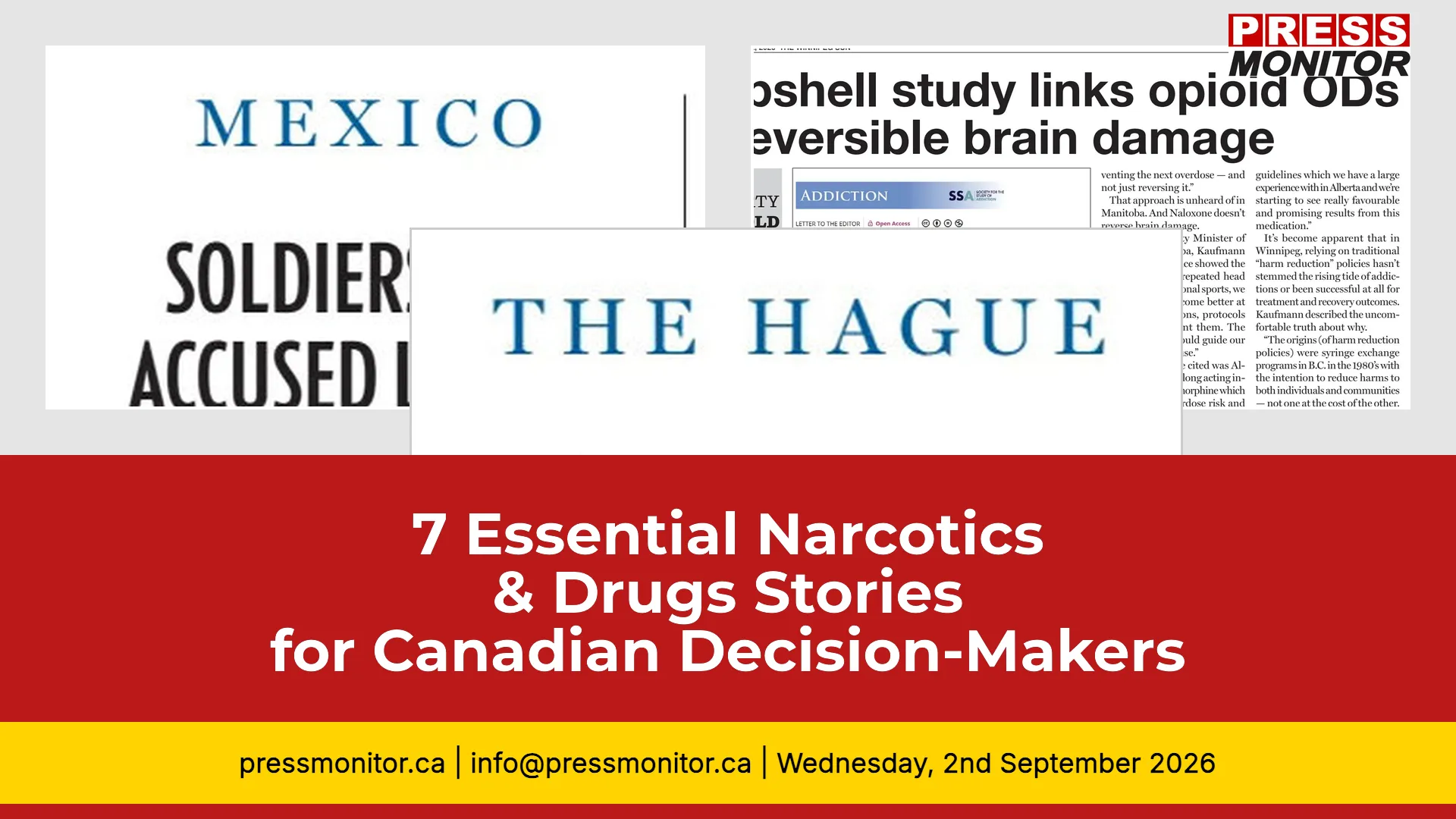
In today's fast-moving media landscape, staying ahead of narcotics and drug-related developments is critical for public safety, policy, and business. According to Press Monitor's tracking of Canadian publications, these seven stories capture the most significant shifts in drug enforcement, health policy, and legal precedent. From cartel takedowns to overdose research, here's your essential press review for September 2, 2026.
1. Cartel Leader Killed in Mexico
Edmonton Journal reports that Mexican soldiers killed Luis Enrique Barragan, an accused drug cartel leader who had a US$3 million American bounty on his head, in a clash in Tocumbo in western Michoacan state. The 39-year-old was a leader of the Cartel de Los Reyes, a faction of the Carteles Unidos coalition that the United States has classified as a foreign terrorist group, and ran an extortion ring targeting avocado farmers in Michoacan, according to Security Minister Omar Garcia Harfuch.
Why it matters: The death of a high-profile cartel leader with a US$3 million bounty signals a major escalation in the drug war and has implications for international security and avocado supply chains.
Key detail: Mexican soldiers killed Luis Enrique Barragan, leader of Cartel de Los Reyes, in Tocumbo, Michoacan. He also ran an extortion ring targeting avocado farmers.
Source: Edmonton Journal, Calgary Herald (cross-source coverage)
Next step: Monitor how this affects avocado imports and cartel succession.
2. 6% Brain Injury Risk After Overdose
The Winnipeg Sun reports that opioid overdoses can cause immediate brain damage, with data from British Columbia showing adults face a 6% risk of diagnosed brain injury within one year of a first overdose, rising to 10% for those under 19. A letter in the journal Addiction co-authored by Dr. Nathaniel Day, Canadian Centre of Recovery Excellence CEO Kym Kaufmann, and BC Chief Scientific Advisor Dr. Daniel Vigo argues that current North American opioid treatment guidelines are silent on acquired brain injury. Columnist Marty Gold contrasts Alberta's prevention-focused approach with Manitoba's harm reduction policies, urging action from minister Asagwara.
Why it matters: New research challenges harm reduction policies by highlighting the immediate brain damage from opioid overdoses, especially in teens.
Key detail: Adults face a 6% risk of diagnosed brain injury within a year of a first overdose, rising to 10% for those under 19. The study was published in the journal Addiction.
Source: Winnipeg Sun
Next step: Review your organization's overdose response protocols and consider brain injury screening.
3. Dutch Police Arrest 34 After Deadly Shootout
Calgary Herald reports that Dutch authorities arrested 34 people, including French, Belgian and Algerian nationals, following a pre-dawn shootout in Overasselt, a town in the eastern Netherlands near the German border. The shootout, reportedly linked to a notorious drug lord, claimed one life. Police urged residents to stay indoors with doors and windows shut in case further suspects remained at large.
Why it matters: A cross-border drug operation led to a deadly shootout and mass arrests, highlighting the international reach of drug trafficking.
Key detail: Dutch authorities arrested 34 people, including French, Belgian, and Algerian nationals, after a pre-dawn shootout in Overasselt linked to a notorious drug lord.
Source: Calgary Herald, Edmonton Journal
Next step: Assess supply chain risks if your business operates in Europe.
4. Ontario Court Upholds Trucker Firing
National Post reports that an Ontario Superior Court has upheld the for-cause dismissal of a long-haul truck driver who failed random drug tests twice while working cross-border routes. The driver alleged discrimination based on a substance use disorder, but the court found he never disclosed a disability or requested accommodation, and the employer had clear policies, written acknowledgments, and a return-to-work program. The ruling confirms that accommodation is a two-way street and employees cannot invoke a disability retroactively to escape workplace consequences.
Why it matters: This ruling clarifies that substance use disorder is not a retroactive shield for workplace misconduct, impacting HR policies across Canada.
Key detail: The court upheld the for-cause dismissal of a truck driver who failed random drug tests twice, finding he never disclosed a disability or sought accommodation.
Source: National Post, Financial Post Magazine
Next step: Ensure your drug testing policies are clear and accommodation processes are documented.
5. Drug Bust in Swan River
The Winnipeg Sun reports that the Swan River RCMP General Investigation Section seized cocaine, cash, and drug paraphernalia during a drug trafficking investigation in Swan River.
Why it matters: Local enforcement actions reflect the ongoing battle against drug trafficking in rural Canada.
Key detail: RCMP seized cocaine, cash, and paraphernalia during a trafficking investigation in Swan River.
Source: Winnipeg Sun
Next step: Stay informed on local enforcement trends to anticipate community impacts.
6. Street Health Strained by Site Closures
Toronto Star reports that a long-time Seaton Street resident is warning that the closure of downtown safe-injection sites has pushed open hard drug use to alarming levels around Street Health at 338 Dundas Street East. Peter Bregg says several people were overtaken by their drug use last year and conditions have become truly distressing this summer as winter approaches. With three condominium buildings and a student highrise set to bring almost a thousand additional residents within a block of the clinic by the end of next year, he is calling for concrete action and measurable results to protect everyone.
Why it matters: The closure of safe-injection sites is pushing drug use into public spaces, raising safety concerns for residents and businesses.
Key detail: A long-time resident warns that conditions around Street Health at 338 Dundas Street East have become alarming, with new developments bringing nearly a thousand residents nearby.
Source: Toronto Star
Next step: Engage with municipal planning to address community safety.
7. Edmonton's Homeless Turn to Meth
Edmonton Journal reports that some people experiencing homelessness in Edmonton rely on methamphetamine to stay awake at night to protect their belongings or to prevent sexual assault while living on the street. Ghosh said meth psychosis is a known side effect of the drug, and many people living rough also suffer from traumatic brain injuries that leave them without impulse control. He argued society applies a troubling double standard, keeping housed Canadians with dementia or brain injuries safe in supported care, while leaving homeless people with similar impairments to fend for themselves.
Why it matters: Methamphetamine use among homeless populations is a growing public health crisis with complex social implications.
Key detail: Some homeless individuals use meth to stay awake and protect themselves, but meth psychosis and traumatic brain injuries are common.
Source: Edmonton Journal
Next step: Consider how your organization can support harm reduction and mental health services.
These stories underscore the importance of comprehensive media intelligence for anyone involved in public safety, health, or policy. By leveraging print media monitoring, you can stay ahead of these developments. What trends are you tracking? Share your thoughts below.