7 Essential Trade Stories for Canadian Business Leaders


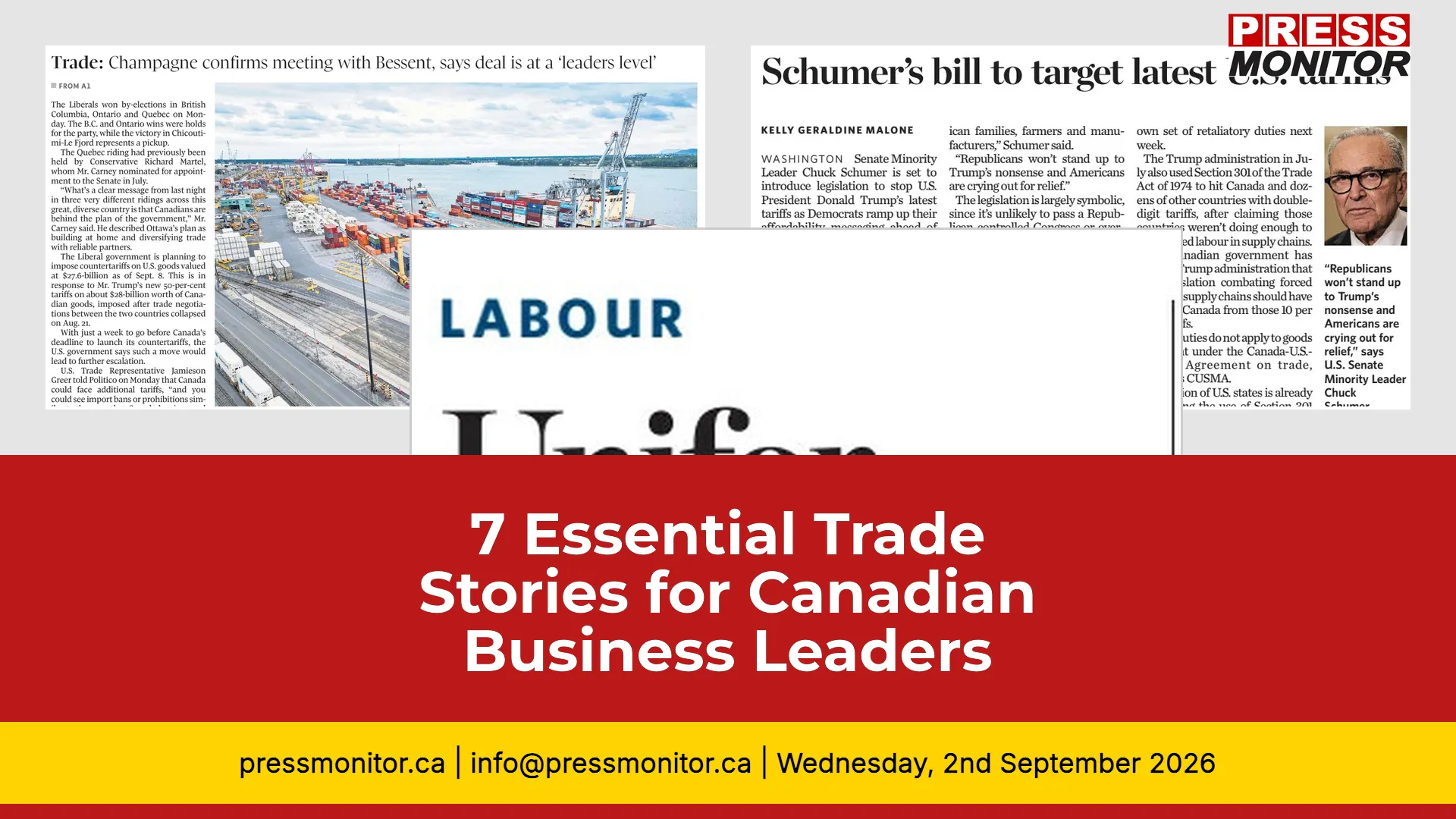
According to Press Monitor's print media monitoring of Canadian publications, the trade landscape has shifted dramatically. Here are the 7 essential stories shaping Canada-US trade relations this week.
1. Carney Open to Trade Talks
The Globe And Mail reports that Prime Minister Mark Carney says Canada is willing to return to the trade negotiating table once the United States stops mocking Canada and gets serious. His comments came after United States President Donald Trump imposed 50 per cent tariffs on about C$28 billion of Canadian goods and as Ottawa prepares countertariffs on C$27.6 billion of American goods effective September 8. United States Trade Representative Jamieson Greer warned the countertariffs could trigger further escalation, including import bans, while Finance Minister Francois-Philippe Champagne met United States Treasury Secretary Scott Bessent at a G20 gathering in Asheville, North Carolina.
Why it matters: Prime Minister Mark Carney signals Canada's willingness to return to negotiations, but only if the US stops mocking Canada.
Key detail: US imposed 50% tariffs on C$28 billion of Canadian goods; Ottawa prepares countertariffs on C$27.6 billion effective Sept. 8.
Source: The Globe and Mail
Next step: Monitor for any shift in US tone before the Sept. 8 countertariffs take effect.
2. Schumer Bill Targets Trump Tariffs
The Hamilton Spectator reports that US Senate Minority Leader Chuck Schumer is set to introduce legislation to stop President Donald Trump's latest tariffs on Canadian goods and duties tied to forced labour in supply chains. The bill is largely symbolic, as it is unlikely to pass the Republican-controlled Congress or survive Trump's veto. Trump imposed 50 per cent tariffs on a range of Canadian goods after trade talks broke down, and Canada is set to respond with retaliatory duties next week.
Why it matters: Senate Minority Leader Chuck Schumer introduces legislation to block tariffs, giving Democrats an affordability message ahead of midterms.
Key detail: Bill is largely symbolic but signals political pressure.
Source: The Hamilton Spectator
Next step: Watch for midterm election impact on trade policy.
3. Unifor Opens Stellantis Contract Talks
The Toronto Star reports that Unifor began contract talks with Stellantis on Tuesday, the final round of its bargaining with the Detroit Three automakers. The union is pushing to maintain Canadian production as Stellantis weighs the closure and sale of its Brampton assembly plant, idled since 2023 after Jeep Compass output moved to the United States. Unifor president Lana Payne and Stellantis Canada chief executive Trevor Longley called the talks critical, amid U.S. tariffs and a threat by Donald Trump to raise levies on Canadian vehicles and parts to 50 per cent.
Why it matters: Union pushes to maintain Canadian production as Stellantis weighs Brampton plant closure.
Key detail: Talks critical amid US tariffs and threat of 50% levies on vehicles.
Source: Toronto Star
Next step: Track bargaining outcomes for auto sector stability.
4. 0.5-Point Hit to Canada's GDP
The Globe And Mail reports that economists expect Canada's latest countertariffs to shave up to 0.5 percentage points off GDP growth over the next year, after the economy posted its fastest expansion since 2023 with 3.3 per cent annualized growth between March and June. Economist Mr. Jaffery said firms could pass on about three-quarters of the higher tariff costs to consumers within 18 months, though they may absorb more if the trade war escalates and consumers pull back on spending. A weaker Canadian dollar, which has slipped to around 72 US cents since the breakdown of trade talks, could further drive up the price of US imports.
Why it matters: Economists expect countertariffs to shave up to 0.5 percentage points off GDP growth.
Key detail: Firms may pass on three-quarters of tariff costs to consumers within 18 months.
Source: The Globe and Mail
Next step: Assess impact on your supply chain and pricing.
5. Canada's 50% Tariffs: Muted Inflation Impact
The Globe And Mail (Ottawa/Quebec Edition) reports that Canada's retaliatory tariffs on C$27.6-billion of United States imports, ranging from 15 to 50 per cent and set to take effect Sept. 8, are expected to have only a muted effect on consumer prices. KPMG Canada chief economist Ali Jaffery predicts the countertariffs will lift overall prices by 0.2 to 0.3 per cent within a year, while directly targeted goods such as appliances and cosmetics could see price jumps of 1 to 15 per cent over six months. The measures respond to U.S. tariffs on an equal amount of Canadian goods that took effect Aug. 22.
Why it matters: Countertariffs expected to lift prices by only 0.2-0.3% overall, but targeted goods could jump 1-15%.
Key detail: Appliances and cosmetics see biggest price increases.
Source: The Globe and Mail
Next step: Plan for selective price adjustments.
6. Trump's Trade War Targets Canada
The Toronto Star reports that U.S. President Donald Trump's escalating trade war against Canada is part of a deliberate plan to absorb the country into the United States, hitting industries from Ontario steel and autos to British Columbia forest products and Quebec textiles. The August 22 tariffs also target hundreds of small and medium-sized businesses, while further escalation could affect Canadian inflation, which remains above the Bank of Canada's two per cent target. The opinion piece notes the tariffs might not survive U.S. court challenges as Trump faces midterm elections in November.
Why it matters: Opinion piece argues tariffs are part of a plan to absorb Canada, hitting steel, autos, forest products, and textiles.
Key detail: Tariffs may not survive court challenges as midterms approach.
Source: Toronto Star
Next step: Consider legal and political avenues for relief.
7. Canada-US Tariffs Hit 5% of Trade
The National Post reports that Canada-US trade talks ended without a deal on August 21, triggering U.S. Section 338 tariffs on a range of Canadian products and impending retaliatory tariffs on U.S. products. The tariffs affect about US$20 billion of the US$450 billion in goods and services Canada exports to the United States each year, roughly five per cent of total trade. Including the Section 232 metal tariffs, roughly 10 to 15 per cent of Canadian exports are impacted, while overall trade between the two countries remains 95 per cent balanced.
Why it matters: Tariffs affect about US$20 billion of US$450 billion in exports, roughly 5% of total trade.
Key detail: Including Section 232 metal tariffs, 10-15% of exports impacted.
Source: National Post
Next step: Evaluate your exposure to affected sectors.
These stories underscore the importance of staying ahead with media monitoring. What's your take on the trade talks? Share your thoughts below.