7 Key Tax Policy Stories for Canadian Finance Leaders


Canada's tax landscape is shifting rapidly. From high-profile tax battles with the CRA to calls for comprehensive reform, the print media is buzzing with stories that directly impact finance leaders. According to Press Monitor's tracking of Canadian publications, here are this week's most critical tax policy stories you need to know.
1. John Tavares' Tax Battle with CRA
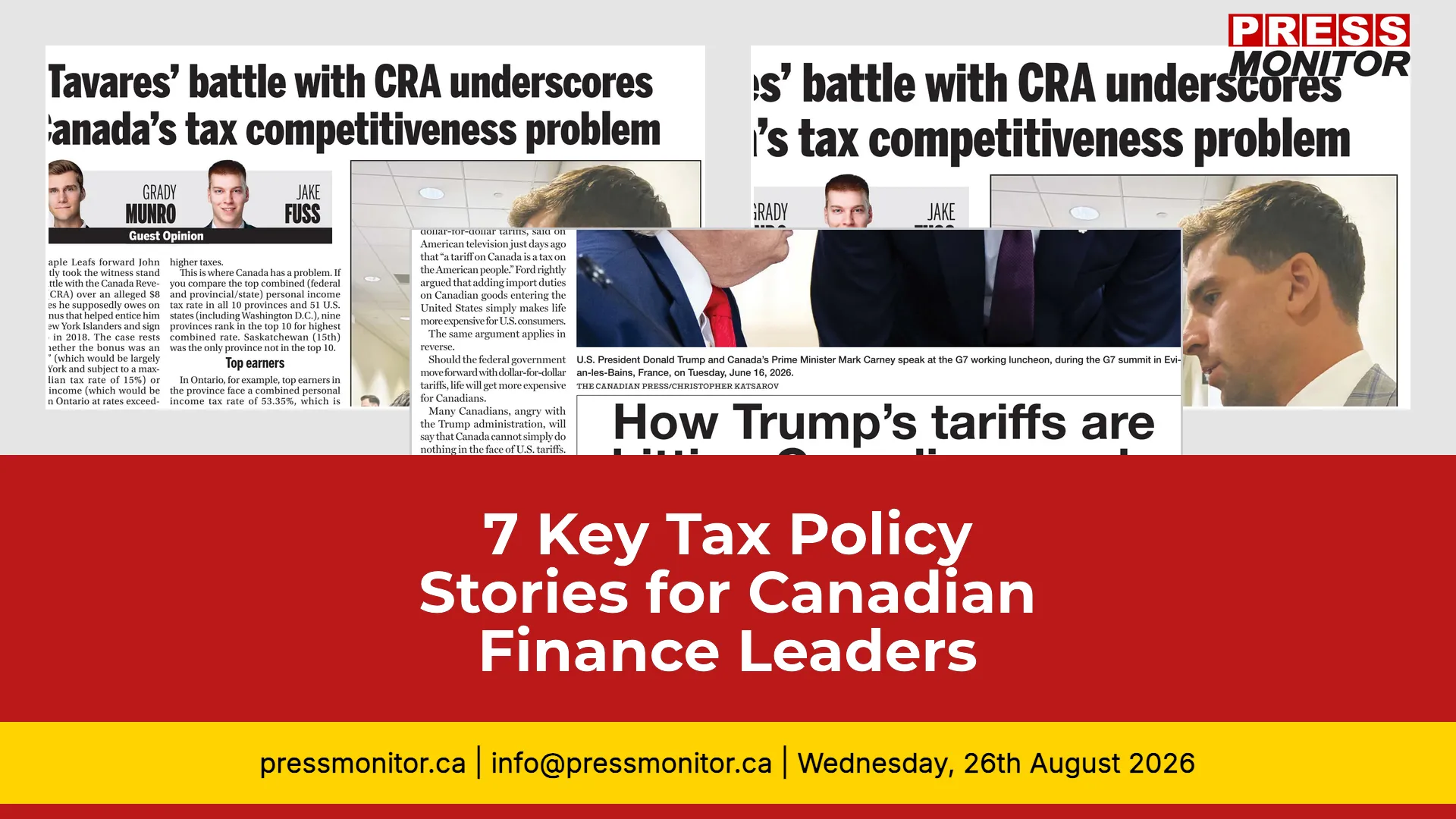
Ottawa Sun reports that Leafs forward John Tavares is embroiled in a tax battle with the Canada Revenue Agency (CRA) over an alleged $8 million bonus he supposedly owes. This case underscores a broader issue in Canada that affects multi-millionaire athletes and performers: the country’s high tax rates make it difficult to attract and retain top talent. Grady Munro and Alex Whalen argue that Canada’s high tax rates hinder the country’s ability to compete globally for high-skilled individuals.
Why it matters: Highlights Canada's tax competitiveness issue for high-skilled individuals.
Key detail: $8 million bonus dispute with the CRA.
Source: Ottawa Sun, Toronto Sun (tracked by Press Monitor's print media monitoring).
Next step: Consider how provincial tax rates affect talent retention.
2. Canada's Top Tax Rates Hit 53.35%
Based on the Fraser Institute’s analysis, nine Canadian provinces rank in the top 10 for the highest combined income tax rates alongside U.S. states. Ontario tops this list with a 53.35% tax rate for top earners—outpacing all U.S. states—while most provinces exceed comparable U.S. sales tax levels. The report asserts this putatively burdensagneous tax burden distorts Canada's economy by deterring talent attraction, retention, and productivity.
Why it matters: Shows Canada's disadvantage in attracting top talent compared to US states.
Key detail: Ontario tops at 53.35%, most provinces exceed US sales tax.
Source: Fraser Institute analysis, Calgary Sun, Edmonton Sun.
Next step: Evaluate your company's compensation strategy in light of high tax rates.
3. Government Urges Tax Reduction Over Subsidies Amid Tariffs
"Selon The Canadian Press, le gouvernement du Canada devrait se concentrer sur la réduction des impôts plutôt que sur les subventions gouvernementales pour stimuler l’économie, face aux tarifs douaniers imposés par les États-Unis. Le gouvernement Carney devrait examiner la possibilité de réduire le taux d’imposition des sociétés et de supprimer les barrières commerciales internes pour améliorer la compétitivité canadienne."
Why it matters: Shifts in government policy approach to US tariffs.
Key detail: Carney government considering corporate tax rate reduction and internal trade barriers removal.
Source: Winnipeg Sun.
Next step: Monitor federal budget announcements for potential tax relief.
4. Canada's Tax System Needs Full Reform, Not Patchwork
According to a report in the National Post, Canada’s tax system is in a state of disrepair, described as a ‘patchwork mess’ that’s almost impossible to navigate. The government’s focus on superficial changes, such as consultations and bite-sized legislation, is a short-sighted approach that fails to address the underlying structural issues. The article argues that a comprehensive overhaul, similar to those undertaken in the 1980s, is urgently needed to create a more efficient and transparent tax system, rather than relying on temporary patches.
Why it matters: Systemic issues require comprehensive overhaul.
Key detail: Current system described as 'patchwork mess' almost impossible to navigate.
Source: National Post.
Next step: Engage with policy consultations to push for structural reforms.
5. Corporate Tax Patchwork Needs Full Renovation
Financial Post reports that Canada’s tax system is in dire need of a full renovation instead of just patching it up, similar to how Kim and his wife opted for a full rebuild of their house instead of adding more layers of patchwork.
Why it matters: Calls for a complete rebuild of corporate tax system.
Key detail: Kim Moody, FCPA, TEP, compares to full house renovation.
Source: Financial Post.
Next step: Review your corporate tax strategy for potential changes.
6. Nova Scotia's Need for Larger Tax Base
The Chronicle Herald reports that Nova Scotia has broken with demographic fatalism after years of population growth and net in-migration. However, the province faces challenges such as strained health care, roads, and housing due to recent growth. To fund essential services, Nova Scotia needs a larger private tax base instead of deeper debt or a larger state, while investing in productivity and wealth creation.
Why it matters: Provincial growth strains infrastructure, requiring larger private tax base.
Key detail: Nova Scotia needs private sector growth to fund services without deeper debt.
Source: Chronicle Herald.
Next step: Consider expansion opportunities in growing provinces.
7. Federal Gas Tax Hike Set for Sept 8
The Canadian Taxpayers Federation reports that the federal government plans to hike the gas tax on Sept. 8, despite opposition from 64 per cent of Atlantic Canadians. Nova Scotia drivers currently pay 26 per cent of the price at the pumps in taxes.
Why it matters: Direct impact on cost of living and business transportation costs.
Key detail: 64% of Atlantic Canadians oppose hike; Nova Scotia drivers pay 26% tax at pumps.
Source: Cape Breton Post.
Next step: Prepare for increased fuel costs and adjust budgets.
Stay ahead of these changes. Press Monitor's media monitoring ensures you never miss a critical tax policy development. Which of these stories will impact your organization most? Let us know in the comments.