7 Pivotal Elections & Campaigns Stories for Political Leaders


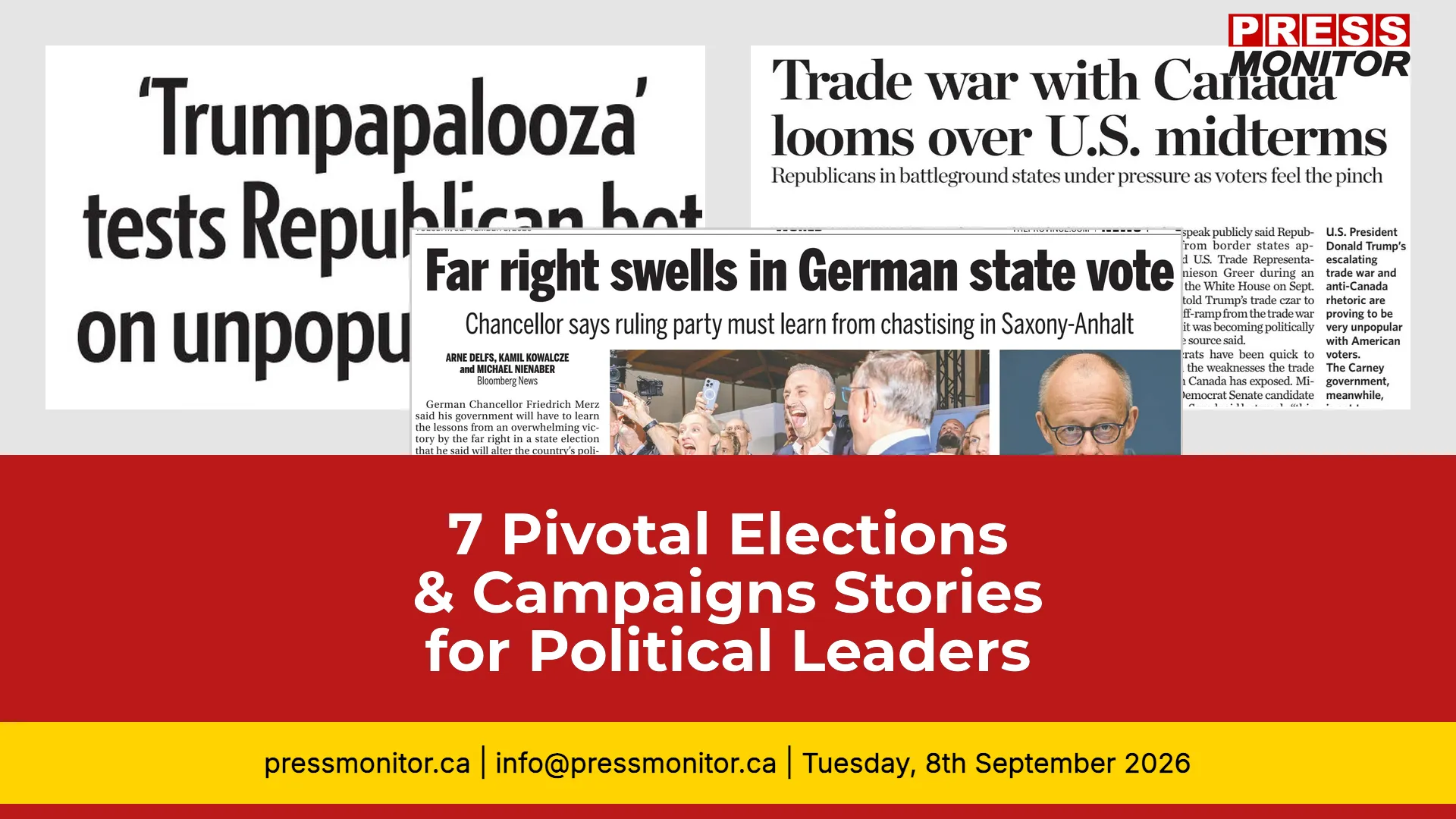
Elections & Campaigns dominate today's headlines as global voters weigh economic policy, trade disputes, and democratic integrity. According to Press Monitor's tracking of Canadian publications, print media remains the definitive source for editorial-vetted insights on ballot outcomes and political strategy. Below is your essential press review of the day's most consequential developments.
1. Donald Trump Heads Dallas GOP Convention
Edmonton Journal reports that Republican leaders are hosting a two-day convention in Dallas, Texas, this week to rally voters behind Donald Trump amid grim midterm election forecasts. House Speaker Mike Johnson and other organizers hope to tie the upcoming November elections to President Donald Trumps administration record, despite concerns over his low approval ratings and reluctance from many vulnerable candidates to attend. The event also serves as a major fundraising opportunity, though scheduling conflicts with the National Football League season and internal party divisions pose significant risks to the strategy.
Why it matters: The Republican Party is attempting to unify its base ahead of November, despite internal fractures and declining approval ratings.
Key detail: House Speaker Mike Johnson and VP JD Vance will rally supporters at the American Airlines Center, leveraging the event for both voter mobilization and critical fundraising amid tight congressional forecasts.
Source: Edmonton Journal
Next step: Track how vulnerable lawmakers navigate the scheduling conflicts with the NFL season and whether the convention shifts early polling data.
2. 50% Tariffs Threaten Midterms
The Hamilton Spectator reports that President Donald Trump’s 50 percent tariffs on Canadian goods are pressuring Republican candidates in battleground states like Maine, Alaska, Iowa, Michigan and Ohio, with Senator Susan Collins of Maine warning that the tariffs hurt her seat. Polls show most Americans reject the tariff policy and the renaming of Lake Ontario, giving Democrats an opening amid the 2026 midterm election.
Why it matters: Escalating trade tensions are directly impacting re-election prospects for Republican senators in border and manufacturing states.
Key detail: Polls show majority disapproval of the tariff policy and the Lake Ontario renaming initiative, giving Democrats a strategic opening in Maine, Michigan, Ohio, and Alaska.
Source: Hamilton Spectator
Next step: Monitor state-level campaign messaging as candidates distance themselves from federal trade rhetoric.
3. AfD Wins 44% in Saxony-Anhalt Vote
The Province reports that the far-right Alternative for Germany party secured its best result with 44 percent of the vote in a state election in Saxony-Anhalt, Germany on Sunday. Chancellor Friedrich Merz said his Christian Democrat party must learn from the loss, while the anti-immigration party came three seats short of an outright majority. Merz remains committed to his reform agenda despite the weak performance.
Why it matters: A historic surge by the far-right Alternative for Germany party signals shifting voter sentiment across Europe and tests mainstream coalition building.
Key detail: Chancellor Friedrich Merz acknowledged the setback while ruling out formal alliances with anti-immigration leaders, emphasizing a continued focus on Western values and energy reform.
Source: The Province
Next step: Watch for ripple effects in neighboring EU elections and domestic policy adjustments.
4. Van Praagh Warns Trump To Steal Midterms
The Globe And Mail reports that Peter Van Praagh, head of the Halifax International Security Forum, warned that U.S. President Donald Trump is preparing to steal the 2026 midterm elections. Van Praagh said warning signs have been clear and pointed to Trump placing supporters in charge of key agencies and potential use of Immigration and Customs Enforcement officers at polling stations. He urged Americans to vote in overwhelming numbers to make any plan to overturn results more difficult.
Why it matters: Security experts are raising alarms about potential institutional interference and the deployment of federal agencies at polling stations.
Key detail: Peter Van Praagh of the Halifax International Security Forum urged overwhelming voter turnout to safeguard electoral integrity against coordinated disruption attempts.
Source: The Globe And Mail
Next step: Track legislative responses and state-level election security funding allocations.
5. UCP Video Sparks NDP Complaint
Edmonton Journal reports that Alberta's New Democratic Party has filed a complaint with Elections Alberta over a United Conservative Party campaign video for the Calgary-Shaw byelection that used footage of the Evanston Heights School before it opened to the public. NDP director Heather Wilson argued the footage constitutes government resources used for campaign purposes, which is prohibited by the Election Finances and Contributions Disclosure Act. United Conservative Party communications director Dave Prisco countered that the NDP hired an American ad agency for their own campaign ads.
Why it matters: Provincial campaign finance laws are under scrutiny as opposition parties challenge the use of government resources in digital advertising.
Key detail: Elections Alberta is reviewing allegations that the United Conservative Party utilized footage of unopened public infrastructure, violating the Election Finances and Contributions Disclosure Act.
Source: Edmonton Journal
Next step: Follow the regulatory investigation outcome and its precedent for future provincial races.
6. Ottawa Accuses Quebec of Infiltration
Le Journal de Montreal reports that Ottawa has long been involved in Quebec elections, with accusations of federal interference dating back to the nineteen ninety-five referendum. Paul St-Pierre Plamondon and others claim evidence of covert operations designed to influence vote outcomes, citing incidents such as the nineteen ninety-seven Parti Québécois campaign and other alleged illicit tactics. The article details claims of mail distribution, financial transfers, and surveillance against the Parti Québécois.
Why it matters: Historical tensions resurface as federal officials allege covert operations designed to influence provincial vote outcomes and referendum campaigns.
Key detail: Claims cite historical mail distribution, financial transfers, and surveillance targeting the Parti Québécois, reigniting debates over federal neutrality in regional politics.
Source: Le Journal de Montreal
Next step: Monitor intergovernmental communications and potential policy reforms regarding election oversight.
7. Beattie Wins Hamilton East—Stoney Creek Byelection
The Hamilton Spectator reports that Jeff Beattie won the Hamilton East—Stoney Creek byelection on Thursday with 39 per cent of the votes cast. The Progressive Conservative candidate prevailed despite most voters not choosing him. Catherine Schuler of Ancaster warns that opposition parties must unite to defeat Doug Ford's government.
Why it matters: Local municipal and provincial dynamics continue to shape broader electoral strategies ahead of the next general election cycle.
Key detail: Progressive Conservative Jeff Beattie secured 39 percent of the vote, prompting opposition calls for unified campaigning to challenge the current provincial administration.
Source: The Hamilton Spectator
Next step: Analyze turnout patterns and demographic shifts in Southern Ontario ridings.
These developments highlight why print media monitoring remains indispensable for executives navigating political risk. Which campaign shift will reshape your sector's regulatory landscape next quarter?