7 Pivotal Geopolitical Stories for Canadian Executives


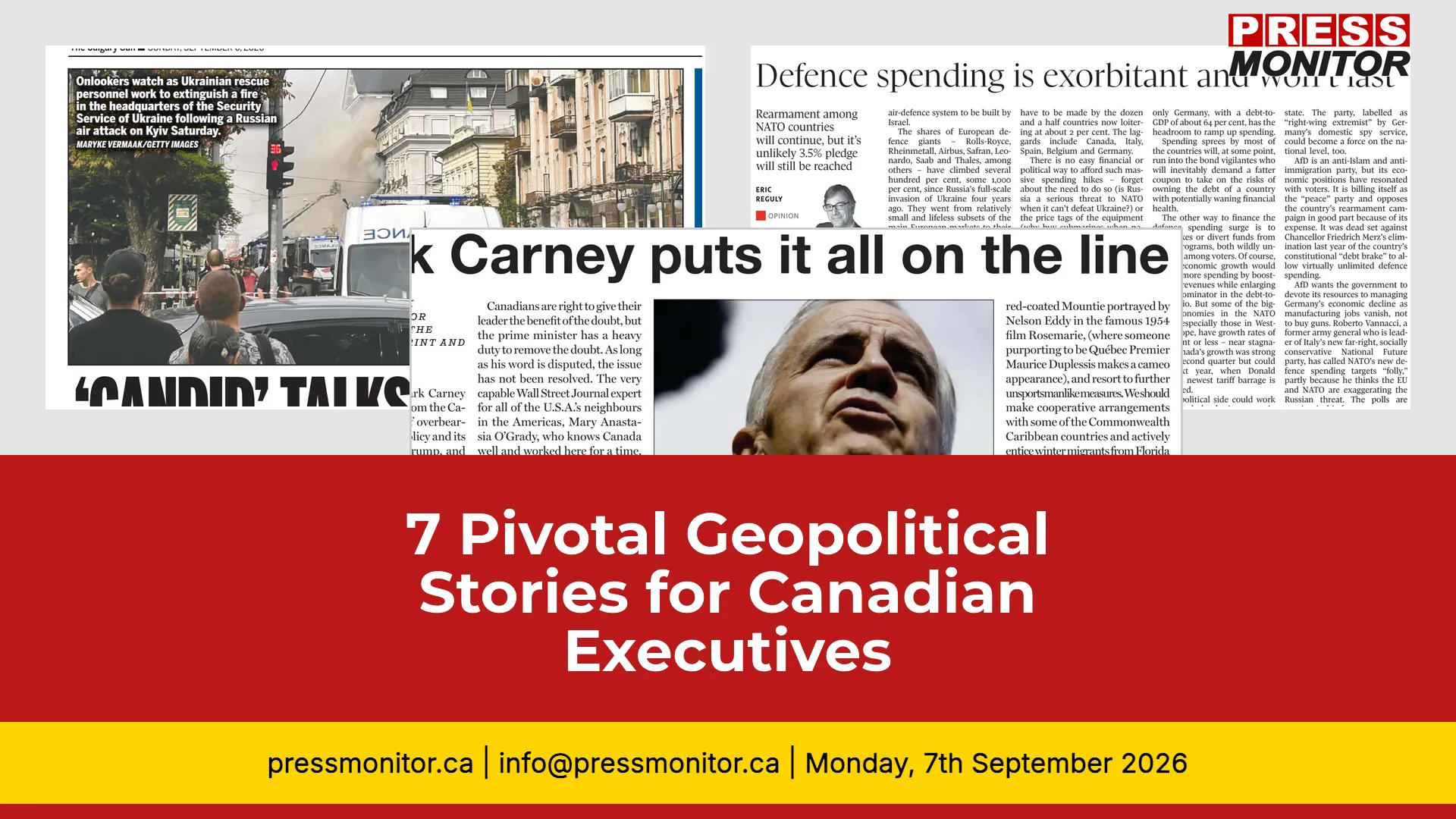
Navigating today’s shifting global landscape requires sharp media monitoring to separate diplomatic signals from noise. This press review distills seven critical developments shaping trade, security, and diplomacy for Canadian stakeholders. Our media intelligence team tracked these stories across national and regional print outlets to deliver actionable insights.
1. US Envoys Meet Putin in Moscow
Calgary Sun reports that U.S. envoys Steve Witkoff and Jared Kushner met with Russian President Vladimir Putin in Moscow on Saturday in a visit aimed at reviving peace talks with Ukraine after nearly eight months of deep freeze. The talks lasted more than three hours and ended close to midnight, described by Putin's foreign policy aide Yuri Ushakov as substantive, constructive and extremely candid. Kremlin spokesman Dmitry Peskov said Putin had agreed to halt strikes on Kyiv starting from midnight Saturday in relation to the negotiations, though Putin has previously vowed to continue hitting Ukraine.
Why it matters: High-level diplomatic engagement could reset stalled peace negotiations, directly impacting global energy markets and allied security frameworks.
Key detail: Talks lasted over three hours, with Kremlin aides describing them as substantive and candid. A temporary halt on Kyiv strikes was announced alongside the meetings.
Source: Calgary Sun
Next step: Track follow-up envoy movements to Kyiv for alignment on territorial demands.
2. NATO Defence Spending Unlikely to Hit 3.5%
The Globe And Mail reports that NATO countries in Europe are increasing weapons purchases, but the 3.5% GDP spending pledge is unlikely to be reached due to high debt loads and political opposition. Canada, Italy, Spain, Belgium, and Germany are lagging behind with spending near 2% of GDP, while debt-to-GDP ratios in Greece and Italy reach about 140% and 116% in France. Political movements like Germany's Alternative for Germany party oppose the rearmament campaign, and investors are warned that the spending rally may not last.
Why it matters: European rearmament targets face fiscal headwinds, affecting defense contractor pipelines and allied burden-sharing expectations.
Key detail: Debt-to-GDP ratios in Greece and Italy exceed 140%, while Canada, Germany, and Spain hover near 2%. Political opposition is rising against accelerated spending.
Source: The Globe And Mail
Next step: Monitor parliamentary debates in key NATO capitals for budget reallocations.
3. Carney Tariff Dispute With Trump
The Winnipeg Sun reports that Prime Minister Mark Carney ended trade negotiations with the United States government on September 1, 2026, and plans retaliatory sanctions on politically vulnerable Republican areas before the November midterm elections. Treasury Secretary Scott Bessent and Ontario Premier Doug Ford exchanged hostile comments, while commentators Mary Anastasia O'Grady and Laura Ingraham offered contrasting perspectives on the dispute. The article warns that if Carney's account of events proves false, his government could face a collapse similar to John Diefenbaker's in 1963.
Why it matters: Escalating trade friction between Ottawa and Washington threatens supply chain stability and cross-border investment flows.
Key detail: Prime Minister Mark Carney suspended negotiations, signaling retaliatory sanctions targeting politically vulnerable Republican districts ahead of midterm elections.
Source: Winnipeg Sun
Next step: Assess exposure to US steel/aluminum tariffs and diversify North American logistics routes.
4. Latvian Civilians Train For Drone Defense
Times Colonist reports that Latvian citizens and business leaders are gathering at the Drone House in Riga to learn how to operate military-grade drones amid growing security threats from Russia. The civilian initiative aims to train 50,000 residents, including high school students, while Ukrainian instructors share frontline expertise on interceptor technology. This grassroots defense effort coincides with Canada-leading NATO operations in the Baltic region and newly reinstated national conscription programs.
Why it matters: Grassroots military preparedness highlights evolving hybrid warfare tactics that could influence Baltic security policy and NATO training doctrines.
Key detail: Riga aims to train 50,000 residents, including students, using Ukrainian frontline expertise on interceptor technology.
Source: Times Colonist
Next step: Watch for Canadian defense tech partnerships emerging from Baltic civilian initiatives.
5. U.S. Denies Israel Gaza Displacement Plan
Toronto Sun reports that United States Ambassador Mike Huckabee said there is no plan to force Palestinians out of Gaza, after Israeli ministers outlined ideas to expel the territory's two million residents. Israeli National Security Minister Itamar Ben Gvir proposed removing 250,000 Palestinians from Gaza in the first year, while Defence Minister Israel Katz said Israel was ready to remove Palestinians by sea and land but was waiting for the United States to discuss where the population would go.
Why it matters: Diplomatic positioning on Palestinian displacement affects humanitarian aid flows, Middle East stability, and international legal precedents.
Key detail: US Ambassador Mike Huckabee explicitly rejected proposals by Israeli ministers to relocate two million residents, citing lack of US backing.
Source: Toronto Sun
Next step: Follow UN humanitarian council statements for potential policy shifts.
6. Lebanon Raids Kill Four Palestinians
The Edmonton Sun reports that on Saturday Lebanon raised the toll in Israeli strikes on the country's south and east overnight, with Israel saying it was responding to an attempted Hezbollah attack. Lebanon's health ministry reported four people killed including an eighteen-year-old woman, and thirty-two others wounded, including several women and children, in strikes on several locations on Friday, particularly in the Nabatieh region. Israeli army forces struck Hezbollah terrorists and infrastructure including weapon storage facilities.
Why it matters: Cross-border strikes risk reigniting broader regional conflict, disrupting shipping lanes and insurance premiums for multinational operations.
Key detail: Israeli forces targeted Hezbollah infrastructure in Nabatieh following an attempted attack, raising the Lebanese death toll to four overnight.
Source: Edmonton Sun
Next step: Review corporate travel advisories for Levant operations.
7. Iran to Announce Exclusion Zone Near Strait of Hormuz
{source_name} reports that Iran plans to announce an exclusion zone outside the Strait of Hormuz targeting vessels it believes are attempting to transit the waterway. The announcement comes a day after the U.S. struck three Iranian oil tankers in response to Tehran launching ballistic missiles at U.S. warships. Experts called the launches a dangerous escalation after Iran's previous attacks at sea targeted commercial shipping.
Why it matters: Maritime security restrictions in critical chokepoints directly impact global oil pricing and Canadian energy export routing.
Key detail: Tehran plans to designate vessels attempting transit as targets, escalating tensions after recent US strikes on Iranian tankers.
Source: The Globe And Mail
Next step: Update maritime compliance protocols and monitor tanker insurance rates.
Tracked by Press Monitor — our print media monitoring feeds ground-truth reporting into strategic decision-making. Which of these geopolitical shifts will most impact your sector next quarter?