7 Pivotal Geopolitics Stories for Canadian Executives


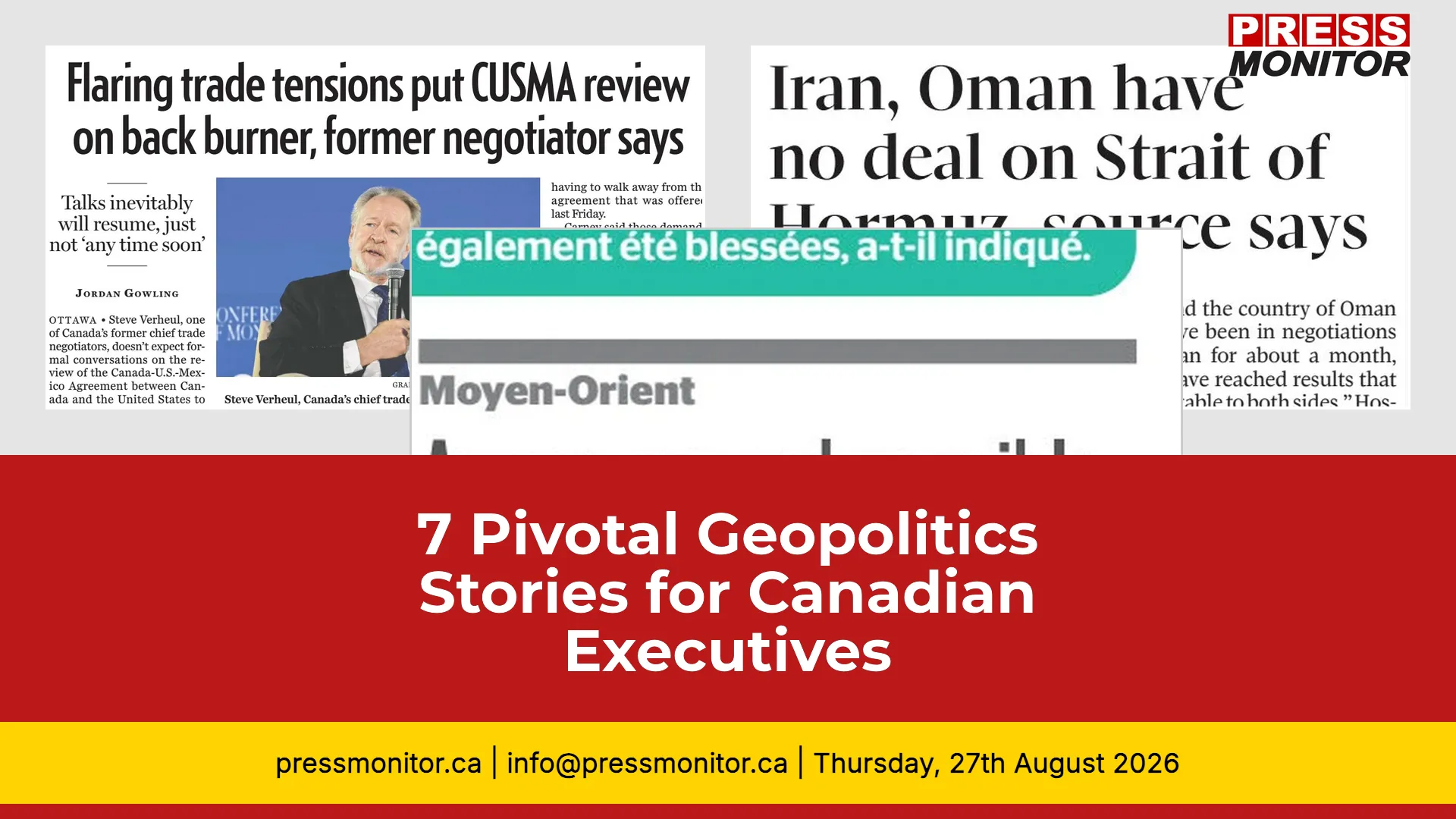
media monitoring reveals seven pivotal geopolitical developments shaping trade, diplomacy, and security this week. According to Press Monitor's tracking of Canadian publications, this press review distills complex international maneuvers into actionable media intelligence for decision-makers.
1. Canada-U.S. Trade Deadlock on CUSMA Drafts
Vancouver Sun reports that former CUSMA chief negotiator Steve Verheul anticipates a delay in formal Canada-U.S. reviews due to rising trade tensions. After failed talks last week, U.S. tariffs on Canadian goods have prompted retaliation, leading to a contestedvertedstand. U.S. President Donald Trump’s looming threats to escalate steel, aluminum, and auto sector tariffs have intensified discontent; the Canadian Prime Minister cited U.S. demands restricting sovereignty and trade flexibility as a key cause for failed negotiations.
Why it matters: The collapse of bilateral talks threatens economic stability and national sovereignty.
Key detail: Former chief negotiator Steve Verheul warns formal reviews are delayed indefinitely as U.S. tariffs on steel, aluminum, and autos escalate. Ottawa cites restrictive sovereignty demands as the breaking point.
Source: Vancouver Sun
Next step: Monitor tariff implementation timelines and prepare contingency supply chain adjustments.
2. Iran and Oman Reach Strait of Hormuz Deal Amid U.S. Escalation Tensions
The Globe And Mail reports that Iran's Islamic Revolutionary Guard Corps revealed partial agreements on managing the Strait of Hormuz with Oman, pending U.S. compliance with set conditions during a tense interim ceasefire pause. Iran and Oman have explored navigating the waterway critical for global oil and LNG shipments, though progress is delayed by U.S. observers, including a directive by former President Donald Trump against Oman cooperating with Tehran. A false hope for normalization remains; Iran insists Islamic Republic Cooperation Guards must curb U.S. restrictions to allow operations within bilateral terms.
Why it matters: Global energy shipping routes face unprecedented diplomatic friction.
Key detail: Partial agreements on managing the waterway are pending U.S. compliance during an interim ceasefire pause. Progress remains stalled by American directives against Omani cooperation with Tehran.
Source: The Globe And Mail
Next step: Track LNG and oil shipment routing alternatives for Q4 logistics planning.
3. Israel Declares No Diplomatic Accord Possible With Iran
Selon Le Journal de Quebec, le premier ministre israélien Benyamin Nétanyahou a déclaré lors d'une rencontre avec le président américain Donald Trump à Washington en juillet que 'aucun accord diplomatique n'est possible avec les dirigeants iraniens, qualifiés de sauvages'. Les deux hommes ont évoqué la possibilité d'une reprise d'action militaire contre l'Iran et le soutien à une campagne de pression économique menée par les États-Unis. Le ministre des Finances Scott Bessent a annoncé des sanctions supplémentaires visant à imposer une asphyxie économique à l'Iran, tandis que le président iranien Pezeshkian a réagi en affirmant que les États-Unis ne réussiraient rien avec ces mesures.
Why it matters: Hardline rhetoric signals prolonged regional instability and potential military escalation.
Key detail: PM Benyamin Nétanyahou labeled Iranian leaders “savages” during meetings with President Donald Trump, endorsing renewed economic sanctions and potential military action.
Source: Le Journal de Quebec
Next step: Assess defense sector exposure and monitor allied policy alignments.
4. U.S. Official Faces Backlash Over Claims Canada Lacks Military
"Selon Financial Post Magazine," Canada is among the U.S.’s closest military partners, with the two sharing the North American Aerospace Defence Command, a mutual defence organization. The story details how Vance’s claims about Canada’s defence echoed comments by U.S. transportation secretary Sean Duffy, who told Fox News that Canada was ‘a country that doesn’t have a military.’ Former U.S. military leaders reacted badly, with one retired admiral citing Canada's significant military deployments to Afghanistan as evidence to the contrary.
Why it matters: Mischaracterizations of Canadian defense capabilities risk damaging NATO partnerships.
Key detail: Comments echoing Transportation Secretary Sean Duffy’s Fox News remarks sparked immediate pushback from former U.S. military leaders citing Canada’s extensive Afghanistan deployments and NORAD integration.
Source: Financial Post Magazine
Next step: Engage in strategic communications to reaffirm bilateral defense commitments.
5. Mark Carney to Address European Parliament
Toronto Star reports that Prime Minister Mark Carney will address the European Parliament and attend the European Union's state of the union address next month. The visit follows a breakdown in trade talks with the United States regarding tariffs on Canadian exports. Carney aims to strengthen Canada's economic and security partnership with Europe.
Why it matters: Shifting focus to Europe offers a vital alternative trade and security framework.
Key detail: Prime Minister Mark Carney will deliver the state of the union address next month, aiming to cement economic and security ties following U.S. trade breakdowns.
Source: Toronto Star
Next step: Follow parliamentary proceedings for new EU-Canada regulatory alignments.
6. Alberta Premier Smith Warns Retaliatory Tariffs Would Hurt Canada
"Selon le Premier ministre de l'Alberta, Danielle Smith, taxer ou bloquer l'énergie en réponse aux tarifs douaniers américains serait désastreux pour tout le pays. Au lieu de cela, elle estime qu'Albert devraient répondre en aidant les entreprises touchées et en améliorant la diplomatie avec les législateurs américains avant les élections de mi-mandat à venir. Ces commentaires sont venus le mercredi après-midi, après que le gouvernement fédéral ait révélé le catalogue complet de ses tarifs de représailles. Le Canada va bientôt imposer des droits de douane sur plus de 700 importations américaines, à des taux de 15 %, 25 % et 50 %. Cela représente une contre-frappe de 276 milliards de dollars de produits et aura lieu juste après minuit le 8 septembre."
Why it matters: Provincial leadership advocates targeted diplomacy over broad energy blockades.
Key detail: Premier Danielle Smith cautions against taxing energy exports, recommending instead direct aid to affected businesses and proactive lobbying ahead of U.S. midterm elections. Ottawa plans $276B in retaliatory duties starting Sept 8.
Source: Toronto Sun
Next step: Align corporate advocacy strategies with provincial diplomatic channels.
7. Canada’s Tough U.S. Stand Wins Fans in China
The Globe And Mail reports that Canada’s firm stance against U.S. President Donald Trump’s trade war has earned it favor in China. Bilateral trade between Canada and China grew 18.7% in the first half of 2026, with Canadian exports to China increasing by over 29%. This has led to China positioning itself as a mature superpower and protector of the global free trade order.
Why it matters: Resistance to U.S. protectionism opens doors to emerging markets.
Key detail: Bilateral trade surged 18.7% in H1 2026, with Canadian exports to China jumping over 29%. Beijing positions itself as a defender of global free trade amid North American friction.
Source: The Globe And Mail
Next step: Evaluate export diversification opportunities in Asian markets.
Closing: This print media monitoring roundup captures the intersection of trade policy, diplomatic maneuvering, and security realignments. How will your organization adapt to these shifting alliances? Share your strategy below.