7 Pivotal Supply Chain & Procurement Stories for Executives


Navigating today’s supply chain & procurement landscape requires real-time visibility into trade shifts, logistics bottlenecks, and policy changes. This press review distills seven critical developments shaping global and domestic operations. For leaders tracking news on supply chain & procurement, this media intelligence briefing delivers actionable insights grounded in verified reporting. According to Press Monitor's tracking of Canadian publications, here is what executives need to know right now.
1. Tariffs Hit Canadian Auto Parts
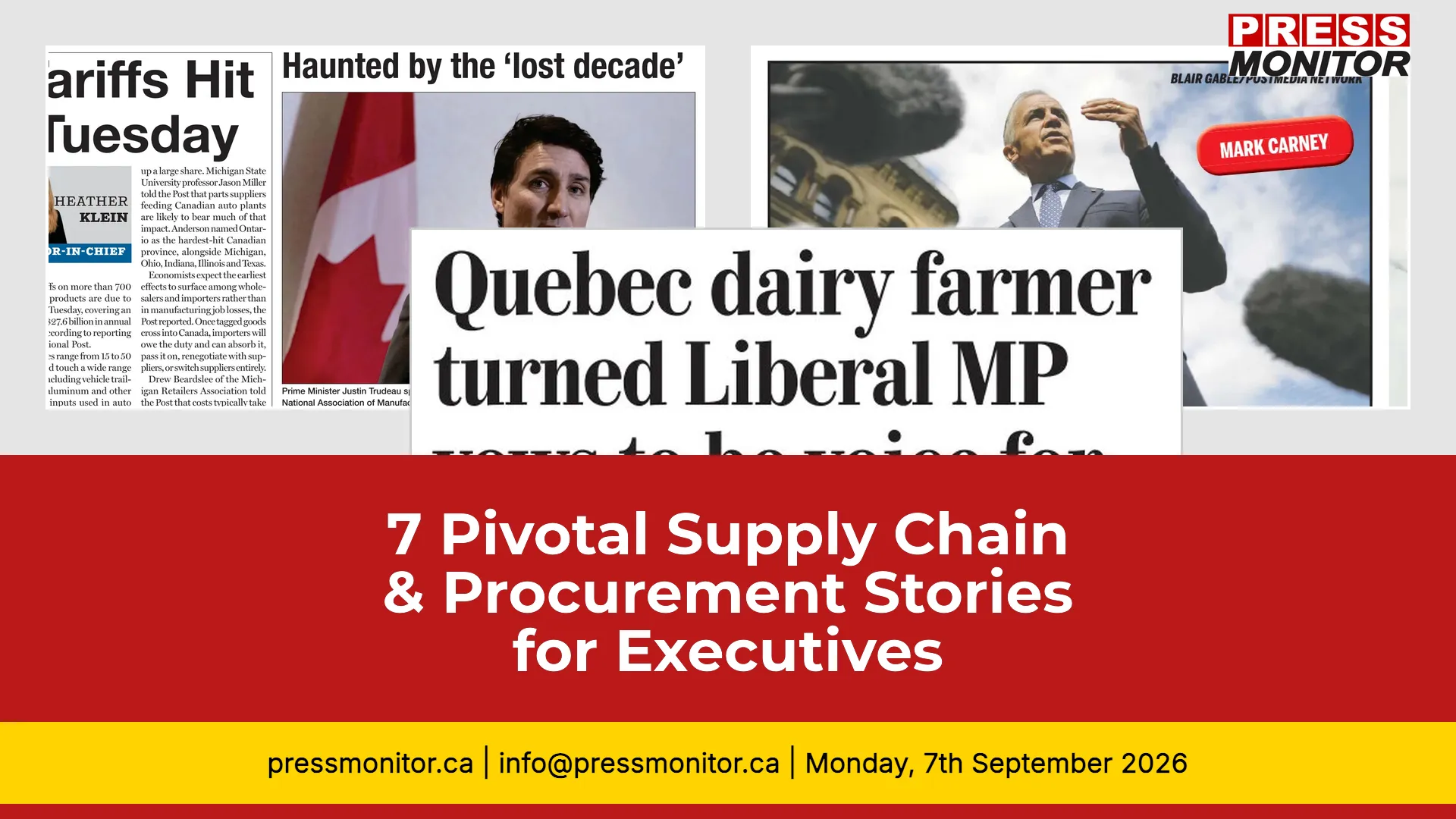
Winnipeg Sun reports that tariffs on imported parts are disrupting Canadian auto plants, with suppliers in Ontario, Michigan, Ohio, Indiana, Illinois and Texas facing the biggest impact. The article notes that wholesalers and importers may absorb or pass on costs, and retailers could shift to cheaper suppliers in China and Vietnam.
Why it matters: Cross-border manufacturing relies on seamless component flow. New tariff structures threaten margins and force immediate sourcing adjustments.
Key detail: Wholesalers and importers face cost absorption or pass-through pressures, while retailers may pivot to cheaper suppliers in China and Vietnam.
Source: Winnipeg Sun
Next step: Audit Tier-1 supplier contracts and model tariff impact scenarios for Q4 inventory planning.
2. Carney Taps Pichette to Lead Digital Transformation Canada
Ottawa Sun reports that Prime Minister Mark Carney has created Digital Transformation Canada, a new agency to scale technologies in the public service. The agency, led by former Google executive Patrick Pichette as CEO, will focus on equipping public servants with modern tools and using government purchasing power to support Canadian digital and AI companies. It will operate under Procurement Minister Joél Lightbound and include a fellowship model to bring private-sector expertise into government.
Why it matters: Public sector procurement is undergoing a massive tech overhaul, creating new B2G opportunities and shifting government purchasing power toward Canadian AI firms.
Key detail: Former Google executive Patrick Pichette will head the new agency under Procurement Minister Joél Lightbound, integrating private-sector expertise via a fellowship model.
Source: Ottawa Sun
Next step: Align vendor roadmaps with emerging federal digital procurement standards and explore public-private partnership pipelines.
3. Gobeil Elected to Protect Dairy Supply Management
The Times Colonist reports that newly elected Liberal MP Daniel Gobeil says his experience as a dairy farmer will help him be a voice in Ottawa for a Quebec region on the front lines of the Canada-U.S. trade war. Gobeil, formerly president of Quebec's dairy producers, said his opinion was taken into account even before voters in Chicoutimi-Le Fjord elected him to Parliament in an August 31 byelection. The former vice-president of Dairy Farmers of Canada said Prime Minister Mark Carney gave him a receptive ear during the campaign as Canada negotiated with the United States.
Why it matters: Supply management frameworks remain a cornerstone of Canadian agricultural trade negotiations, especially amid ongoing Canada-U.S. tariff discussions.
Key detail: Newly elected MP Daniel Gobeil, former president of Quebec’s dairy producers, will advocate fiercely for supply management protocols during federal trade talks.
Source: Times Colonist
Next step: Monitor parliamentary committee schedules and prepare compliance briefings for agricultural export teams.
4. Inspur Exports $5.6B Chips
The Globe And Mail reports that Inspur, a Chinese tech giant, has been exporting at least US$5.6 billion of advanced AI chips from its U.S. subsidiary Aivres to Southeast Asia, bypassing U.S. export controls, while the U.S. government investigates the loophole.
Why it matters: Export control loopholes directly impact semiconductor supply chains and geopolitical tech dependencies.
Key detail: A Chinese tech giant routed advanced AI chips through a U.S. subsidiary to Southeast Asia, triggering an active U.S. government investigation.
Source: The Globe And Mail
Next step: Review end-user verification processes and update sanctions screening protocols for high-value electronics.
5. U.S. Strikes Three Iranian Oil Tankers
Times Colonist reports that U.S. forces struck three Iranian oil tankers in the Gulf of Oman and near the Strait of Hormuz after Navy warships were targeted with ballistic missiles. Two tankers were permanently disabled and a third was destroyed. Iran called the attacks a war crime and warned of more severe consequences if the United States continues to interfere with Iranian shipping.
Why it matters: Maritime security incidents immediately disrupt energy logistics and freight routing across key chokepoints.
Key detail: Two tankers were permanently disabled and one destroyed after ballistic missile exchanges near the Strait of Hormuz.
Source: Times Colonist
Next step: Activate contingency routing plans and secure marine insurance riders covering war-risk zones.
6. Iran to Announce Exclusion Zone Near Strait of Hormuz
{source_name} reports that Iran plans to announce an exclusion zone outside the Strait of Hormuz targeting vessels it believes are attempting to transit the waterway. The announcement comes a day after the U.S. struck three Iranian oil tankers in response to Tehran launching ballistic missiles at U.S. warships. Experts called the launches a dangerous escalation after Iran's previous attacks at sea targeted commercial shipping.
Why it matters: Official maritime exclusion zones formalize transit risks, forcing carriers to reroute or delay shipments.
Key detail: Tehran plans to designate restricted waters targeting vessels suspected of hostile transit, escalating commercial shipping volatility.
Source: The Globe And Mail
Next step: Coordinate with freight forwarders to adjust ETA forecasts and communicate delays to downstream clients.
7. Hundreds Block English Port in Anti-Immigration Protest
{source_name} reports that hundreds of masked anti-immigration protesters blocked roads leading to Britain's busiest ferry port on Saturday, clogging traffic and disrupting travelers and cargo vehicles heading for France. The U.K. government condemned the action, saying it went well beyond peaceful protest, while the Port of Dover said all traffic in and out was stopped due to an ongoing public order incident. Far-right activist Stephen Yaxley-Lennon, who uses the name Tommy Robinson, wrote on X that patriots have mobilised to close down the port.
Why it matters: Civil unrest at major logistics hubs creates immediate cargo bottlenecks and labor coordination challenges.
Key detail: Masked demonstrators halted traffic at Britain’s busiest ferry port, stopping all inbound and outbound commercial vehicles.
Source: Times Colonist
Next step: Diversify port entry points and establish alternative rail/ferry corridors for UK-bound freight.
Staying ahead of operational shocks demands rigorous print media monitoring paired with strategic foresight. Which of these supply chain disruptions requires immediate action in your sector? Share your take below.