7 Pivotal Workplace & Remote Work Stories for HR Leaders & Policy Makers


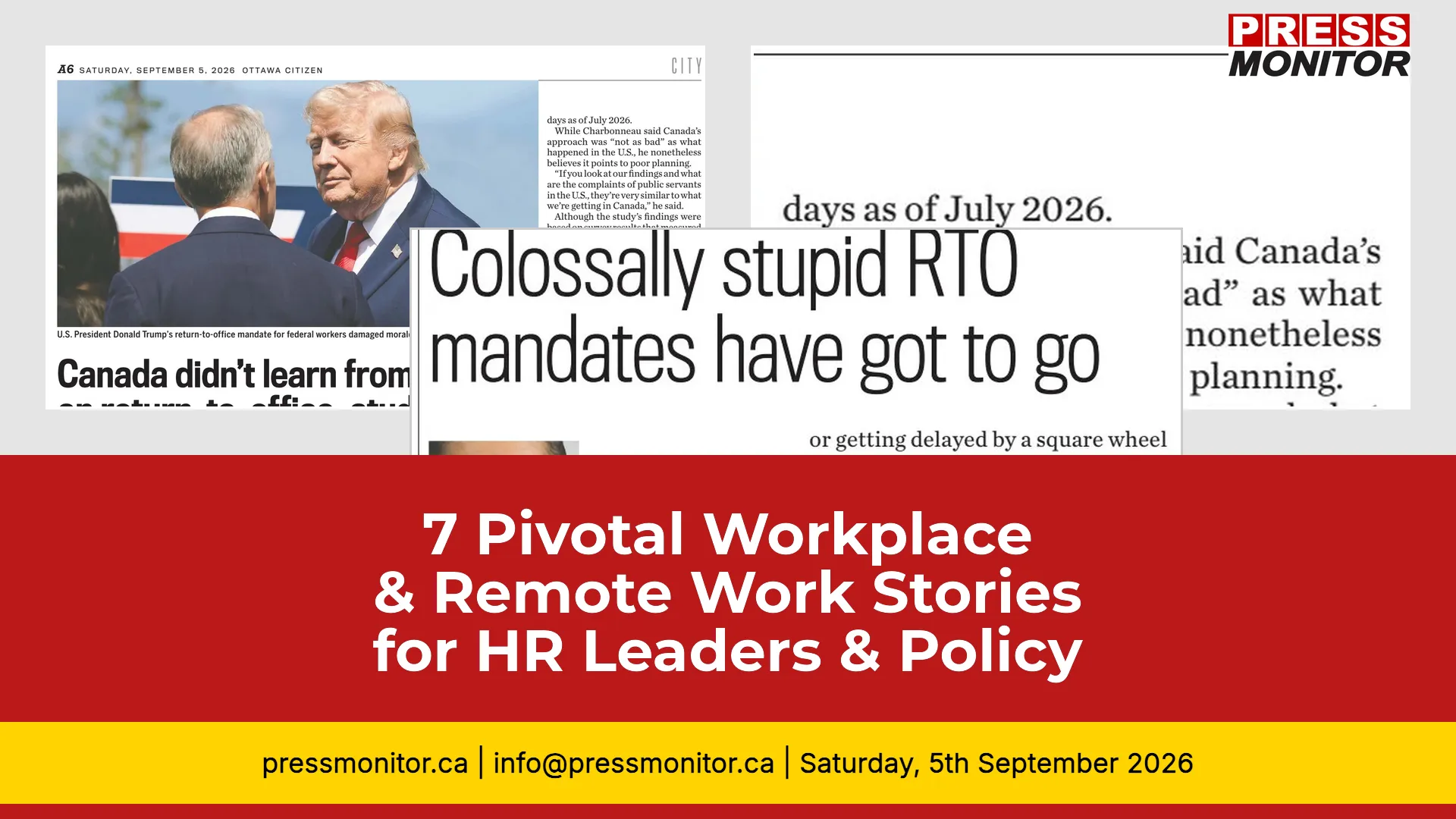
Navigating today’s shifting work landscape requires sharp eyes on emerging trends and policy shifts. This press review distills seven pivotal developments shaping how Canadian organizations operate, drawing directly from print media monitoring to give you actionable insights before they trend elsewhere. Leveraging advanced media intelligence, we’ve filtered the noise to surface what truly impacts talent strategy and real estate planning.
1. Trump Return-to-Office Mandate Damaged Morale
Ottawa Citizen reports that U.S. President Donald Trump's abrupt return-to-office mandate for federal employees damaged morale and eroded trust across the U.S. public service, according to a recent study whose author believes Canada has failed to learn from those mistakes. The peer-reviewed article published in the Review of Public Personnel Management examined the aftermath of a dramatic policy reversal that sent U.S. public servants back into the office full-time in 2025. Etienne Charbonneau, a professor at the National School of Public Administration, said the Canadian government missed an opportunity to learn from the intense blowback to Trump's actions.
Why it matters: International policy shifts often serve as early warning systems for domestic workforce strategy.
Key detail/stat: A peer-reviewed study reveals that abrupt federal return-to-office directives severely eroded trust among public servants, with researchers noting Canada missed a critical opportunity to adapt its own hybrid policies based on those failures.
Source: Ottawa Citizen
Next step: Audit your current flexibility frameworks against recent academic findings on employee retention.
2. Charbonneau Questions Canada Return to Office Planning
Ottawa Citizen reports that Charbonneau said Canada's return to office approach was not as severe as the United States but still showed poor planning, based on public servant survey complaints similar to those in the United States. Late last year, the Treasury Board Secretariat declined recommendations from a working group on measuring public service productivity, while Treasury Board president Shafgat Ali's communications director, Mohammad Kamal, defended a responsible increase in on-site presence. Study authors said gradual or differentiated return to office policies may reduce negative worker responses while maintaining productivity and collaboration.
Why it matters: Gradual implementation beats sudden mandates when trying to preserve productivity.
Key detail/stat: Study authors recommend differentiated return-to-office policies to mitigate negative worker responses, while the Treasury Board Secretariat recently declined working group recommendations on measuring public service productivity.
Source: Ottawa Citizen
Next step: Pilot phased attendance models before scaling citywide or enterprise-wide.
3. Ottawa Mayoral Candidates Scrap RTO Rule
Ottawa Citizen reports that mayoral candidates Alex Lawson and Jeff Leiper are agreeing to scrap the city's five-day return-to-office rule and push federal public servants toward flexibility. The candidates also support satellite offices closer to where people live, while Mayor Mark Sutcliffe maintains that downtown Ottawa benefits from mandated office attendance.
Why it matters: Municipal politics increasingly reflect broader labor market realities and commuter fatigue.
Key detail/stat: Leading mayoral contenders Alex Lawson and Jeff Leiper are pledging to eliminate strict five-day office rules, advocating instead for satellite offices closer to residential hubs, though Mayor Mark Sutcliffe defends downtown economic benefits.
Source: Ottawa Citizen
Next step: Monitor municipal election platforms for future zoning and transit partnerships tied to flexible work.
4. RBC and Scotiabank Mandate Return-to-Office
The Globe And Mail reports that RBC and Scotiabank enforce strict return-to-office policies despite staff struggles with desk shortages and long commutes. Office vacancy rates are dropping in downtown Toronto towers like Scotia Plaza while tech companies like Wealthsimple and Zip expand their real estate footprints without forced mandates.
Why it matters: Financial sector leadership sets benchmarks for corporate real estate and talent expectations.
Key detail/stat: Major banks are enforcing strict on-site requirements despite documented staff struggles with desk shortages and lengthy commutes, even as tech firms like Wealthsimple and Zip expand physical footprints without forced mandates.
Source: The Globe And Mail
Next step: Benchmark your space utilization metrics against banking sector occupancy rates.
5. Lyft Expands Toronto Office To 500 Employees
The Globe And Mail reports that Lyft, the San Francisco-based rideshare rival to Uber, is set to take over 90,000 square feet in First Canadian Place for its newest tech hub later this month. The company, which opened its first Toronto office in 2024 with roughly 50 employees, is now on track to expand its workforce in the city to more than 500. This move is part of a broader revitalization of downtown Toronto's economy as tall towers that suffered from a glut of empty space during the pandemic rapidly fill up again.
Why it matters: Strategic commercial leases signal confidence in urban revitalization and hybrid collaboration.
Key detail/stat: Lyft is securing 90,000 square feet in First Canadian Place, growing its Toronto hub from roughly 50 to over 500 employees, contributing to a noticeable drop in downtown vacancy rates.
Source: The Globe And Mail
Next step: Evaluate long-term lease structures that balance remote autonomy with collaborative anchor spaces.
6. Two Workers Debate Office Return
The Globe And Mail (ottawa/quebec Edition) reports that Canadian workers are weighing mixed experiences with in-office work requirements. Professional recruiter Nina McConnell Abbaszadeh says her four-day-a-week office requirement and twenty-five-minute commute help her productivity and mental health. Consultant Cat Nguyen, who commutes one and a half hours three days a week from Kleinberg, says she likes office work but dislikes the rising cost of going downtown.
Why it matters: Individual productivity metrics vary wildly based on commute length and home environment.
Key detail/stat: Professionals report mixed outcomes; some thrive on four-day office schedules with short commutes, while others struggle with hour-long travels despite valuing in-person collaboration.
Source: The Globe And Mail
Next step: Survey teams on commute tolerance and offer staggered scheduling options.
7. C$3.5-Billion Cost: Menopause Challenges Canadian Workplaces
The Globe And Mail (ottawa/quebec Edition) reports that unmanaged menopause symptoms cost the Canadian economy an estimated C$3.5 billion annually, largely due to missed workdays and reduced career advancement. While British and American policies increasingly mandate workplace accommodations, Canadian employers and regulators have been slow to act, leaving many women navigating severe symptoms without adequate support. Forward thinking companies like Cooke Aquaculture and Sun Life are beginning to implement training and flexible arrangements, highlighting a growing recognition that supportive workplace policies yield significant economic and talent retention benefits.
Why it matters: Health equity initiatives directly impact retention, absenteeism, and organizational economics.
Key detail/stat: Unmanaged symptoms cost the Canadian economy an estimated C$3.5 billion annually through lost days and stalled careers, prompting forward-thinking employers like Sun Life and Cooke Aquaculture to roll out targeted accommodations.
Source: The Globe And Mail
Next step: Review benefits packages for inclusive health support and manager training protocols.
According to Press Monitor's tracking of Canadian publications, these developments highlight a clear shift toward structured flexibility rather than rigid mandates. How is your organization adapting its workspace strategy to match these emerging standards?
