7 Urgent Climate Stories for Decision-Makers


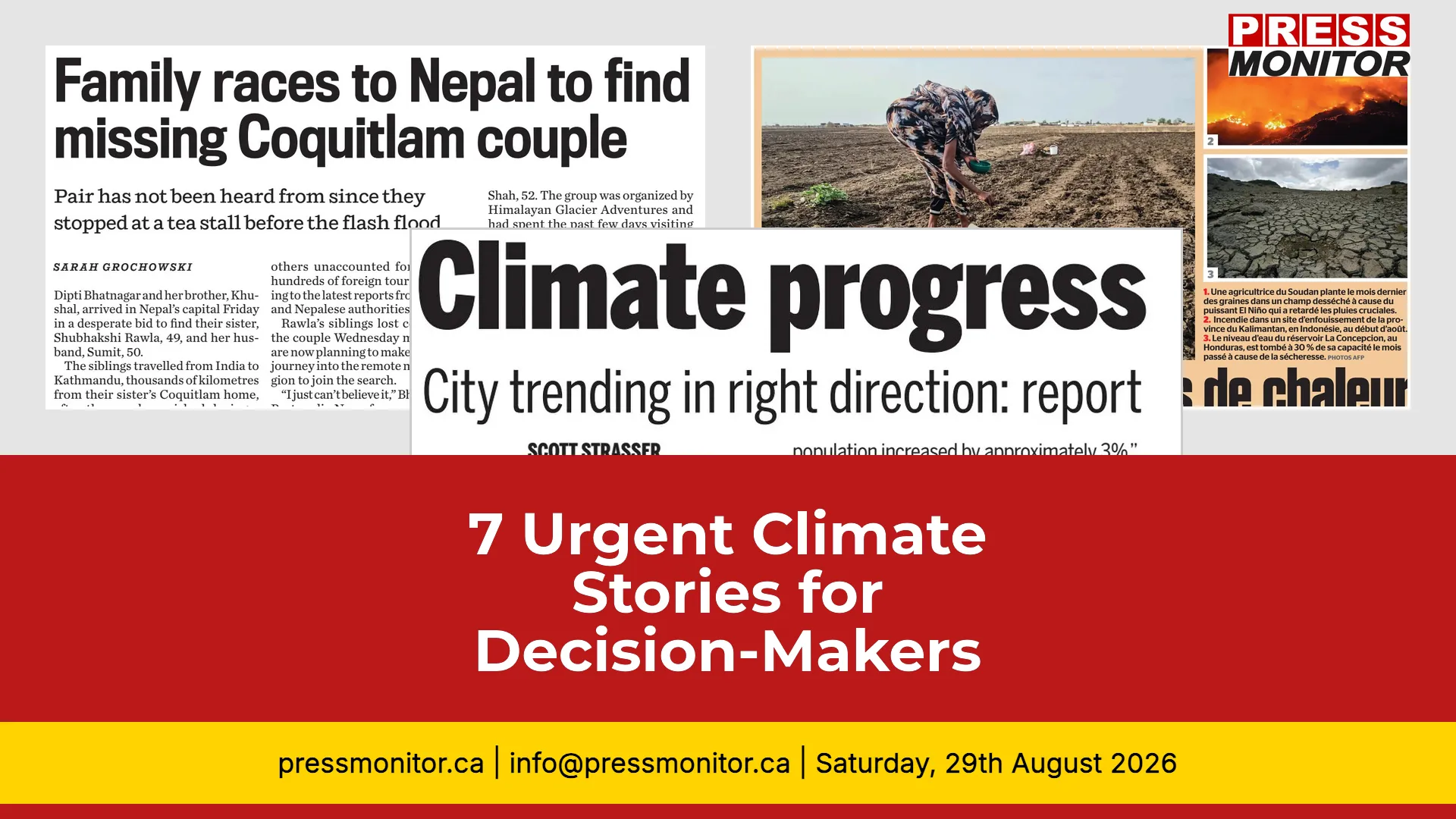
According to Press Monitor's media monitoring of Canadian publications, seven urgent climate stories are shaping the agenda. This press review covers the devastating Nepal flood, record-breaking heatwaves, Calgary's emissions progress, and wildfire prevention strategies. Here are the key developments you need to know.
1. Nepal Flood Disaster: Families Search for Missing Canadians
“A front-page report in Vancouver Sun reports that a family from Coquitlam, British Columbia, is desperately searching for their sister and husband in Nepal after a catastrophic flood. The couple vanished during a pilgrimage to Mount Kailash, a sacred site for several religions, and are among 32 Canadians missing after the devastating floods. Bhatnagar and her brother are traveling to the remote region to join the search, facing challenging conditions due to destroyed roads and limited communication."
Why it matters: The glacial collapse triggered catastrophic floods, killing hundreds and leaving dozens of Canadians missing, highlighting the human cost of climate instability.
Key detail: A Coquitlam family is racing to Nepal to find their missing relatives, among 32 Canadians unaccounted for.
Source: Vancouver Sun (front page)
Next step: Monitor global emergency response and Canadian travel advisories.
2. Record-Breaking Heatwaves Expected in 2026-2027
Le Journal de Montréal reports that the years 2026 and 2027 could become the hottest on record due to an exceptional El Niño event, according to Patrick Grenier from UQAM and Alexis Maximilien Berg from UdeM.
Why it matters: An exceptional El Niño could make these the hottest years ever, impacting agriculture, energy demand, and public health.
Key detail: Scientists from UQAM and UdeM warn that even eastern Canada may see surprises.
Source: Le Journal de Montreal
Next step: Review heat adaptation plans and energy grid resilience.
3. Calgary Makes Progress on Carbon Emissions Despite Budget Cuts
Calgary Sun reports that despite the city council rescinding the previous climate emergency declaration and voting to reduce the climate and environment department's budget, Calgary is making progress on carbon emission reductions. The report highlights that 90% of the actions in Calgary's 2023-2026 climate implementation plan are either completed or underway, and the city has leveraged $215 million to secure almost $300 million in climate-related grant funding since 2023 for environmental projects.
Why it matters: Calgary reduced per-capita emissions while leveraging $215M to secure $300M in climate grants, proving that policy continuity matters.
Key detail: 90% of the city's climate implementation plan actions are completed or underway.
Source: Calgary Sun
Next step: Examine municipal climate strategies for replication.
4. Wildfire Prevention: Proposed Wildfire Protection Bonds
The National Post reports that for about a century, governments across North America have aggressively fought wildfires, leading to the accumulation of vast amounts of combustible vegetation in forests and around towns. This has resulted in significant losses in the wildland urban interface, where communities have grown into forested areas. To mitigate these risks, the article suggests urgent measures including sustainable forest management, wildfire public safety objectives, and the introduction of Wildfire Protection Bonds to finance fuel reduction.
Why it matters: Decades of fire suppression have created combustible forests; new financial instruments could fund fuel reduction.
Key detail: The article suggests Wildfire Protection Bonds to finance risk mitigation.
Source: National Post
Next step: Explore innovative financing for wildfire resilience.
5. Wildland-Urban Interface Protection Urged
The National Post reports that Canada’s fire management institutions must adapt to prioritize protecting communities in the wildland urban interface.
Why it matters: Canada's fire management must adapt to protect communities growing into forested areas.
Key detail: The article calls for sustainable forest management and public safety objectives.
Source: National Post
Next step: Update community wildfire protection plans.
6. Communities Build Firebreaks to Slow Blazes
"Selon The Globe and Mail, certaines communautés au Canada construisent des pare-feu pour ralentir les incendies de forêt qui se propagent toujours plus rapidement. Au cours de cette année, environ 4,5 millions d'hectares ont brûlé à travers le pays. Au Yukon, le gouvernement est en train de construire un pare-feu de 20 kilomètres et d'améliorer ceux-ci à Haines Junction et Teslin, tandis que dans l'Alberta, des pare-feu naturels sont créés en plantant des tremblements d'épinette pour ralentir la progression des incendies."
Why it matters: With 4.5 million hectares burned this year, firebreaks are a proven strategy to protect communities.
Key detail: Yukon is building a 20-km firebreak; Alberta is planting aspen trees as natural barriers.
Source: The Globe and Mail
Next step: Assess local firebreak opportunities.
7. El Niños Intensified by Climate Change, Study Finds
The Hamilton Spectator reports that a new study suggests El Ninos the natural climatic chaos agent that periodically spikes global temperatures are getting stronger because of human-caused climate change. El Ninos are more than 36 per cent stronger than they were before the industrial age began in the mid 1800s, with a 16 per cent jump in just the last 40 years showing that the increase is accelerating.
Why it matters: Human-caused climate change is making El Niños 36% stronger, accelerating global temperature spikes.
Key detail: The increase jumped 16% in just the last 40 years.
Source: The Hamilton Spectator
Next step: Factor stronger El Niños into climate risk models.
This media intelligence roundup is powered by Press Monitor's print media monitoring across Canadian newspapers. Which of these stories impacts your organization most? Let us know in the comments.