7 Urgent Emergency Services & Response Stories for Public Safety Leaders


In a week of record wildfires, aviation emergencies, and rising water fatalities, Canadian emergency services are being tested like never before. According to Press Monitor's tracking of Canadian publications, here are the seven most critical developments you need to know.
1. Mexican Rescue Team Crosses Borders for Earthquake Response
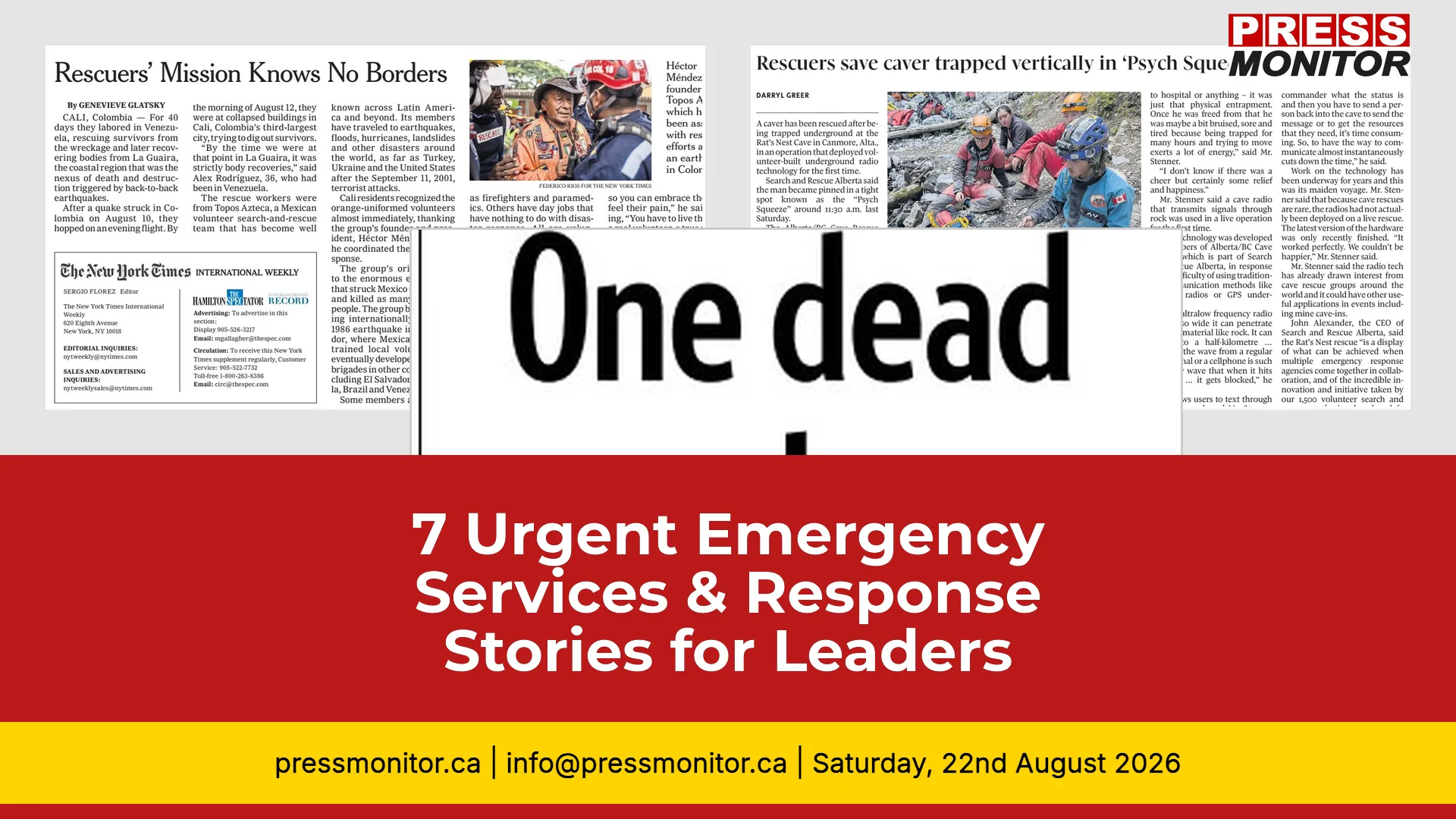
“Selon {source_name}, for 40 days they labored in Venezuela, rescuing survivors from the wreckage and later recovering bodies from La Guaira, the coastal region that was the nexus of death and destruction triggered by back-to-back earthquakes. After a quake struck in Colombia on August 10, they hopped on an evening flight. By the morning of August 12, they were at collapsed buildings in Cali, Colombia’s third-largest city, trying to dig out survivors. By the time we were at that point in La Guaira, it was strictly body recoveries,” said Alex Rodriguez, 36, who had been in Venezuela. The rescue workers were from Topos Azteca, a Mexican volunteer search-and-rescue team that has become well-known across Latin America and beyond.
Why it matters: Topos Azteca, a volunteer search-and-rescue team from Mexico, has been operating across Latin America, demonstrating the power of cross-border emergency collaboration.
Key detail: After 40 days in Venezuela following back-to-back earthquakes, the team moved to Cali, Colombia, within hours of a quake there. Alex Rodriguez, 36, noted that by the time they reached La Guaira, it was strictly body recoveries.
Source: The Hamilton Spectator
Next step: Consider how your agency can build international mutual aid agreements.
2. Volunteer-Built Radio Technology Saves Trapped Caver
The Globe and Mail reports that rescue teams extracted a caver from Canada's Rat's Nest Cave in Canmore using volunteer-built underground radio technology for the first time.
Why it matters: For the first time, rescue teams used volunteer-built underground radio technology to extract a caver from Rat's Nest Cave in Canmore, Alberta.
Key detail: The technology was developed by volunteers and deployed successfully, marking a breakthrough in cave rescue communications.
Source: The Globe and Mail
Next step: Evaluate emerging communication technologies for your rescue operations.
3. Emergency Plane Landing on Foothills Boulevard Kills One
Sekani Air Beechcraft B200 Super King Air makes emergency landing on Foothills Boulevard, striking two vehicles and killing one occupant. Driver Jaime Pawliuk describes the wing shearing the top off his vehicle, while passengers and officials confirm eight aboard with no injuries reported.
Why it matters: A Sekani Air Beechcraft B200 Super King Air made an emergency landing on a busy road north of Prince George, striking two vehicles and killing one occupant.
Key detail: Driver Jaime Pawliuk described the wing shearing the top off his vehicle. All eight aboard the aircraft were unharmed.
Source: National Post
Next step: Review emergency landing protocols and public communication plans for aviation incidents.
4. Alberta Drownings More Than Double Year-Over-Year
Edmonton Sun reports that water-related fatalities in Alberta have more than doubled year-over-year, with 11 deaths recorded as of August 17, 2026. Experts identify adult men and children as the highest-risk groups, citing lack of supervision and safety equipment as primary factors. The Lifesaving Society is calling for stronger government legislation regarding water safety signage.
Why it matters: Water-related fatalities in Alberta have surged, with 11 deaths recorded as of August 17, 2026, compared to five in the same period last year.
Key detail: The Lifesaving Society identifies adult men and children as highest-risk groups and is calling for stronger water safety legislation.
Source: Edmonton Sun
Next step: Implement targeted water safety campaigns for high-risk demographics.
5. Halifax Introduces False Alarm Fee
The Chronicle Herald reports that Halifax Regional Municipality is introducing a new fee to make residents accountable for false alarms. Starting September 1, residents will pay a flat $300 fee per false alarm for commercial properties and multi-unit residential buildings and a $50 fee per alarm for residential properties with fewer than three units.
Why it matters: After 16,700 false alarms since 2023, Halifax Regional Municipality is introducing fees to reduce unnecessary emergency responses.
Key detail: Starting September 1, commercial properties will pay $300 per false alarm, while residential properties with fewer than three units will pay $50.
Source: The Chronicle Herald
Next step: Review your municipality's false alarm policy and consider similar cost-recovery measures.
6. Ontario Wildfires Surpass Record, SPCA Responds
A front-page report in Regina Leader-post says 'the 2026 wildfire season in Ontario has surpassed the 2021 record with over 7,250 square kilometers burned, prompting an unprecedented emergency response effort through the Ontario SPCA and Humane Society's provision of veterinary care, shelters, food, and supplies to displaced families and pets.'
Why it matters: The 2026 wildfire season is now the worst in Ontario's history, with over 7,250 square kilometers burned, forcing thousands from their homes.
Key detail: The Ontario SPCA has provided emergency clinics, food distribution, and medical care to nearly 1,000 cats and dogs.
Source: Regina Leader-Post
Next step: Ensure your emergency plans include provisions for pets and livestock.
7. Fatal Collision on Highway 403 Highlights Response Gaps
The Hamilton Spectator reports that a fatal collision took place at around 9:30 p.m., when an SUV broke down in the westbound lanes of Hwy. 403 near Dundas Street. The Burlington OPP were responding to reports of a vehicle in a live lane that was stopped and broken down. There were two occupants in that vehicle. Before any emergency response could attend, the vehicle was struck by an approaching tractor-trailer. The SUV driver died at the scene. A 67-year-old passenger was taken to hospital with non-life-threatening injuries. The truck driver was not injured. At present, no
Why it matters: A 78-year-old woman died when her broken-down SUV was struck by a tractor-trailer on Highway 403 before emergency services could arrive.
Key detail: The Burlington OPP were responding to reports of a vehicle in a live lane, but the collision occurred before they could attend.
Source: The Hamilton Spectator
Next step: Review rapid response protocols for highway incidents.
Which of these stories is most relevant to your emergency planning? Let us know in the comments. For a comprehensive press review and media intelligence on emergency services, trust Press Monitor to keep you informed.