9 Critical Climate Stories for Sustainability Leaders


As Canada faces escalating climate impacts from wildfires to hurricanes, staying ahead requires more than breaking news alerts. This press review, powered by Press Monitor's tracking of Canadian publications, brings you the most consequential climate stories—grounded in editorial-vetted print media coverage.
1. Hurricane Lala's Aftermath and New Threat
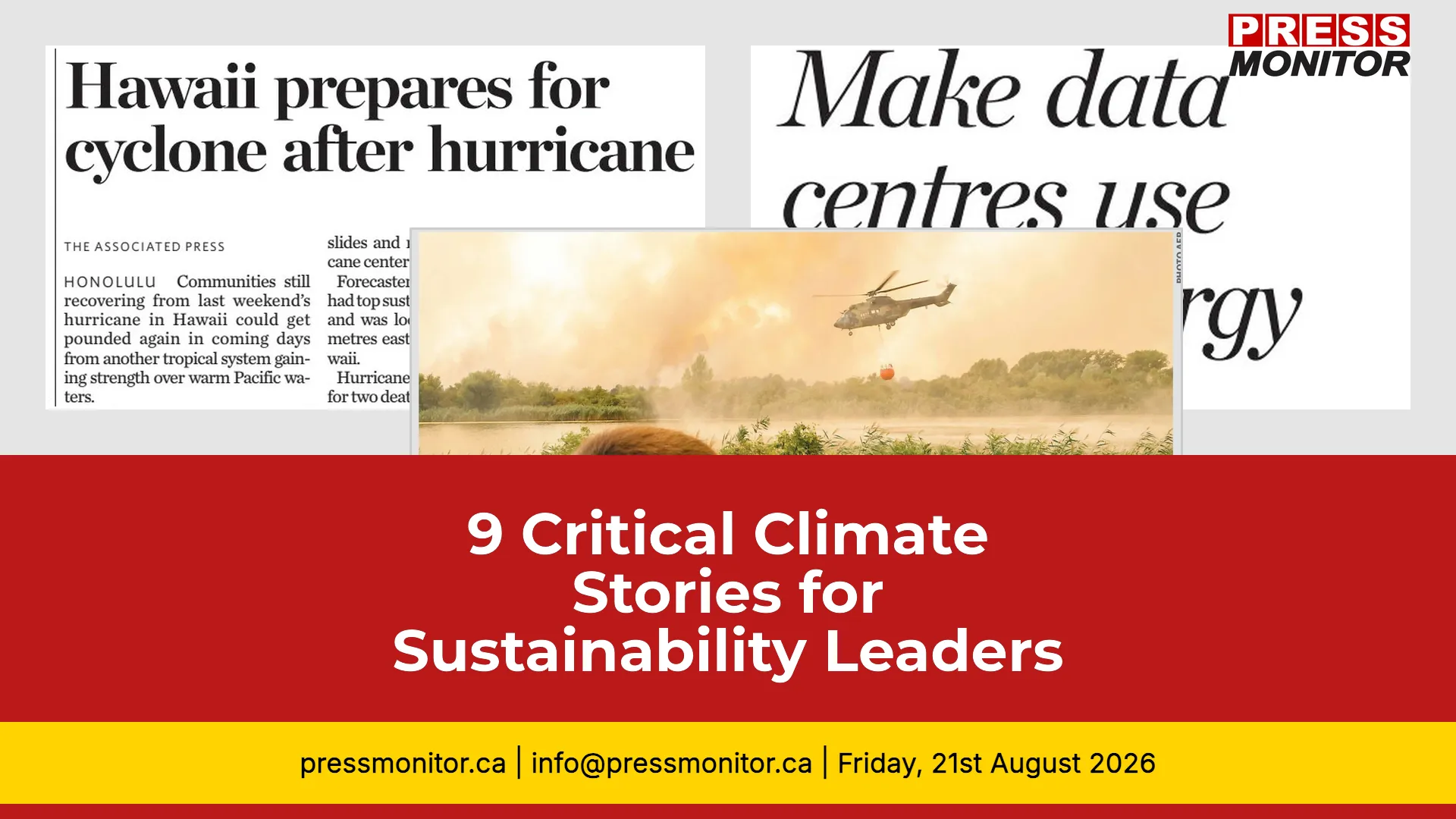
The Hamilton Spectator reports that Hurricane Lala has devastated communities in Hawaii, leaving many homes and businesses without power. Thousands of residents are still in the dark as efforts to restore power could take at least two weeks. Meanwhile, another tropical system is gaining strength over the Pacific, likely to form a tropical storm and pose a new threat to the islands with potential life-threatening flooding, mudslides, and heavy rainfall.
Why it matters: Hawaii remains reeling from Hurricane Lala while a new tropical system threatens life-threatening flooding.
Key detail: Power restoration could take two weeks; thousands remain without electricity.
Source: The Hamilton Spectator
Next step: Monitor emergency response coordination.
2. Mark Carney’s Climate U-Turn on Data Centres
"Selon The Hamilton Spectator, Mark Carney is climate champion — says nobody anymore. Hard to believe Carney’s apparent commitment to climate action was something that made him appealing to Canadians last year, when he asked for a mandate to govern the country. His dramatic retreat on the climate front as prime minister has left many Canadians feeling deeply disappointed, even betrayed. And now this. On a whole new front, Carney appears poised to abandon the climate fight. That new front is AI data centres, the faceless factories of the future, which have become a prickly flashpoint in the struggle between Silicon Valley’s powerful tech barons and communities all over the US. and Canada. Oakville and Mississauga have just joined hundreds of American municipalities that are holding back data centre approvals, in response to local anger that these enormous centres consume huge amounts of electricity and water, but create few jobs. ‘The centres also pose a broader threat: they potentially worsen the climate crisis. The word "potentially" is important, because the centres don’t have to make the climate crisis worse. The centres require immense amounts of electricity to fuel the relentless computing and processing of artificial intelligence. But that electricity could come from renewable energy (solar, wind, water). And requiring data centres to use renewable energy could help the transition to renewables — a transition every sensible person knows is necessary to save the planet. But can we count Carey among sensible people? While he’s capitulated to oil interests on pipelines, he talks apparently earnestly about the need to transition to clean energy. Here's a perfect opportunity for him to put some muscle behind his words. He should follow the lead of jurisdictions — including Treland and New South Wales — that require tech companies to power their data centres with renewable energy and to provide that renewable energy themselves, adding to the supply. Indeed, tough government regulations could force tech companies to provide and pay for enormous new quantities of renewable energy, thereby advancing a revolution already underway. However, Carney is taking us in a different direction. Next month, he’s hosting a global investors’ summit in Toronto which will focus on attracting foreign capital to finance, among other things, Al infrastructure for Canada. But he’s laid down no requirement that data centres in Canada use renewable energy. On the contrary, Carney is on board with Alberta marketing itself asa jurisdiction that allows data centres to be powered by natural gas — a carbon-emitting fossil fuel that Alberta has in abundance and is keen to sell. Ontario is also planning to attract data centres, and to power them with nuclear energy. Although nuclear is considered a "clean" energy because it doesn’t contribute to climate change, it has other extremely seri- ous drawbacks, including the unsolved problem of disposing of highly toxic, long-lasting nuclear waste. Yet the Carney government is keenly backing nuclear energy. While Ottawa offers tax benefits for renewable energy, it provides more direct and robust support for nuclear energy (and fossil fuels). Al is jockeying to dominate the future, with its colossal data centres dotting the landscape. We can resist this dominance by, among other things, compelling its multibillionaire owners to use and generate huge amounts of new renewable energy. Or we can allow the centres to become vast additional sources of emissions pushing us further toward climate catastrophe. We need a prime minister tough enough to take on the tech billionaires."
Why it matters: Canada's PM abandons renewable energy requirements for AI data centres, sparking betrayal among climate advocates.
Key detail: Carney's global investors summit next month has no renewable mandate.
Source: The Hamilton Spectator
Next step: Track policy shifts on data centre regulation.
3. Massive Wildfire Engulfs Serbian Reserve
Serbian firefighters, supported by a Russian airborne firefighting aircraft, are battling a massive wildfire in the Deliblatska Pescara nature reserve that has burned over 3,600 hectares since August 5. Authorities ordered the evacuation of a nearby hamlet as flames intensified and threatened homes.
Why it matters: Over 3,600 hectares burned in Deliblatska Pescara; Russian aircraft deployed.
Key detail: Evacuations ordered as flames threaten homes.
Source: Le Journal de Montreal (AFP)
Next step: Assess international firefighting aid coordination.
4. Bald Range Evacuees Navigate Rough Roads
Vancouver Sun reports that people fleeing Bald Range blaze forced to travel routes plagued with rocks, ruts. As fast-moving fires necessitate complex evacuations at short notice, evacuees need better information on the condition of B.C’s back roads.
Why it matters: Highway closures forced evacuees onto dangerous back roads, highlighting infrastructure gaps.
Key detail: BC's 2Ol Forest Service Road in poor condition.
Source: Vancouver Sun (Glenda Luymes)
Next step: Advocate for better evacuation mapping.
5. Firefighter Chronicles Mental Health Toll
Radio-canada Info reports that a firefighter from BC Wildfire on Salt Spring Island discusses the intense and prolonged nature of forest fires, the mental health challenges faced, and the importance of safety measures and rest.
Why it matters: BC Wildfire fighter shares PTSD struggles from marathon blazes.
Key detail: Paramilitary environment and lack of rest compound trauma.
Source: Radio-Canada Info
Next step: Support mental health resources for firefighters.
6. BC Care Workers Under Wildfire Stress
"Selon Vancouver Sun, les travailleurs des services de soins à long terme de la Colombie-Britannique sont confrontés à une pression croissante en raison des incendies de forêt. Des foyers de soins spécialisés comme le Kimberley Special Care Home ont été évacués en raison de la menace des incendies Matthew Creek et Bald Range, tandis que le Summerland Community Health Centre et le Summerland Seniors Village ont également opéré en mode d'urgence. Avec la menace des incendies de forêt qui s'intensifie, la Colombie-Britannique doit se préparer à davantage d'évacuations de foyers de soins pour les semaines à venir. Ce problème est aggravé par le recours à la main-d'œuvre occasionnelle et le manque de soutien adéquat pour ces travailleurs clés."
Why it matters: Long-term care staff evacuated vulnerable patients without reimbursement or support.
Key detail: Kimberley Special Care Home and others operated in emergency mode.
Source: Vancouver Sun / The Province
Next step: Develop dedicated care facility evacuation protocols.
7. Alberta's Hail Busters See Record Season
The Calgary Herald reports that airborne hail busters have been unusually busy over southern Alberta this summer. Weather Modification International has scrambled a fleet of aircraft to seed 68 storms in the region. Despite the high number of storms, Calgary has avoided the worst of the extreme weather so far.
Why it matters: Cloud-seeding aircraft scrambled 68 storms, but Calgary dodged major damage.
Key detail: Twin-engine King Air C9O fleet used.
Source: Calgary Herald
Next step: Explore weather modification as adaptation tool.
8. Neskantaga First Nation Evacuated Again
The Toronto Star reports that Neskantaga First Nation had to be evacuated again after a sewage flood at the community’s only nursing station, the northern Ontario community's chief said on Thursday.
Why it matters: Sewage flood at only nursing station forces repeat evacuation.
Key detail: Chronic infrastructure crisis in northern Ontario.
Source: Toronto Star / The Hamilton Spectator
Next step: Prioritize Indigenous community infrastructure funding.
9. Wildfire Evacuation Teaches Hard Lesson
The Globe And Mail reports that a months-long renovation was interrupted by a wildfire in Summerland, British Columbia. The fire led to a hasty evacuation, highlighting the challenges of disaster information dissemination.
Why it matters: Summerland resident's months-long renovation interrupted by fire, revealing information gaps.
Key detail: Disaster info dissemination challenges.
Source: The Globe and Mail
Next step: Improve real-time evacuation alerts.
Media monitoring of this depth helps organizations anticipate climate disruptions before they dominate headlines. Which story impacts your sector most?