9 Essential Accounting and Tax Stories for CFOs


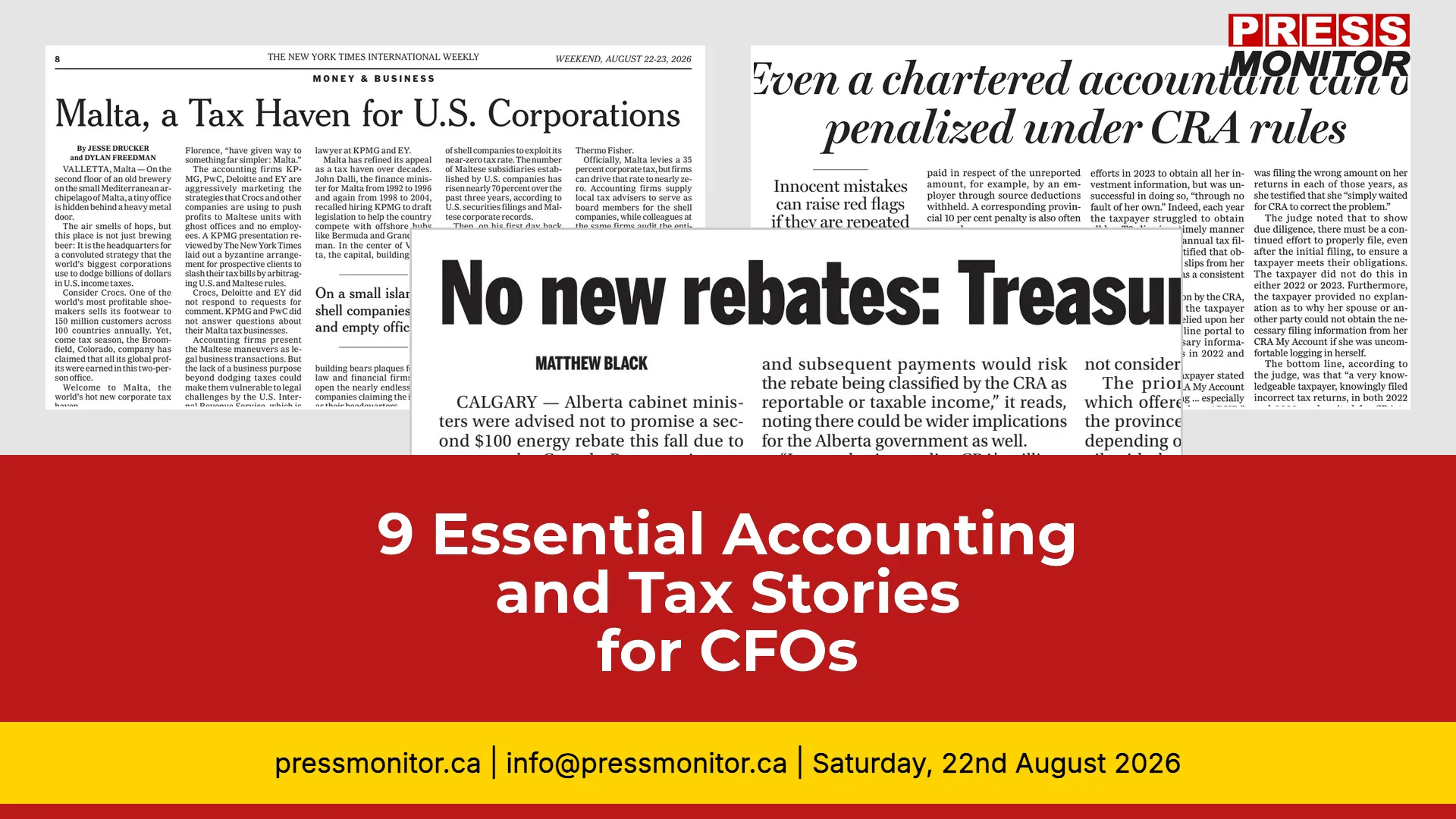
Stay ahead of the curve with Press Monitor's curated roundup of the most impactful accounting, tax, and corporate secretarial stories from Canadian print media. From CRA rulings to cross-border estate planning, here are the stories that matter for your media intelligence strategy.
1. Malta as a Corporate Tax Haven
The New York Times reports that Malta has become a popular tax haven for U.S. corporations, allowing them to avoid billions in U.S. income taxes by setting up shell companies with no business operations.
Why it matters: U.S. corporations are using Malta to avoid billions in income taxes, a trend that could reshape international tax norms and affect Canadian multinationals.
Key detail: The New York Times reports that shell companies with no business operations are the primary vehicle.
Source: The Hamilton Spectator
Next step: Review your own corporate structure for exposure to similar tax haven scrutiny.
2. Tax Court Upholds Penalty for Chartered Accountant
According to a report in the Vancouver Sun, a taxpayer appeared before the Tax Court in Vancouver seeking to cancel a penalty assessed by the Canada Revenue Agency for failing to report all her income on her 2O23 return. The case highlights the rules regarding omitting income, particularly the ‘repeated failure to report income’ penalty which applies if income is omitted in any of the three preceding years. The taxpayer, a chartered accountant, argued she exercised due diligence but struggled to obtain investment information consistently, resulting in her failure to report $12,715 in income, leading to the penalty’s upholdance.
Why it matters: Even tax professionals can face penalties for repeated failure to report income, highlighting the strictness of CRA rules.
Key detail: The taxpayer, a CA, failed to report $12,715 in income and was penalized despite claiming due diligence.
Source: Vancouver Sun
Next step: Ensure your tax reporting processes include robust checks for all income sources.
3. Alberta Energy Rebates Could Become Taxable
Calgary Sun reports that Treasury Board advised Alberta cabinet ministers against promising a second $100 energy rebate this fall, warning that subsequent automatic payouts might be classified by the Canada Revenue Agency as taxable income.
Why it matters: The CRA may classify future energy rebates as taxable income, affecting millions of Albertans and provincial fiscal policy.
Key detail: A leaked Treasury Board document warns that automatic payouts risk being treated as reportable income.
Source: Calgary Sun
Next step: Monitor CRA guidance on government payments to avoid unexpected tax liabilities.
4. Simplifying Tax Code Is About Social Trust
{source_name} reports that Canada Revenue Agency leadership says the tax code is too complicated and needs a gradual shakeup. While simplification is needed, experts warn that stripping away fairness and integrity would deepen inequities and erode public trust.
Why it matters: CRA leadership acknowledges the tax code is too complex, but warns that simplification must not sacrifice fairness.
Key detail: Experts caution that stripping away integrity could deepen inequities and erode public trust.
Source: Toronto Star
Next step: Engage with policy discussions to ensure your organization's voice is heard on tax simplification.
5. Zero ACB Tax Implications for REITs
The Globe And Mail reports that when a REIT’s adjusted cost base drops to zero, investors should be aware of the tax implications of trusts’ distributions. REITs like Chartwell (CSH.UN) and PROREIT (PRV.UN) pay distributions mostly as return of capital, and once book cost reaches zero, any further distributions may be treated as capital gains and become taxable.
Why it matters: When a REIT's adjusted cost base hits zero, distributions become taxable as capital gains, a critical consideration for investors.
Key detail: REITs like Chartwell (CSH.UN) and PROREIT (PRV.UN) pay mostly return of capital.
Source: The Globe and Mail
Next step: Review your REIT holdings and consult a tax advisor on ACB tracking.
6. Executors Across Borders: Tax Considerations for Canadians
«{source_name} reports that» when planning an estate, factors like asset types and beneficiaries’ locations significantly impact executor choices. Due to differing estate and tax laws between Canada and the US—particularly the absence of federal estate tax in Canada—cross-border considerations are crucial, especially for non-resident children and grandchildren. Bonding of foreign executors is at the court’s discretion, but proper tax planning is essential to navigate these complexities and avoid potential issues.
Why it matters: Cross-border estates involve complex tax laws, especially between Canada and the U.S., where federal estate tax differs.
Key detail: Bonding of foreign executors is at the court's discretion, but proper tax planning is essential.
Source: Calgary Herald
Next step: If you have non-resident beneficiaries, update your estate plan to address cross-border tax issues.
7. $2.5 Million Family Finance Plan Required
Calgary Herald reports that George and Eileen need a comprehensive retirement plan to manage legal, tax, liquidity, and partnership risks in their rental properties. Upgrading to a C$2.5 million home will increase their capital allocation by an extra C$1.2 million and drastically reduce monthly cash flow surplus.
Why it matters: Upgrading to a higher-value home can drastically reduce cash flow and increase tax and liquidity risks.
Key detail: The move would increase capital allocation by $1.2 million.
Source: Calgary Herald
Next step: Run a comprehensive retirement plan that factors in real estate and tax implications.
8. Gilda's Club Toronto Closure After Losing Charitable Status
The Toronto Star reports that Gilda’s Club Greater Toronto, which provided free emotional and social support to people living with cancer as well as their families, has abruptly ended its operations after losing its charitable status.
Why it matters: The abrupt closure of a major cancer support charity raises questions about compliance and governance for non-profits.
Key detail: Gilda's Club Greater Toronto lost its charitable status, ending free emotional and social support services.
Source: Toronto Star
Next step: Non-profit boards should review their own compliance with CRA charitable status requirements.
9. Malta Tax Haven Exposure
The New York Times reports that Malta has become a popular tax haven for U.S. corporations, allowing them to avoid billions in U.S. income taxes by setting up shell companies with no business operations.
Why it matters: The Malta story underscores the global nature of tax avoidance and the need for robust media monitoring to track regulatory changes.
Key detail: According to Press Monitor's tracking of Canadian publications, this story has cross-border implications for Canadian firms with international operations.
Source: The Hamilton Spectator
Next step: Use print media monitoring to stay informed on international tax developments that could affect your business.
Which of these stories impacts your organization most? Let us know in the comments.
