9 Essential Geopolitics Stories for Decision Makers


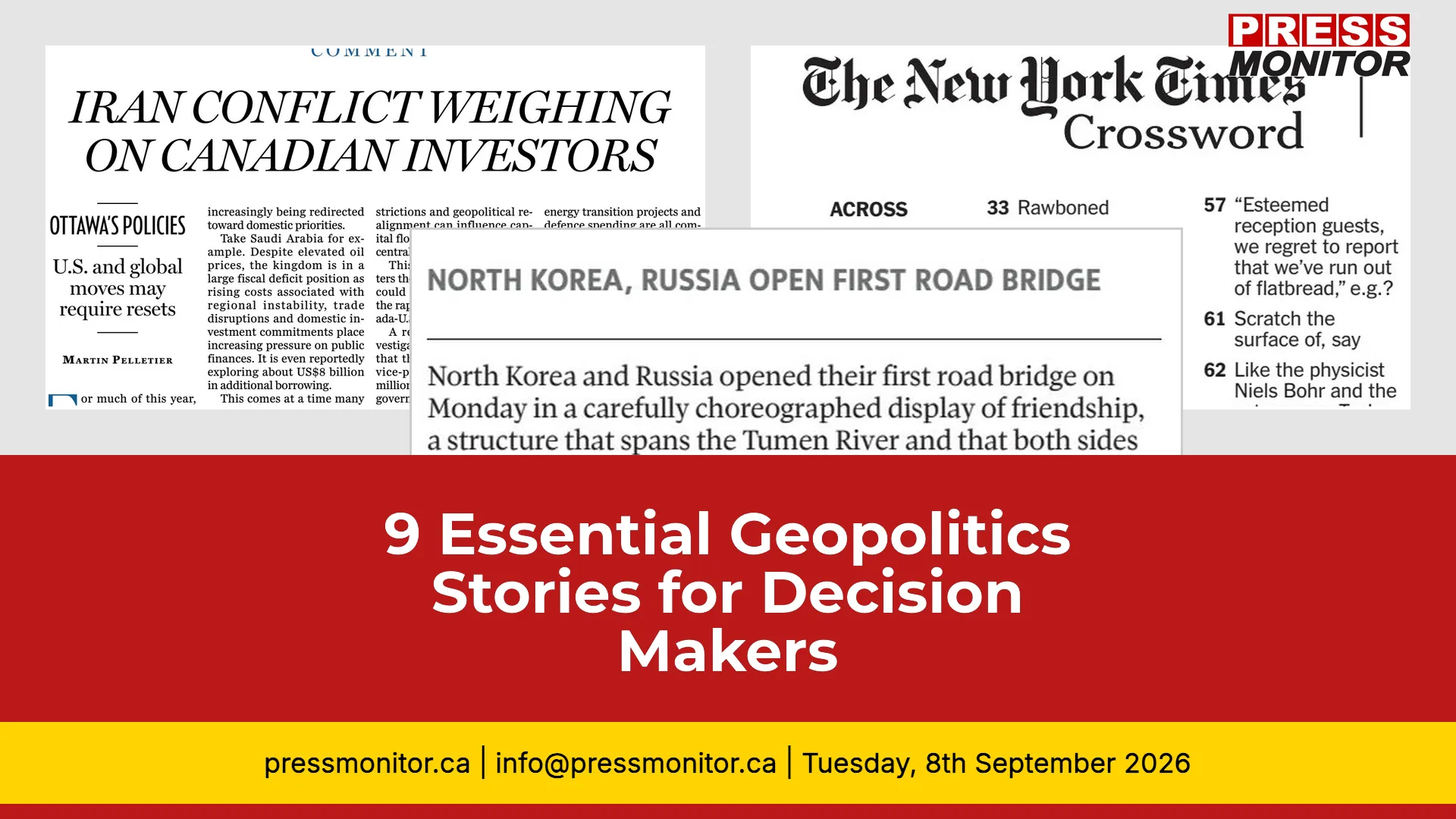
Today's press review of Canadian print media reveals nine essential developments reshaping the global geopolitical landscape. From trade wars to bridge openings, this media intelligence report, grounded in media monitoring and print media monitoring of Canadian publications, draws on Press Monitor's tracking to deliver the news on geopolitics that matters most to decision-makers.
1. Iran Conflict Reshapes Global Capital Flows
Financial Post Magazine reports that the ongoing conflict involving Iran is increasingly influencing government finances, global capital flows, and investment decisions beyond just oil prices. Middle Eastern sovereign wealth funds are redirecting capital toward domestic priorities, leaving technology companies to rely more heavily on debt markets for AI infrastructure buildout. Canada faces heightened scrutiny from Washington regarding sanctions enforcement and trade relations, with potential consequences for investors who may need to reposition portfolios.
Why it matters: The Iran conflict is redirecting sovereign wealth away from Western markets, tightening liquidity for AI infrastructure and raising borrowing costs globally.
Key detail: Middle Eastern nations are shifting capital toward domestic security, while U.S. tech firms increasingly rely on bond markets. Canada faces heightened scrutiny from Washington on sanctions enforcement.
Source: Financial Post Magazine, Martin Pelletier, CFA
Next step: Investors should reassess portfolio exposure to Middle Eastern capital flows and AI-sector debt.
2. Hoekstra and Heyman Differ on Canada
The Edmonton Journal reports that the puzzle section features crossword clues and solutions. Readers can find answers to previous puzzles and new clues for across and down entries. The content includes wordplay hints and abbreviation puzzles.
Why it matters: As the Canada-U.S. trade war escalates, the stark contrast between the current and former U.S. ambassadors to Canada signals deepening diplomatic fractures.
Key detail: A petition for Ambassador Hoekstra's removal has gathered over 260,000 signatures, while former Ambassador Heyman has publicly defended Canada.
Source: Edmonton Journal, Evie Hutchhines
Next step: Corporate affairs teams should monitor cross-border diplomatic rhetoric for trade policy implications.
3. North Korea Russia Open First Road Bridge
The Globe And Mail (ottawa/quebec Edition) reports that North Korea and Russia opened their first road bridge on Monday, creating a permanent link across the Tumen River. Russian Prime Minister Mikhail Mishustin and North Korean Premier Pak Thae Song addressed officials via video, framing the project as a historic milestone in their deepening strategic partnership. The new structure will handle up to three hundred vehicles daily, replacing decades of makeshift plank crossings established since nineteen fifty-nine and significantly boosting bilateral trade and transportation networks.
Why it matters: The first permanent road bridge across the Tumen River marks a historic deepening of ties between two Western-sanctioned nations amid the Ukraine war.
Key detail: The bridge will handle up to 300 vehicles daily, replacing decades of makeshift plank crossings. Russian PM Mishustin and North Korean Premier Pak Thae Song framed it as a strategic milestone.
Source: The Globe and Mail, Reuters
Next step: Defence and logistics firms should assess new transport corridor implications for regional supply chains.
4. EU Pledges €200 Million to Greenland
{source_name} reports that the European Union pledged €200 million in investment to Greenland to strengthen partnership following threats from U.S. President Donald Trump to take control of the island. European Commission President Ursula von der Leyen announced the funding during a visit to Nuuk, aiming to help tackle climate change, improve internet connections, and boost hydropower, fisheries, and education over the next two years.
Why it matters: The European Union's investment pledge aims to counter U.S. threats to take control of Greenland, reinforcing Arctic sovereignty and NATO alliance cohesion.
Key detail: European Commission President Ursula von der Leyen announced €200 million over two years during a visit to Nuuk, targeting climate change, internet, hydropower, fisheries, and education.
Source: The Globe and Mail, Lorne Cook
Next step: Arctic policy stakeholders should track how EU investment reshapes the strategic balance in the North Atlantic.
5. C$28 Billion Tariffs Escalate Canada U.S. Trade War
The Globe And Mail (ottawa/quebec Edition) reports that Canada is preparing to impose C$28 billion in retaliatory tariffs against the United States after diplomatic talks collapsed over unreasonable demands. Prime Minister Mark Carney confirmed there were no last-minute negotiations, as President Donald Trump escalated tensions through social-media threats targeting Bombardier and broader sovereignty claims. The new duties, covering nearly nine hundred American goods, take effect Tuesday morning, signaling a major escalation in the cross-border economic dispute.
Why it matters: Canada's retaliatory tariffs on nearly 900 American goods mark a major escalation in the cross-border economic dispute, with no last-minute negotiations.
Key detail: Prime Minister Mark Carney confirmed the collapse of talks as President Trump escalated tensions through social-media threats targeting Bombardier and broader sovereignty claims.
Source: The Globe and Mail, Marieke Walsh and Sophia Bertuzzi
Next step: Supply chain managers should prepare for Tuesday's tariff implementation and review contingency sourcing.
6. Iran Threatens Gulf Energy Infrastructure
The Globe And Mail reports that Iran threatened to retaliate against any new U.S. attacks on its assets, warning that energy infrastructure across the Gulf is vulnerable. Iranian Parliament Speaker Mohammad Bager Qalibaf made the statement after U.S. and Iranian strikes on shipping over the weekend pushed oil prices up. Tehran also announced plans for a new restricted zone in the Gulf as the collapse of an interim ceasefire led to renewed hostilities.
Why it matters: Iran's warning that Gulf energy infrastructure is vulnerable follows U.S.-Iran strikes on shipping, pushing oil prices higher and collapsing an interim ceasefire.
Key detail: Iranian Parliament Speaker Mohammad Bager Qalibaf announced plans for a new restricted zone in the Gulf as hostilities resumed.
Source: The Globe and Mail, Nayera Abdallah Eman Abu Hassira
Next step: Energy sector leaders should model scenarios for Strait of Hormuz disruptions and alternative supply routes.
7. UAE Linked to Sudan War Mercenaries
The Globe And Mail reports that United Nations investigators have found evidence the United Arab Emirates trained and financed Colombian mercenaries who participated in the siege and massacre of civilians in Darfur last October. As many as two thousand mercenaries were hired by a UAE-based company with close links to the government and helped operate drones and artillery for the Rapid Support Forces.
Why it matters: UN investigators found evidence that the UAE trained and financed Colombian mercenaries involved in the Darfur siege, raising serious accountability questions.
Key detail: As many as 2,000 mercenaries were hired by a UAE-based company with close government links, operating drones and artillery for the Rapid Support Forces.
Source: The Globe and Mail, Geoffrey York
Next step: Compliance teams should review supply chain due diligence for UAE-linked entities in conflict zones.
8. Peru Shows Boundaries of Washington's Anti-China Push
The Globe And Mail reports that China's expanding economic footprint in Peru, marked by the US$1.3-billion Chancay megaport, has become a flashpoint in Western Hemisphere strategy as the Trump administration seeks to roll back Beijing's influence. Peruvian officials and analysts argue the port is economically vital and reject U.S. sovereignty warnings, while China remains Peru's largest trading partner and has filled investment gaps left by Western financiers. Secretary of State Marco Rubio is planning a visit this week as diplomatic friction escalates over the port's regulation and broader economic ties.
Why it matters: China's $1.3-billion Chancay megaport in Peru has become a flashpoint in Western Hemisphere strategy, challenging U.S. efforts to roll back Beijing's influence.
Key detail: Peruvian officials reject U.S. sovereignty warnings, and Secretary of State Marco Rubio is planning a visit as diplomatic friction escalates.
Source: The Globe and Mail, Genevieve Glatsky
Next step: Trade policy teams should monitor how Latin American nations navigate the U.S.-China competitive dynamic.
9. Canada Resumes Defence Talks With China
The Globe And Mail reports that Canada has restarted military talks with China after a break of more than eight years that began with Beijing's jailing of two Canadians in late 2018. The two countries held a defence co-ordination dialogue on September 4 in Ottawa, according to a statement issued by China's Ministry of National Defense, while Canada's Department of National Defence confirmed the meeting took place but did not publicize it.
Why it matters: After an eight-year break stemming from the jailing of two Canadians, Canada and China have restarted military dialogue, signaling a cautious thaw in relations.
Key detail: The defence co-ordination dialogue took place on September 4 in Ottawa, confirmed by both China's Ministry of National Defense and Canada's Department of National Defence.
Source: The Globe and Mail, Steven Chase
Next step: Defence and foreign policy analysts should watch for incremental cooperation signals in the Indo-Pacific context.
These nine stories, tracked through Canadian print media, underscore the interconnected nature of today's geopolitical challenges. What developments will you be watching tomorrow?