9 Essential Government Stories for Public Administrators


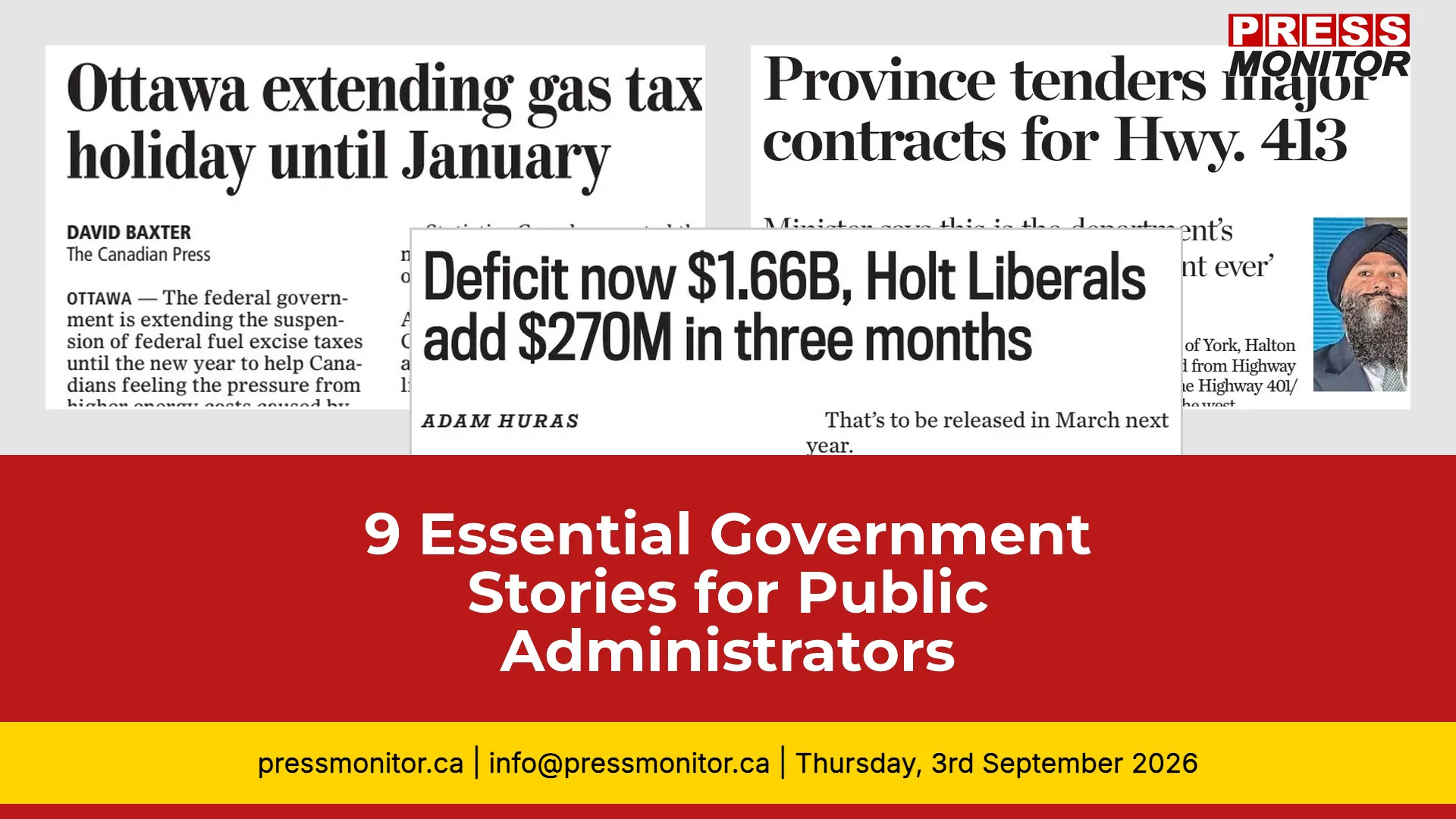
According to Press Monitor's tracking of Canadian publications, this press review delivers the media intelligence public sector leaders need to navigate today's government landscape. From federal fiscal policy to Indigenous resource governance, these 9 stories define the news on government policy that matters most.
1. Federal Gas Tax Holiday Extended Through 2027
Times Colonist reports that the federal government is extending the suspension of the federal fuel excise tax until January 2027 to ease pressure on Canadians from higher energy costs linked to Middle East instability. Finance Minister François-Philippe Champagne said Wednesday in Ottawa that the 10-cent-per-litre tax, first suspended in April after the U.S. war on Iran caused fuel prices to spike, will be phased back in over three months, returning to normal in April 2027. Mark Carney said the full gas tax holiday will cost C$5.3 billion in lost government revenue, up from an earlier estimate of C$2.4 billion.
The federal gas tax suspension is now locked in until January 2027, with Finance Minister Francois-Philippe Champagne confirming the 10-cent-per-litre pause will cost C$5.3 billion in lost revenue. The tax will be halved before resuming fully on April 1, 2027.
Why it matters: Every Canadian household and business feels the impact of fuel price relief, but the deficit implications are significant.
Key detail: The extension was driven by Middle East instability and trade tensions with the United States, not just domestic affordability concerns.
Source: Times Colonist, The Canadian Press
Next step: Watch for countertariff announcements and provincial responses to the federal extension.
2. Ontario Tenders Largest-Ever Highway 413 Contracts
The Welland Tribune reports that the Ontario government is seeking proposals to design and build the eastern stretch of Highway 413, from west of The Gore Road to Highway 400, along with an extension of Highway 427 from Major Mackenzie Drive, in the Brampton, Caledon and Vaughan corridor. Transportation Minister Prabmeet Sarkaria said the contract is expected to be the largest infrastructure procurement ever issued by the Ministry of Transportation, covering about one third of the 52-kilometre corridor. The province also awarded the Highway 410 extension contract to Infrastructure Partners of Ontario, a joint venture of Miller Paving, Green Infrastructure Partners and Amico.
Transportation Minister Prabmeet Sarkaria has announced the largest infrastructure procurement ever issued by the Ministry of Transportation, covering roughly one-third of the 52-kilometre Brampton-Caledon-Vaughan corridor.
Why it matters: This signals a major acceleration of GTA infrastructure development with billions in economic activity at stake.
Key detail: The province also awarded the Highway 410 extension to Infrastructure Partners of Ontario, a joint venture of Miller Paving, Green Infrastructure Partners and Amico.
Source: The Welland Tribune
Next step: Monitor contractor bid timelines and community consultation processes along the corridor.
3. Holt Government's Deficit Balloons to $1.66B
The Tribune (new Brunswick) reports that the Holt government’s record-breaking deficit has ballooned by about another $270 million in just three months.
New Brunswick's record-breaking deficit has grown by approximately $270 million in just three months, raising serious questions about fiscal sustainability.
Why it matters: A ballooning deficit in a smaller province can trigger credit rating pressure and reduced fiscal flexibility.
Key detail: The deficit growth comes amid rising oil prices and new U.S. tariffs that could further strain borrowing costs.
Source: The Tribune (New Brunswick)
Next step: Track whether the province announces corrective measures or faces credit agency scrutiny.
4. New Brunswick Budget Overruns Across Departments
The Tribune reports that New Brunswick's provincial government is over budget in several areas including transportation, justice and public safety, and housing. Despite this, Finance Minister René Legacy asserts the province's health care investments will have long-term impacts.
Multiple departments including transportation, justice, public safety, and housing are over budget, signaling systemic spending challenges across the provincial government.
Why it matters: Overruns in core service areas suggest deeper structural budget pressures that may require difficult trade-offs.
Key detail: Finance Minister René Legacy maintains that health care investments will deliver long-term returns despite near-term deficits.
Source: The Tribune (New Brunswick)
Next step: Assess whether the overruns trigger a mid-year budget revision or spending freeze.
5. New Brunswick Overspending Raises Credit Concerns
The New Brunswick government reports significant overspending in several departments including transportation, justice, and housing. Despite the financial deficits, officials maintain that investments will have long-term positive impacts on health care and other services. The province faces pressure from rising oil prices and new U.S. tariffs, prompting concerns about borrowing costs and potential credit rating downgrades.
Beyond departmental overruns, the province faces potential credit rating downgrades as borrowing costs rise amid global economic uncertainty.
Why it matters: A credit downgrade would increase borrowing costs for the province and affect infrastructure financing and public services.
Key detail: Rising oil prices and U.S. tariffs are compounding the fiscal pressure on New Brunswick's bottom line.
Source: The Tribune (New Brunswick)
Next step: Monitor credit agency commentary and bond market reactions to NB fiscal data.
6. Ottawa Says Climate Law Binds Nobody
Winnipeg Sun reports that the Carney government is arguing in Federal Court that the Canadian Net-Zero Emissions Accountability Act sets no binding obligations or penalties on Ottawa over its net-zero-by-2050 commitments. The editorial notes a December progress report shows Canada on track for roughly half of its 2030 target of cutting emissions 40 to 45 percent below 2005 levels, and Prime Minister Mark Carney has acknowledged the 2030 and 2035 targets will be missed. The Winnipeg Sun calls on Ottawa to either scrap the unenforceable act or table new targets it is prepared to defend in Parliament.
The Carney government is arguing in Federal Court that the Canadian Net-Zero Emissions Accountability Act sets no binding obligations or penalties on Ottawa over its net-zero-by-2050 commitments.
Why it matters: If the court upholds this interpretation, Canada's climate accountability framework becomes effectively unenforceable.
Key detail: Prime Minister Mark Carney has acknowledged the 2030 and 2035 targets will be missed, and a December progress report shows Canada is on track for roughly half of its 2030 emissions reduction target.
Source: Winnipeg Sun Editorial
Next step: Watch for potential legislative amendments or court rulings that could strengthen accountability.
7. West Moberly Chief Slams BC Royalty Model
Vancouver Sun reports that West Moberly First Nations Chief Roland Willson is warning that British Columbia's proposed oil and gas royalty model would return only 11 to 14 per cent of industry net profits, far short of the government's 50 per cent commitment. The Treaty 8 Nations say a natural gas pricing calculation error has inflated provincial revenue forecasts by about C$500 million a year, and they are urging the province to correct its flawed revenue assumptions so British Columbians receive a fair return.
West Moberly First Nations Chief Roland Willson warns that British Columbia's proposed oil and gas royalty model would return only 11 to 14 percent of industry net profits — far short of the government's 50 percent commitment.
Why it matters: A flawed royalty model means First Nations communities and British Columbians are losing millions in fair revenue share.
Key detail: A natural gas pricing calculation error has inflated provincial revenue forecasts by approximately C$500 million annually, and Treaty 8 Nations are urging the province to correct its flawed assumptions.
Source: Vancouver Sun
Next step: Track whether BC corrects its revenue assumptions and engages Treaty 8 Nations in revised negotiations.
8. Federal Government Prioritizes Canadian Materials for PM Residence Restoration
Regina Leader-post reports that the federal government is prioritizing the use of Canadian materials and mandating Indigenous involvement in the multimillion-dollar project to restore the official prime minister’s residence at 24 Sussex Drive in Ottawa.
The federal government is mandating Indigenous involvement in the multimillion-dollar restoration of the official prime minister's residence at 24 Sussex Drive in Ottawa.
Why it matters: This procurement policy sets a precedent for how federal infrastructure projects integrate Indigenous participation and Canadian sourcing.
Key detail: Canadian materials are being prioritized alongside Indigenous involvement requirements for the 24 Sussex Drive restoration project.
Source: Regina Leader-post
Next step: Monitor whether this procurement model is replicated across other federal infrastructure projects.
9. Federal Jobs Prioritized by Race, Sex, Disability
The National Post reports that a new report by the Aristotle Foundation for Public Policy reveals that key federal departments are prioritizing candidates based on race, gender, and disability in new job postings. The report states that 42 percent of the 301 government job openings analyzed between February and July were subject to explicit or potential prioritization based on group identity.
A new report by the Aristotle Foundation for Public Policy reveals that 42 percent of 301 government job openings analyzed between February and July were subject to explicit or potential prioritization based on group identity.
Why it matters: The scale of identity-based prioritization in federal hiring is sparking debate about equity, merit, and transparency in public service recruitment.
Key detail: Key federal departments are leading the prioritization efforts across 42 percent of analyzed job postings.
Source: National Post
Next step: Watch for parliamentary questions and potential policy reviews of federal hiring practices.
Closing: These stories reflect the complexity of Canadian governance in 2026 — from fiscal pressures and infrastructure investment to climate accountability and equity in public service. For ongoing news on government policy, Press Monitor's print media monitoring delivers the curated intelligence professionals rely on. Which story will have the biggest impact on your work this week?