9 Essential Human Resources Stories for HR Leaders


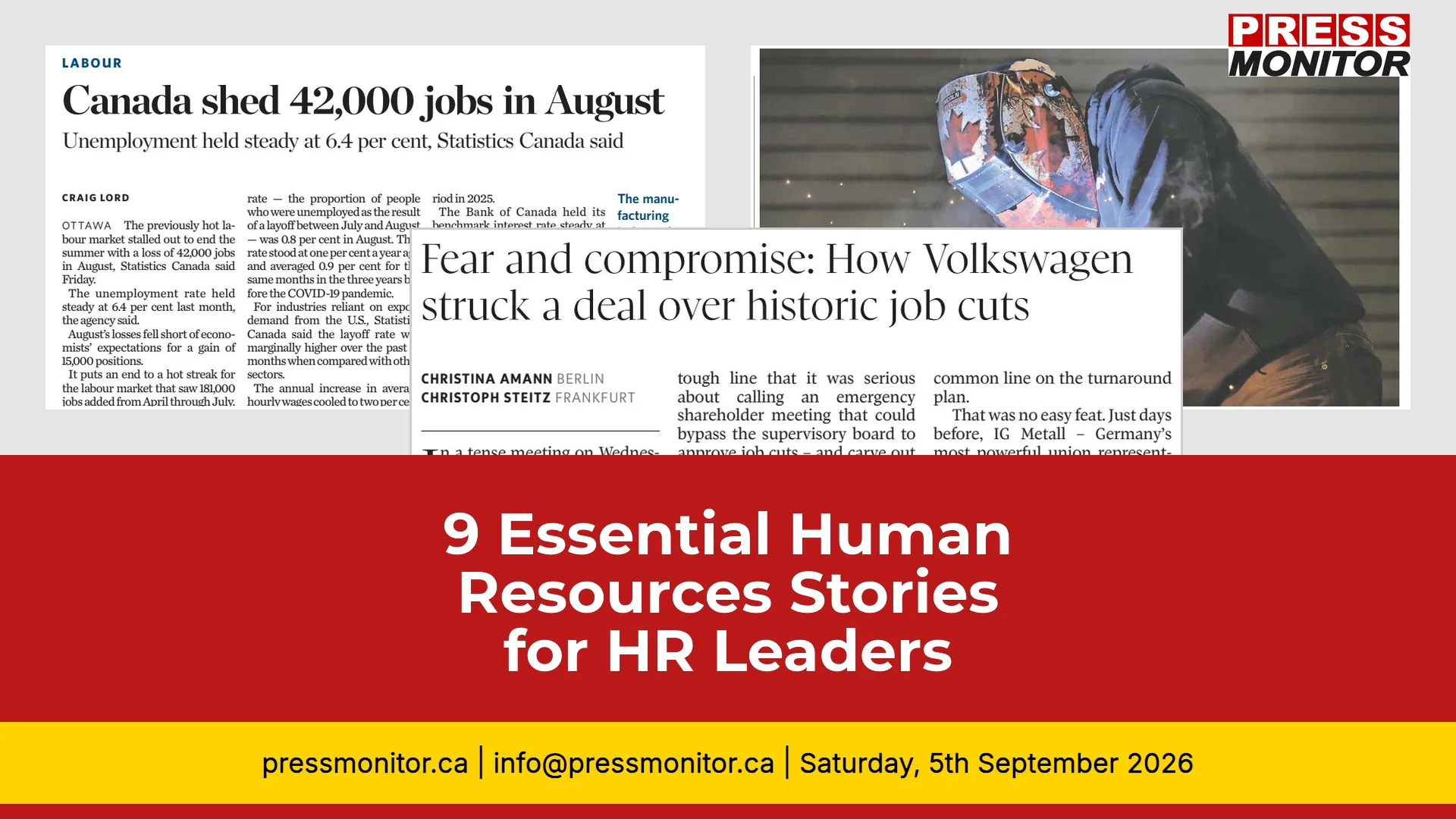
According to Press Monitor's tracking of Canadian publications, this media monitoring report delivers nine essential news on human resources stories shaping Canada's labour landscape. From job losses to union wins, these developments define the week ahead for HR leaders and labour relations professionals. This print media monitoring analysis combines media intelligence with real editorial data to give you the edge before your next board meeting.
1. Canada Loses 42,000 Jobs in August
The Hamilton Spectator reports that Canada lost 42,000 jobs in August as the labour market stalled, with the unemployment rate holding steady at 6.4%, down from a hot streak that saw 18,000 jobs added from April through July. Statistics Canada reported that the public sector shed 20,000 positions for a third straight month, manufacturing gained 22,000 jobs despite US tariffs taking effect on $28 billion in Canadian goods, and young workers aged 15 to 24 faced 19,000 job losses in the month. Canada's labour market stalled in August, shedding 42,000 jobs as the unemployment rate held steady at 6.4%. The public sector shed 20,000 positions for a third straight month, while manufacturing added 22,000 jobs despite US tariffs on $28 billion in Canadian goods. Young workers aged 15 to 24 faced 19,000 job losses. Why it matters: This is the sharpest monthly reversal in months, signaling that tariff uncertainty is now hitting Canadian employment directly. Source: Statistics Canada via The Hamilton Spectator. Next step: HR leaders should prepare contingency workforce plans for sectors exposed to cross-border trade disruption.
2. 22,000 Manufacturing Jobs Added in August
{source_name} reports that Canada added 22,000 manufacturing jobs in August, marking one of the few bright spots in the country's employment statistics. A welder works at a manufacturing facility in Vars, Ont, highlighting the sector's contribution to employment. Manufacturing was the only sector to record significant employment gains, adding approximately 22,000 jobs in August. A welder at a facility in Vars, Ontario, symbolises the sector's contribution to national employment. Why it matters: As tariffs take effect, manufacturing remains a rare bright spot, offering a counter-narrative to broader job losses. Source: Edmonton Journal. Next step: Talent acquisition teams in manufacturing should accelerate hiring before potential tariff-driven slowdowns deepen.
3. Volkswagen Agrees to 100,000 Job Cuts
The Globe And Mail reports that Volkswagen has struck a landmark restructuring deal to cut 100,000 jobs, avoiding a threatened emergency shareholder meeting that could have bypassed the supervisory board. Chief executive Oliver Blume, supervisory board chair Hans Dieter Poetsch, and Lower Saxony state premier Olaf Lies reached the agreement, which represents the biggest restructuring in the group's 89-year history. The deal averts a damaging standoff between management and unions but still requires further negotiation with workers. Volkswagen struck a landmark restructuring deal to cut 100,000 jobs, the biggest in the group's 89-year history. CEO Oliver Blume, supervisory board chair Hans Dieter Poetsch, and Lower Saxony premier Olaf Lies reached the agreement, averting a damaging standoff between management and unions. Why it matters: The deal sets a precedent for how global automakers will navigate the transition to electric vehicles while managing workforce reductions. Source: The Globe and Mail. Next step: HR leaders in automotive supply chains should monitor downstream employment impacts across Canadian manufacturing partners.
4. NHL Season Changes Under New CBA
The Ottawa Citizen reports that the NHL's new four-year collective bargaining agreement introduces significant changes for the upcoming season, including a reduction in preseason games, a return to eighty-four regular-season games, and stricter emergency backup goaltender requirements. Additionally, contract lengths are capped, and neck guards become mandatory for rookies, while nineteen-year-old draft picks may now be assigned to the American Hockey League. The NHL's new four-year collective bargaining agreement introduces reduced preseason games, a return to 84 regular-season games, stricter emergency backup goaltender requirements, and mandatory neck guards for rookies. Contract lengths are capped and nineteen-year-old draft picks may now be assigned to the American Hockey League. Why it matters: Labour-management relations in professional sports offer HR lessons in negotiated flexibility and workforce structure. Source: Ottawa Citizen. Next step: HR teams in sports and entertainment should study the CBA's approach to contract governance and emergency staffing protocols.
5. United States Jobs Rebound
The Welland Tribune reports that employers in the United States added one hundred sixty-two thousand jobs in August, while the unemployment rate stayed at four point one percent, according to a Labor Department report released on Friday. The stronger hiring, led by restaurants and bars, construction and manufacturing, gives President Donald Trump favorable economic news before United States midterm elections and may affect Federal Reserve interest-rate decisions. US employers added 162,000 jobs in August while unemployment held at 4.1%. The stronger hiring, led by restaurants, construction, and manufacturing, gives President Donald Trump favourable economic news before midterm elections. Why it matters: A resilient US labour market influences Canadian cross-border talent flows and wage competitiveness. Source: The Welland Tribune. Next step: Canadian HR leaders should track US hiring trends for implications on north-south talent mobility and compensation benchmarking.
6. Radio-Canada Workers Get 14.5% Raise
Le Journal de Montreal reports that Radio-Canada and the CBC are set to grant a 14.5% salary increase to their unionized employees following a tentative agreement signed Thursday night. Union president Lise Millette will recommend the deal to members, which includes hikes of 6% in 2026, 3% in 2027, 3% in 2028, and 2.5% in 2029. Radio-Canada and the CBC are set to grant a 14.5% salary increase to unionized employees following a tentative agreement. Union president Lise Millette will recommend the deal, which includes hikes of 6% in 2026, 3% in 2027, 3% in 2028, and 2.5% in 2029. Why it matters: Public broadcasting labour peace demonstrates the value of proactive collective bargaining in avoiding disruptive strikes. Source: Le Journal de Montréal. Next step: HR leaders in public-sector and media organizations should benchmark this settlement against their own compensation structures.
7. Six Ontario Teacher Myths Exposed
The Hamilton Spectator reports that as collective agreements expire, six myths about Ontario teachers are misleading the public. Andrew Wilkin argues precarious employment, biased hiring, and unsafe schools harm both educators and students, with underfunding dating back to the 1990s. He urges support for unions fighting for secure contracts and healthier workplaces. As collective agreements expire, six myths about Ontario teachers are misleading the public. Andrew Wilkin argues that precarious employment, biased hiring, and unsafe schools harm both educators and students, with underfunding dating back to the 1990s. Why it matters: Teacher labour relations directly affect school board HR planning and public trust in education. Source: The Hamilton Spectator. Next step: Education-sector HR leaders should use these findings to strengthen union engagement and contract negotiation strategies.
8. 200 Long-Term Care Workers Demand Fair Deal
The Daily Press reports that 200 long-term care workers at Extendicare Timmins are demanding a fair collective agreement after eight months without a contract. These employees, including nurses and support staff, held a province-wide day of action on Thursday to protest stalled wage negotiations led by the Canadian Union of Public Employees. The for-profit facility currently has 298 people on a waiting list for its 180 licensed beds. 200 long-term care workers at Extendicare Timmins are demanding a fair collective agreement after eight months without a contract. These employees, including nurses and support staff, held a province-wide day of action to protest stalled wage negotiations led by CUPE. The for-profit facility has 298 people on a waiting list for its 180 licensed beds. Why it matters: Healthcare labour disputes directly impact service delivery and patient care standards. Source: The Daily Press (Timmins). Next step: HR leaders in healthcare should prioritize contract negotiations before work stoppages escalate.
9. AUPE Fights For Workers' Rights
Edmonton Journal reports that Sandra Azocar, president of the Alberta Union of Provincial Employees, writes about the ongoing struggles of workers in Alberta. She highlights how the Alberta government has used the notwithstanding clause to deny teachers and other workers their constitutional right to strike, and how AUPE members in continuing care face dangerous understaffing. Azocar calls on Albertans to support unions in their fight to preserve workers' rights and ensure safe, dignified workplaces. Sandra Azocar, president of the Alberta Union of Provincial Employees, highlights how the Alberta government has used the notwithstanding clause to deny teachers and other workers their constitutional right to strike. AUPE members in continuing care face dangerous understaffing. Why it matters: The use of legislative override on labour rights raises fundamental questions about workers' protections in Canada. Source: Edmonton Journal. Next step: Labour relations professionals should monitor legislative developments that may affect collective bargaining rights across provinces.
Which of these stories will reshape your HR strategy in the coming quarter?