9 Essential Railways Stories for Industry Leaders


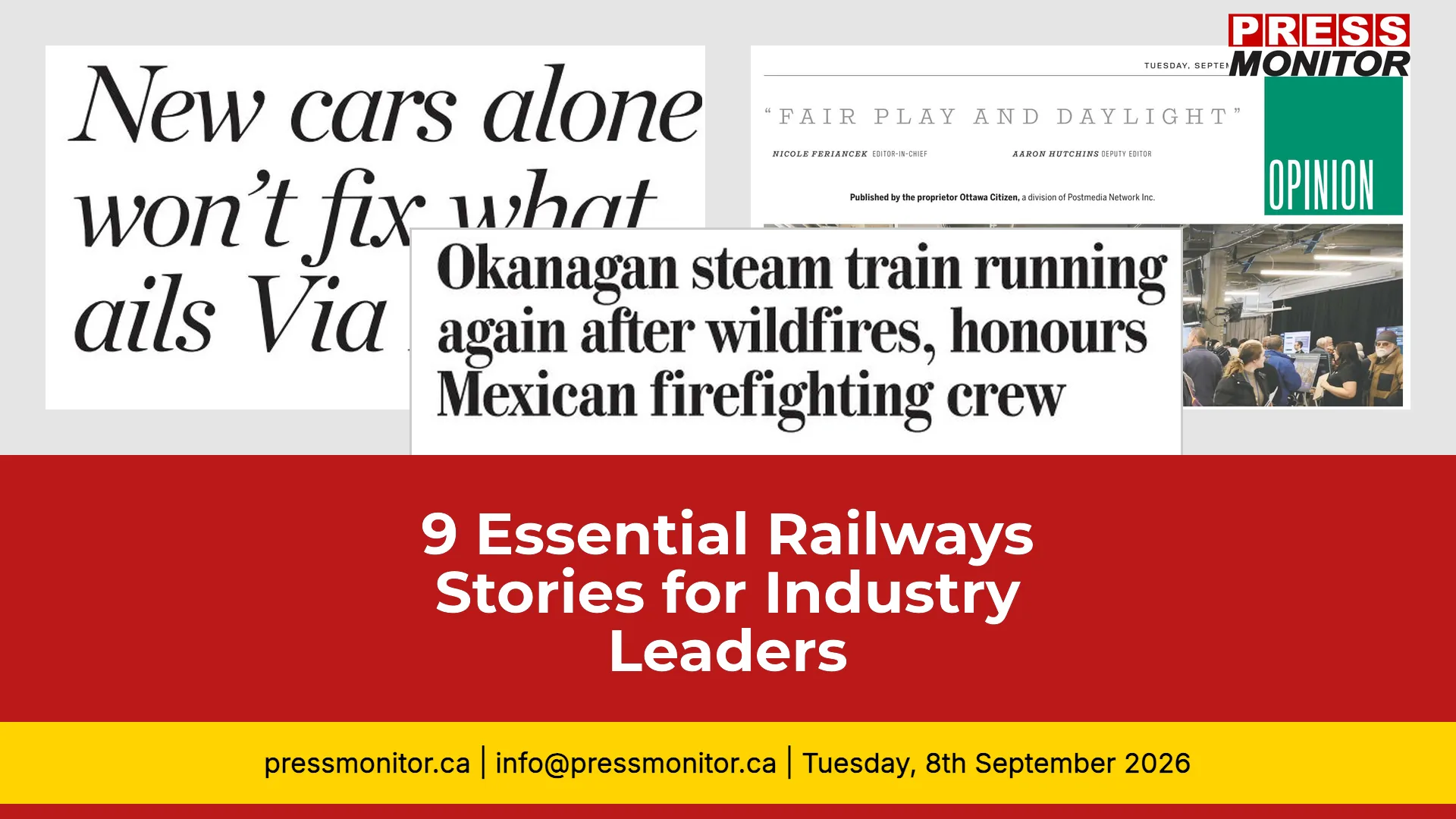
According to Press Monitor's tracking of Canadian publications, today's print media delivers nine essential stories on railways and rail transport — from a historic Via Rail fleet announcement to urgent calls to cancel the Alto high-speed rail project. This press review offers media intelligence on the investments, controversies, and developments shaping Canada's rail future. Whether you follow news on railways for investment decisions or policy strategy, this media monitoring roundup demands your attention.
1. $4.7 Billion Via Rail Fleet
The Standard reports that Prime Minister Mark Carney announced a new fleet of 300 Via passenger rail cars to be built by Alstom in Thunder Bay at a cost of $4.7 billion. The fleet will use Canadian steel and be maintained in Canada, with the goal of making Via Rail faster and more reliable. The announcement also references plans for high-speed rail between Toronto and Quebec City. Prime Minister Mark Carney announced a new fleet of 300 Via passenger rail cars to be built by Alstom in Thunder Bay at a cost of $4.7 billion. Why it matters: This is the largest single rail investment in Canadian history, using Canadian steel and Canadian maintenance — a major win for domestic manufacturing. Key detail: The fleet aims to make Via Rail faster and more reliable, with plans for high-speed rail between Toronto and Quebec City. Source: The Standard, by Matt Gurney. Next step: Watch for Alstom's construction timeline and union impact in Thunder Bay. How will this reshape Canada's passenger rail landscape?
2. Alto Rail Project Faces Call for Cancellation
Ottawa Citizen reports that readers are urging Prime Minister Mark Carney to freeze or cancel the Alto high-speed rail project, citing its estimated cost of 60 billion to 90 billion Canadian dollars and the failures of Ottawa's light rail system. Critics argue that winter weather makes electric trains impractical in Canada and that limited population density reduces potential ridership. Another letter raises concerns about Elections Quebec providing voting information only in French, and a separate submission notes that excessive summer rainfall has ruined wild blueberry crops in Ontario and Quebec. Readers are urging Prime Minister Mark Carney to freeze or cancel the Alto high-speed rail project, citing an estimated cost of $60 billion to $90 billion Canadian dollars. Why it matters: The project's price tag dwarfs the Via Rail investment and raises questions about fiscal responsibility. Key detail: Critics reference Ottawa's troubled light rail system, limited population density, and winter weather as reasons the project is impractical. Source: Ottawa Citizen, by Kathleen To. Next step: Monitor whether the government responds to public pressure. Is this the beginning of the end for Alto Rail?
3. Kettle Valley Railway Reopens, Honours Crew
Times Colonist reports that the Kettle Valley Steam Railway has resumed operations near Summerland after a one-month closure due to the Bald Range wildfire. Organizers arranged a complimentary afternoon excursion specifically to honour the Mexican firefighting crews whose assistance was instrumental in battling the blaze. The Kettle Valley Steam Railway has resumed operations near Summerland after a one-month closure due to the Bald Range wildfire. Why it matters: The restart demonstrates rail infrastructure resilience and community spirit. Key detail: Organizers arranged a complimentary excursion to honour the Mexican firefighting crews whose assistance was instrumental in battling the blaze. Source: Times Colonist, by Rob Gibson. Next step: Track recovery timelines for other wildfire-affected rail lines in British Columbia.
4. Railtown Businesses Push for Housing and Retail Development
Vancouver Sun reports that businesses in the Railtown area of Vancouver are urging municipal planners to revise zoning laws to accommodate more residential units, retail spaces, and restaurants. City officials warn that mixing housing with active industrial zones requires careful design to manage rail noise and vibration while protecting vital employment areas. Community advocates stress that adding affordable housing and support services will help sustain the neighbourhood workforce without erasing its distinct industrial character. Businesses in Vancouver's Railtown area are urging municipal planners to revise zoning laws to accommodate more residential units, retail spaces, and restaurants. Why it matters: The tension between industrial rail corridors and urban growth is a national trend. Key detail: City officials warn that mixing housing with active industrial zones requires careful design to manage rail noise and vibration. Source: Vancouver Sun. Next step: Follow Vancouver city council's zoning revision process.
5. Quebec Transit Funding Crisis
Montreal Gazette reports that Quebec tailpipe pollution from cars is the fastest-growing source of greenhouse gases, with a social cost of C$2.4 billion in 2026. Yet public transit remains overlooked by political parties, while the CAQ government has starved mass transport of funding and no new projects have launched in Greater Montreal for eight years. Studies show losing existing transit would add 688,000 cars to roads, but new projects like the Blue Line extension and REM expansions could boost affordability, fight climate change, and create jobs. Quebec tailpipe pollution from cars is the fastest-growing source of greenhouse gases, with a social cost of C$2.4 billion in 2026, yet public transit remains overlooked. Why it matters: The CAQ government has starved mass transport of funding with no new projects in Greater Montreal for eight years. Key detail: Losing existing transit would add 688,000 cars to roads, but new projects like the Blue Line extension and REM expansions could boost affordability and create jobs. Source: Montreal Gazette. Next step: Watch for transit funding announcements in the next provincial budget.
6. $9,200 Car Cost Drives Transit Debate
The Montreal Gazette reports that a new joint study by the Communauté métropolitaine de Montréal and the Chambre de commerce du Montréal métropolitain shows investing in public transport could address major social, financial, and environmental issues. With motorists spending an average of nine thousand two hundred dollars annually on vehicles, expanding mass transit offers a viable alternative to high household costs and severe traffic congestion. Boosting commuter rail networks would simultaneously create jobs, improve business efficiency, and mitigate over six billion dollars in annual productivity losses. A joint study by the Communauté métropolitaine de Montréal and the Chambre de commerce du Montréal métropolitain shows that motorists spend an average of $9,200 annually on vehicles. Why it matters: Expanding mass transit offers a viable alternative to high household costs and severe traffic congestion. Key detail: Boosting commuter rail networks would create jobs, improve business efficiency, and mitigate over $6 billion in annual productivity losses. Source: Montreal Gazette, by Allison Hanes. Next step: Will this study influence Quebec transit policy debates?
7. Cars Eat 15% of Income
Montreal Gazette reports that a study by the Communauté métropolitaine de Montréal and the Chambre de commerce du Montréal métropolitain finds that car ownership consumes up to fifteen percent of household income and that investing in public transit could cut costs to just over one percent, while also creating jobs and reducing congestion and greenhouse‑gas emissions. A study finds that car ownership consumes up to 15% of household income and that investing in public transit could cut costs to just over 1%. Why it matters: The financial case for transit investment has never been stronger. Key detail: Beyond cost savings, expanded transit reduces congestion and greenhouse gas emissions. Source: Montreal Gazette, by John Mahoney. Next step: Share this data with local transit advocates and municipal planners.
8. $40 Million Hotel Planned for Vancouver
The Vancouver Sun reports that major redevelopment projects are transforming Vancouver's Marine Landing area into a dense urban hub around the Marine Drive Station. PCI Developments plans to add two 43-storey towers and mid-rise buildings providing approximately 1,000 rental homes, while another developer proposes a 324-room hotel featuring an industrial Breka bakery. Experts and officials highlight the benefits of transit-oriented growth, though some caution about protecting limited industrial land as the neighbourhood expands towards the Fraser River waterfront. PCI Developments plans to add two 43-storey towers and mid-rise buildings near Marine Drive Station, including a 324-room hotel with an industrial Breka bakery. Why it matters: Transit-oriented development around rail stations is reshaping Vancouver's urban landscape. Key detail: Experts highlight the benefits of mixing housing and retail with rail infrastructure, though some caution about protecting limited industrial land. Source: Vancouver Sun, by Savio Grochowski. Next step: Monitor community feedback on the Marine Landing redevelopment.
9. UAE Secures Trade Routes Against War
The Globe And Mail (ottawa/quebec Edition) reports that the United Arab Emirates is building alternative routes for its energy exports and trade to ensure they are not held hostage by the continuing war between the United States and Iran. UAE presidential adviser Anwar Gargash announced the expansion of port capacity and development of pipelines, railways, and trade routes at the Hili Forum in Abu Dhabi. Gargash warned that rebuilding trust after Iranian attacks could take decades and criticized Gulf Arab states for failing to unify their strategy. The UAE is building alternative routes for energy exports and trade, including the expansion of railways and pipelines, to ensure they are not held hostage by the US-Iran conflict. Why it matters: Global trade route security directly affects Canadian export logistics and commodity pricing. Key detail: UAE presidential adviser Anwar Gargash announced the expansion at the Hili Forum in Abu Dhabi, warning that rebuilding trust after Iranian attacks could take decades. Source: The Globe and Mail (Ottawa/Quebec Edition). Next step: Track how Gulf rail infrastructure investments affect global supply chains.
These nine stories, tracked by Press Monitor from Canadian print publications, reveal a railways sector at a pivotal moment — from record investments in Via Rail to urgent debates over high-speed rail feasibility and transit funding. Which story will have the biggest impact on your sector? Share your thoughts in the comments.