9 Essential Supply Chain Stories for Logistics Leaders


From critical mineral deals to tariff disputes and retail transformation, today's Canadian print media landscape offers a sharp view into the forces reshaping logistics and supply chains. According to Press Monitor's tracking of Canadian publications, here are the stories that matter most to professionals relying on media monitoring for timely insights.
1. Canada's Unused Dairy Access
{source_name} reports that Canada has made approximately C$413 million of preferential dairy access available to the United States since July 2020, but only about C$164 million has been used. That leaves roughly C$249 million, or 60 per cent of the negotiated access, unused, representing an estimated C$500 million to C$700 million in American dairy products that could have entered Canada.
Why it matters: A key CUSMA commitment remains largely unfulfilled, signaling ongoing friction in Canada-U.S. agricultural trade.
Key detail: Only C$164M of C$413M in preferential dairy access has been used since 2020, leaving an estimated C$500-700M in potential American dairy imports on the table.
Source: Regina Leader-Post
Next step: Importers should reassess supply chain strategies for cross-border dairy shipments.
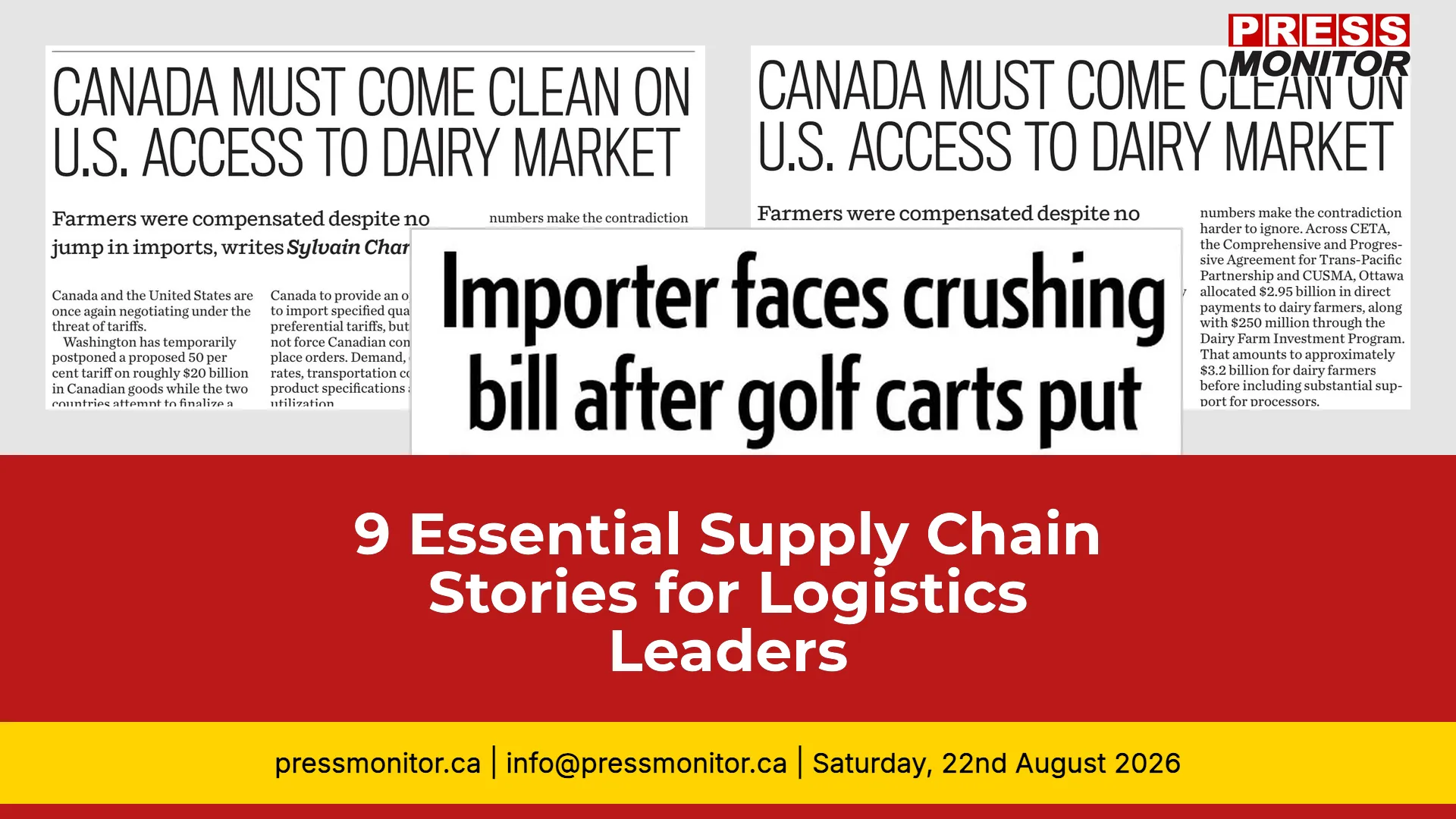
2. Canada Must Come Clean on U.S. Dairy Market Access
Saskatoon Starphoenix reports that despite Canada and the United States negotiating under the threat of tariffs, Ottawa has not demonstrated that it is honoring the practical market-access commitments it made in 2020. The article highlights that only about 164 million kg of the 413 million kg of preferential dairy access made available to the United States since July 2020 has been utilized.
Why it matters: Ottawa faces pressure to demonstrate it is honoring trade commitments made during tariff negotiations.
Key detail: Only 164M kg of 413M kg of preferential access utilized since July 2020.
Source: Saskatoon StarPhoenix
Next step: Monitor for policy announcements that could affect logistics and warehousing for dairy imports.
3. Import Company Faces $178K Bill
National Post reports that a Canadian small business, JPSMGolf, is in jeopardy after the federal government placed electric golf carts in the same import category as electric vehicles. This categorization led to a heavy surtax bill of over 178,000 dollars for Joseph McLuckie's company.
Why it matters: Tariff classification errors are creating massive cost burdens for small businesses.
Key detail: Electric golf carts reclassified as EVs resulted in a C$178K surtax for JPSMGolf.
Source: National Post
Next step: Ensure your import compliance team reviews HS code classifications regularly.
4. Lululemon's Calgary Recycling Hub
Vancouver-based Lululemon partners with Denver-based Tersus Solutions to open a 25,000-square-foot recycling facility in Calgary. The plant will clean, repair, and resell used athletic apparel using liquid CO2 technology.
Why it matters: A new 25,000-sq-ft facility using liquid CO2 cleaning technology marks a major shift in textile recommerce logistics.
Key detail: Partners with Tersus Solutions to clean, repair, and resell used apparel.
Source: Vancouver Sun
Next step: Explore reverse logistics partnerships for your own circular economy initiatives.
5. Elevra Lithium Secures Supply Price Floor
Calgary Herald reports that Elevra Lithium Ltd. has secured a price-floor agreement to supply spodumene concentrate to Mangrove Lithium's planned conversion plant in Canada. The deal aims to ensure the long-term viability of the Quebec-based project as Western countries seek to reduce reliance on Chinese critical-mineral supply chains.
Why it matters: A price-floor agreement for spodumene concentrate strengthens Canada's critical mineral supply chain independence from China.
Key detail: Deal with Mangrove Lithium ensures long-term viability for a Quebec conversion plant.
Source: Calgary Herald
Next step: Consider how price-floor contracts can stabilize raw material sourcing in your supply chain.
6. Trump Administration Allows More Beef Imports
The Toronto Star reports that President Donald Trump announced that his administration will allow more temporary beef imports into the US without triggering higher tariffs. This move has drawn pushback from cattle producers and conservative rural-state Republicans.
Why it matters: Temporary import allowance without higher tariffs could affect North American beef logistics.
Key detail: Pushback from cattle producers and GOP lawmakers.
Source: Toronto Star
Next step: Adjust demand forecasting for cross-border beef shipments if policy shifts.
7. Shein's IPO Valuation Drops to $25B
{source_name} reports that Shein, once a fast-fashion virtual leader once hyped at US$100 billion, is poised for a second public appearance at a much lower valuation (~US$25 billion) in Hong Kong, despite declining U.S. sales and legal scrutiny over labor practices and supply chain ethics.
Why it matters: The fast-fashion giant's declining valuation and supply chain scrutiny signal risks for global e-commerce logistics.
Key detail: U.S. sales decline and labor practice investigations ahead of Hong Kong listing.
Source: The Globe and Mail
Next step: Evaluate exposure to fast-fashion supply chain partners for potential disruptions.
8. Roots Corp Export Deal by Marquee Brands
Marquee Brands, the New York-based management firm behind Martha Stewart, Laura Ashley and Roberto Cavalli, has agreed to buy Roots Corp. and aims to export the Canadian brand globally, targeting markets such as Korea, India and Mexico. The deal would expand Roots’ limited U.S. presence and build on existing operations in Asia and through Tmall.
Why it matters: A U.S. brand management firm acquires Roots for global expansion, targeting Korea, India, Mexico.
Key detail: Marquee Brands plans to build on existing Asia operations and Tmall presence.
Source: The Globe and Mail
Next step: Watch for new distribution and warehousing requirements as Roots expands internationally.
9. Canadian Oak Barrels: A Whisky Revolution?
Saskatoon Starphoenix reports that Canadian oak barrels are being used by both French winemakers and Canadian whisky makers to produce award-winning products. While some experts are convinced of the flavour advantage of Canadian oak barrels, others remain unconvinced. The debate is further complicated by the potential impact of U.S. tariffs on the export of Canadian whisky.
Why it matters: Tariff risks and flavour debates create uncertainty for Canadian whisky exporters.
Key detail: U.S. tariffs could impact the export of Canadian whisky, affecting barrel supply chains.
Source: Saskatoon StarPhoenix
Next step: Monitor tariff developments that could disrupt spirits logistics.
Closing: Which of these logistics trends will impact your business most? Follow Press Monitor for daily press reviews powered by comprehensive print media monitoring.