9 Key Environment & Conservation Stories for Sustainability Leaders


Staying ahead of environmental shifts is critical for sustainability leaders. According to Press Monitor's tracking of Canadian publications, here are the 9 most important environment and conservation stories from August 22, 2026, covering AI's climate cost, wildfire health risks, and more. This press review delivers the media intelligence you need to navigate today's landscape.
1. AI's Climate Cost Rises
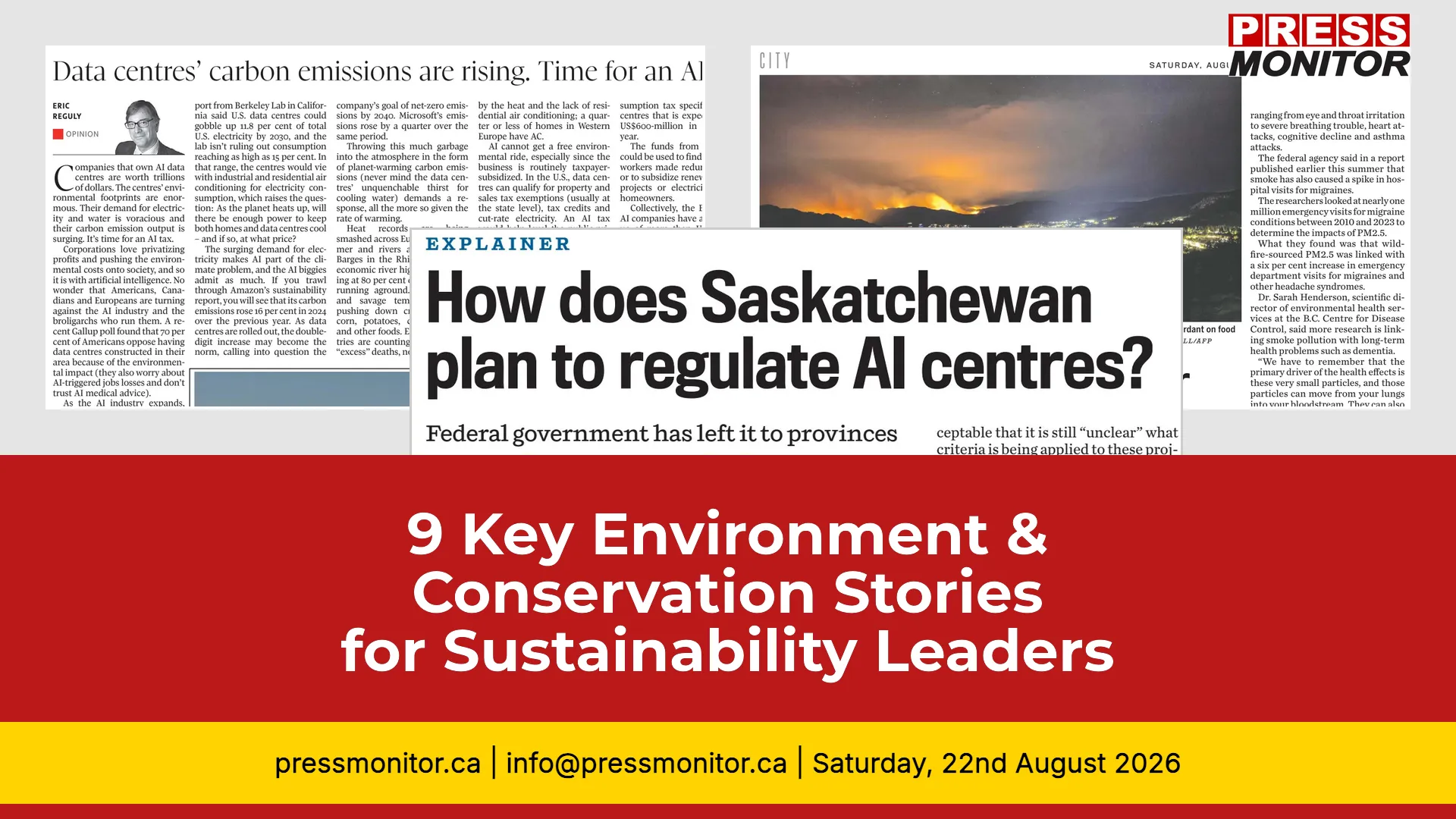
A front-page report in The Globe And Mail reports that data centres’ carbon emissions are rising, driven by surging electricity and water demand, fueling public opposition and calls for an AI tax. Companies like Amazon and Microsoft have seen significant increases in emissions, undermining net-zero goals. Proposed AI taxes aim to address environmental costs, with funds directed toward renewable energy or displaced workers.
Why it matters: Data centres' carbon emissions are surging, undermining net-zero goals. Key detail: A front-page report in The Globe and Mail reveals that companies like Amazon and Microsoft have seen significant emission increases, fueling calls for an AI tax.
Source: The Globe and Mail (Eric Reguly). Next step: Monitor policy developments around AI taxation and renewable energy mandates.
2. Wildfire Evacuees Face Health Risks
The Vancouver Sun reports that as many B.C. residents return home after recent wildfires tore through their communities, experts urge caution because smoke damage, ash, spoiled food and crops, chemical or gas leaks, as well as unclean drinking water all pose serious health risks.
Why it matters: As B.C. residents return home after wildfires, experts warn of serious health risks from smoke damage, ash, and contaminated water. Key detail: The Vancouver Sun reports that spoiled food, chemical leaks, and unclean drinking water pose ongoing threats.
Source: Vancouver Sun (Tiffany Crawford). Next step: Ensure your organization's emergency response plans include post-fire health protocols.
3. AI Data Centres in Saskatchewan Raise Oversight Questions
"Selon le Starphoenix, l'essor de l'intelligence artificielle au Saskatchewan soulève des questions sur la surveillance de ces nouveaux projets technologiques. Au moins deux grands centres de données IA ont été choisis dans la province au cours des six derniers mois, suscitant l'intérêt du public et soulevant des doutes quant à l'examen adéquat de ces installations. Bell Canada est en train de construire un campus d'IA de 300 mégawatts près de Regina, tandis qu'Aztec AI Health a demandé la construction d'un centre de données de 150 mégawatts à Moose Jaw. Les décisions concernant ces projets sont entre les mains des provinces et des municipalités, suscitant des préoccupations quant à leur impact environnemental et nécessitant un examen plus approfondi."
Why it matters: At least two major AI data centres are planned in Saskatchewan, but environmental oversight is lacking. Key detail: Bell Canada is building a 300-megawatt campus near Regina, while Aztec AI Health seeks a 150-megawatt centre in Moose Jaw.
Source: Saskatoon StarPhoenix. Next step: Engage with municipal planning processes to ensure environmental assessments are thorough.
4. Port Hope Nuclear Reactor Plans
The Globe And Mail reports that Port Hope, Ontario, is grappling with plans to build one of the world’s largest nuclear power plants in a community already heavily contaminated with low-level radioactive waste.
Why it matters: Port Hope, Ontario, already contaminated with low-level radioactive waste, faces plans for one of the world's largest nuclear plants. Key detail: The Globe and Mail reports the community is grappling with the proposal.
Source: The Globe and Mail. Next step: Review environmental impact assessments and community consultation plans.
5. Biodegradable Utensils Combat Microplastics
The Hamilton Spectator reports that in Woburn, Massachusetts, CJ Biomaterials is pioneering the use of bioplastic pellets to create forks and films that degrade in composting bins, offering an alternative to persistent microplastics in the environment.
Why it matters: Bioplastics offer a solution to persistent microplastic pollution. Key detail: The Hamilton Spectator reports that CJ Biomaterials in Massachusetts is producing bioplastic forks and films that degrade in composting bins.
Source: The Hamilton Spectator. Next step: Explore bioplastic alternatives for your supply chain.
6. Canada Joins International Declaration to Reduce GHG Procurement Emissions
"Selon Ottawa Citizen, le gouvernement fédéral a signé une déclaration internationale dans le but de limiter les émissions de gaz à effet de serre liées aux achats publics. La Déclaration de Belém sur l'approvisionnement public durable, présentée par le Brésil lors de la COP3O en novembre 2025, promeut le partage de connaissances et la collaboration internationale pour réduire les émissions de gaz à effet de serre dans les achats gouvernementaux. La Lituanie, les Pays-Bas et le Mexique ont également signé la déclaration. Bien que la déclaration soit « non contraignante et ne soit pas assortie d’engagements financiers ou d’obligations légales », selon un site web du gouvernement brésilien, la participation du Canada confirme son engagement à utiliser les achats publics comme un outil stratégique pour soutenir la croissance économique et réduire l’impact environnemental tout en assurant la valeur pour les Canadiens."
Why it matters: Canada signed the Belém Declaration on sustainable public procurement to reduce greenhouse gas emissions. Key detail: The non-binding declaration promotes knowledge sharing and international collaboration.
Source: Ottawa Citizen. Next step: Align your procurement policies with emerging sustainable procurement standards.
7. Proposed Pipeline Focus of Millgrove Info Session
The Hamilton Spectator reports that Enbridge Gas is considering a new natural gas pipeline in rural Hamilton. The project involves installing over 10 kilometers of 48-inch pipeline between valve sites in Kirkwall and Hamilton as part of the Dawn Parkway System Renewal Project.
Why it matters: Enbridge Gas is considering a new natural gas pipeline in rural Hamilton. Key detail: The project involves over 10 kilometres of 48-inch pipeline as part of the Dawn Parkway System Renewal Project.
Source: The Hamilton Spectator (Andrew Baulcomb). Next step: Participate in community information sessions to understand local impacts.
8. Seven Groups Push Parks Smoking Ban
Seven organizations, including the Canadian chapter of Action on Smoking and Health, have written to Environment and Climate Change Minister Julie Dabrusin urging a smoking ban in national parks, historic sites and conservation areas to reduce wildfire risk and cigarette-butt litter. The groups argue the ban is needed as climate change worsens wildfire conditions and would help Canada meet its tobacco-reduction goals.
Why it matters: Seven organizations urge a smoking ban in national parks to reduce wildfire risk and cigarette-butt litter. Key detail: The letter to Environment Minister Julie Dabrusin argues the ban is needed as climate change worsens wildfire conditions.
Source: The Globe and Mail (Matthew Frank). Next step: Support policies that reduce wildfire ignition sources.
9. Increased Mustard Spiciness Due to Prairies Drought
The Toronto Star reports that there has been a notable increase in the spiciness of the Canadian mustard crop. This is due to the hotter and drier conditions on the Canadian Prairies over the last five years, which have affected the glucosinolate levels in mustard seeds. Food manufacturers may need to adjust their recipes as a result.
Why it matters: Climate change is altering crop characteristics, affecting food manufacturers. Key detail: The Toronto Star reports that hotter, drier conditions on the Prairies have increased glucosinolate levels in mustard seeds, making them spicier.
Source: Toronto Star. Next step: Food companies should adjust recipes and monitor agricultural impacts of climate change.
Closing: These stories highlight the intersection of technology, policy, and environmental health. Which of these trends is most relevant to your organization? Share your thoughts below.