9 Key Geopolitics Stories for Global Strategy Leaders


In today's media monitoring roundup from Press Monitor's tracking of Canadian publications, we bring you the latest news on geopolitics and international relations from Canadian print media. From trade war escalations to military strikes, here is your essential press review covering the most pivotal developments.
1. Canada's Struggle to Diversify Trade Partners
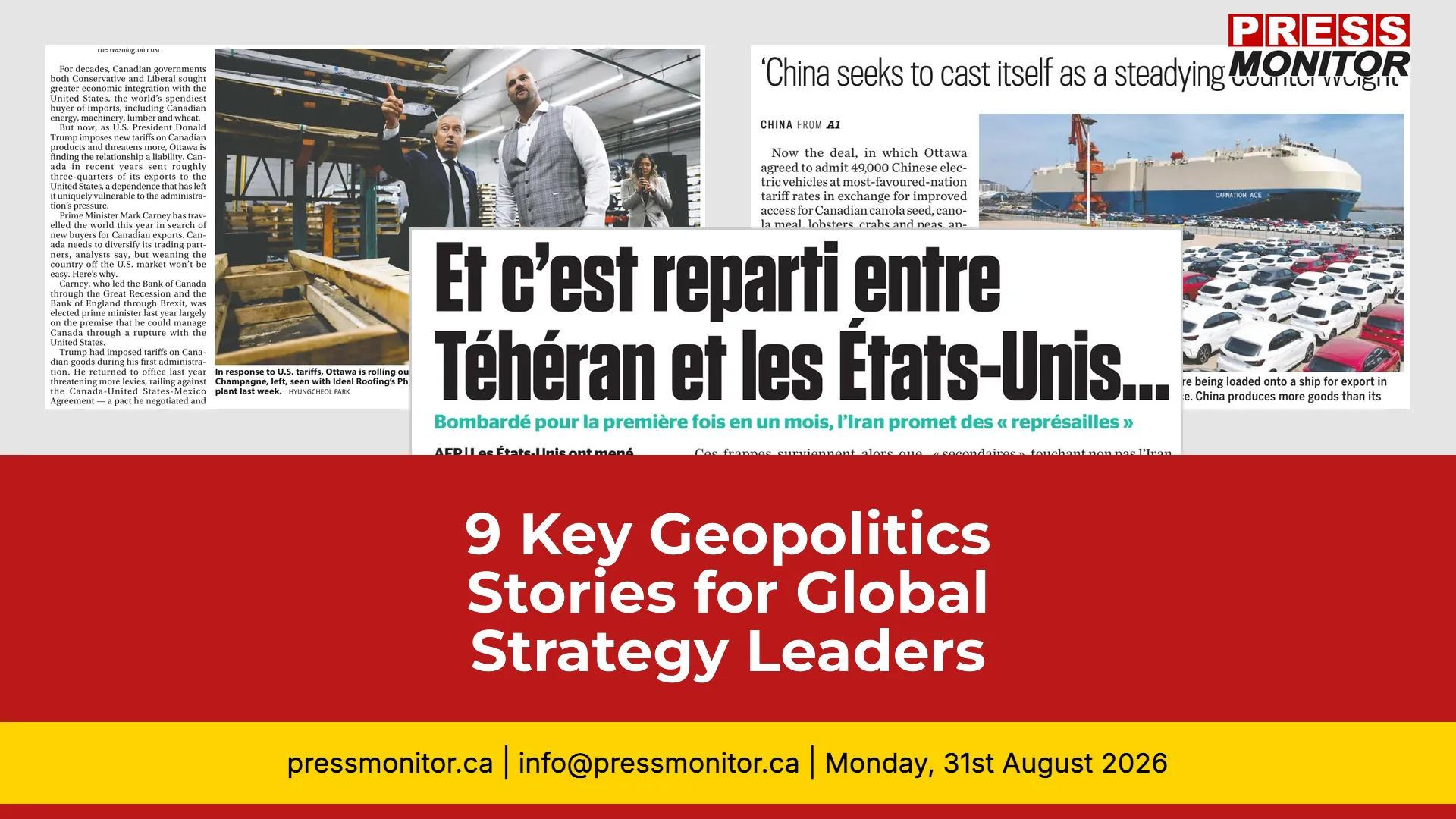
{source_name} reports that Canadian Prime Minister Mark Carney is actively seeking new buyers for Canadian exports as U.S. President Donald Trump imposes new tariffs and threatens more, creating a unique liability for Canada's heavily dependent economy. Since taking office, Carney has championed trade diversification and visited two dozen countries to cultivate new non-U.S. partnerships.
Why it matters: As the US imposes tariffs, Canada's heavy reliance on the American market becomes a critical vulnerability. Key detail: Prime Minister Mark Carney has visited two dozen countries to secure new buyers for Canadian exports.
Source: The Province. Next step: Global strategy leaders should monitor how Canada's trade diversification efforts unfold and potential new partnerships. Question: How will Canada's search for new partners reshape global trade lanes?
2. China Positions as Free Trade Champion
"Selon Ottawa Citizen, as the US. President Donald Trump imposes tariffs on goods from Canada and around the world, China is casting itself in a role once claimed by the United States: champion of free trade and stable markets in a chaotic world. Canada’s decision to walk away from trade talks and impose retaliatory tariffs on U.S. products, becoming the second nation to do so, drew praise from the first. A "Chinese-styled counterattack," state media claimed Aug. 23, the day after Trump imposed new 5O per cent tariffs on $28 billion of Canadian goods. "Canada’s response offers the world a glimpse of what China has long stood for."
Why it matters: China is casting itself as a stable counterweight to US protectionism. Key detail: State media called Canada's retaliatory tariffs a "Chinese-styled counterattack."
Source: Ottawa Citizen (cross-reported by 5 other papers). Next step: Watch for deepening China-Canada ties in EVs and agriculture. Question: Can China sustain its free trade rhetoric while managing its own trade disputes?
3. Iran Bombed for First Time in a Month, Promises Retaliation
«Plus tôt dans la journée, les forces américaines ont frappé deux lanceurs iraniens sur l’île de Larak » où des « forces des Gardiens de la Révolution islamique ont été observées en train de se préparer à lancer des roquettes chargées de mines marines dans le détroit d’Ormuz », a annoncé le porte-parole du Centcom, Tim Hawkins, dans un communiqué transmis à l’AFP. Les frappes américaines ont fait «des morts et des blessés », ont affirmé dans un communiqué les Gardiens de la Révolution iraniens. En réponse à cette « agression », des « représailles » seront menées. Ces frappes surviennent alors que les hostilités avaient perdu en intensité, même si des échanges de tirs sporadiques s'étaient poursuivis dans la région, surtout dans et autour du détroit d’Ormuz.
Why it matters: Escalation in the Gulf after a period of reduced hostilities. Key detail: US forces struck Iranian missile launchers on Larak Island.
Source: Le Journal de Quebec. Next step: Monitor Strait of Hormuz shipping risks and energy market volatility. Question: Will this spark a wider conflict in the Middle East?
4. Trade War Escalates: Trudeau Mobilizes Cabinet
According to Toronto Star reports, Prime Minister Justin Trudeau mobilized cabinet ministers after U.S. President Donald Trump imposed tariffs impacting Canadian exports. The government's combative response followed Trump's false claims that tariffs target 'other nations' while increasing American consumer costs. Analysts noted parallels between the current dispute and previous negotiations involving U.S. Treasury Secretary James Baker under the Reagan administration. 67% of Canadians approve of Trudeau's firm stance, contrasting with plummeting support for Trump (33%), whose policies have caused domestic economic strain.
Why it matters: Canada's firm response enjoys 67% public approval. Key detail: Trump imposed tariffs on $28 billion of Canadian goods.
Source: Toronto Star. Next step: Watch for further retaliatory measures from Ottawa. Question: Can diplomacy defuse the escalating trade war?
5. Canada Should Impose 25-Per-Cent Tariff on All Vehicle Imports
According to a Globe and Mail report, Prime Minister Mark Carney suggests Canada should mirror U.S. tariffs on vehicles, tying relief to continued Canadian production. This strategy aims to counter potential U.S. shifts to Mexico and incentivize investment from non-American automakers. The article highlights a decline in Canadian vehicle output since the 1980s and calls for bold measures to protect the domestic auto industry, citing the Detroit 3’s reduced production and reliance on foreign suppliers.
Why it matters: A bold proposal to protect Canada's auto industry. Key detail: PM Carney suggests mirroring US tariffs to incentivize production.
Source: The Globe and Mail. Next step: Auto industry stakeholders should assess supply chain impacts. Question: Would this tariff save or shrink Canada's auto sector?
6. Canada's Auto Sector Is Marked for Death
The Canada-US auto industry has been closely integrated since the 1965 auto pact, with huge benefits for both countries. But US President Donald Trump does not believe in win-win arrangements. For Canada, the moment is dire as the sector was responsible for $17-billion of economic activity in 2024.
Why it matters: The integrated North American auto industry faces an existential threat. Key detail: The sector contributed $17 billion to Canada's economy in 2024.
Source: The Globe and Mail. Next step: Executives should prepare for drastic restructuring scenarios. Question: Can any policy intervention reverse the decline?
7. Bank of Canada Holds Rate Steady Amid Trade Tensions
The Bank of Canada is expected to keep its benchmark interest rate steady at 2.25 per cent due to escalating trade tensions. Analysts predict no interest-rate hike or cut as the bank waits for developments in trade negotiations between Ottawa and Washington.
Why it matters: Interest rate decisions are critical for business borrowing costs. Key detail: The Bank of Canada kept its rate at 2.25%, awaiting trade negotiations.
Source: The Globe and Mail. Next step: CFOs should plan for prolonged uncertainty in borrowing costs. Question: When will the Bank of Canada move on rates?
8. Iceland Voters Reject EU Accession
The Toronto Star reports that Iceland’s voters rejected restarting negotiations to join the European Union in a referendum that pitted concerns about geopolitical stability against keeping national control of Iceland’s prized fisheries.
Why it matters: A blow to EU enlargement and a statement on national sovereignty. Key detail: Icelanders prioritized control over fisheries over geopolitical stability.
Source: Toronto Star. Next step: Watch for Arctic geopolitical realignments. Question: Will EU integration stall further in Nordic countries?
9. U.S. Treasury Bars Reporters from G20 Finance Meeting
The U.S. Department of the Treasury has barred several reporters from The New York Times, The Wall Street Journal, and Bloomberg News from covering the Group of 20 finance meeting in Asheville, North Carolina. The decision has been criticized as an attempt to evade public scrutiny and restrict media access.
Why it matters: Press freedom concerns as Treasury limits media access. Key detail: NYT, WSJ, and Bloomberg reporters were barred from the G20 finance meeting.
Source: The Globe and Mail. Next step: Media watchdogs and transparency advocates should raise concerns. Question: What does this move signal about US commitment to open governance?
This press review is powered by Press Monitor — Canadian print media monitoring for geopolitics and international relations professionals. Stay ahead with media intelligence from trusted sources.