9 Key Supply Chain & Procurement Stories for CFOs


Stay ahead with our daily media monitoring of supply chain & procurement trends. This press review distills nine critical developments reshaping logistics, sourcing, and cross-border trade. Our media intelligence engine scans print media monitoring archives to deliver verified news on supply chain & procurement shifts before markets react. According to Press Monitor's tracking of Canadian publications, here is what procurement leaders and CFOs need to know today.
1. Houthis Seize Yemen's Mocha Port
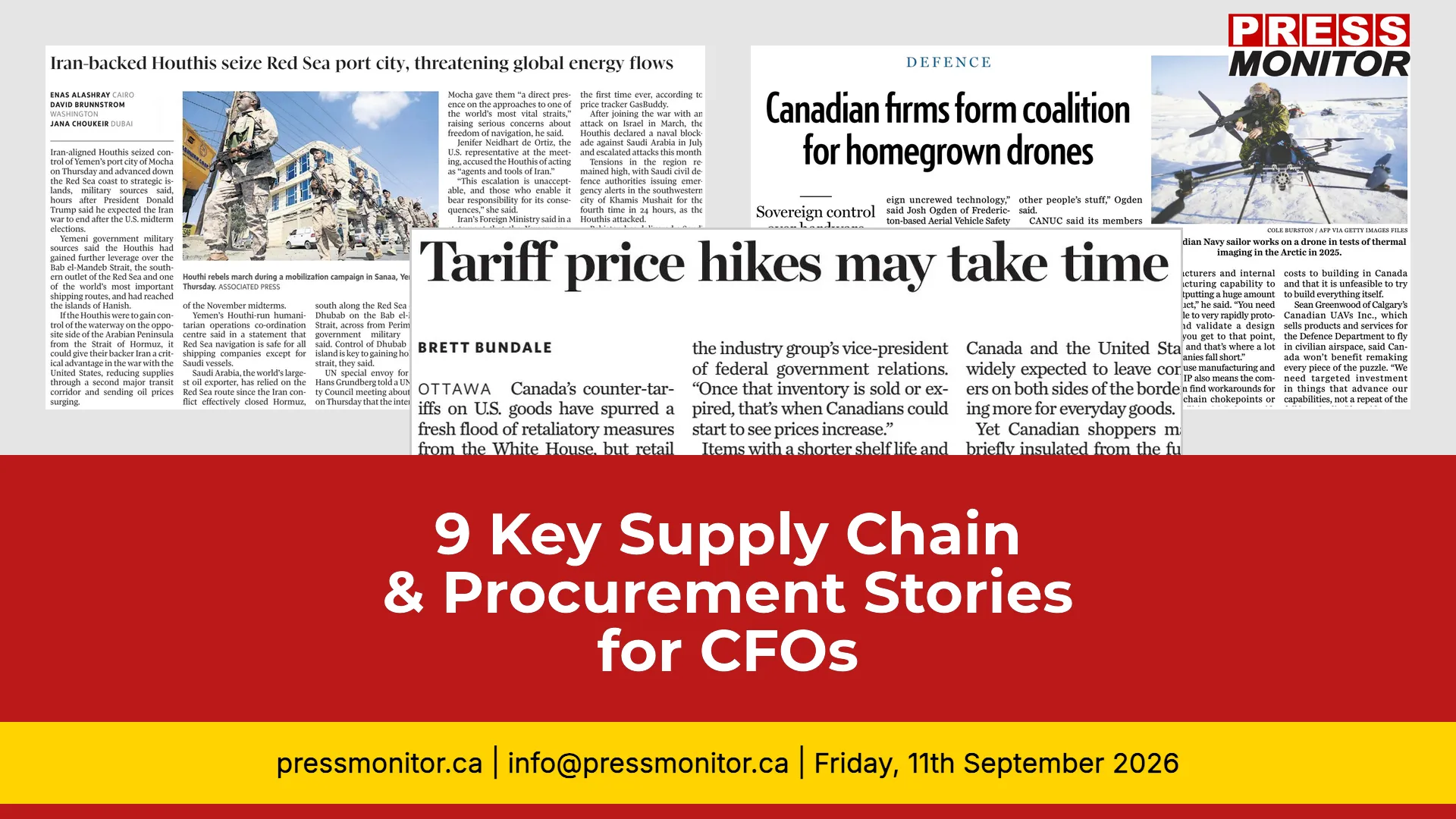
The Globe And Mail (ottawa/quebec Edition) reports that Iran-aligned Houthis seized control of Yemen's port city of Mocha and advanced down the Red Sea coast to strategic islands, raising concerns about global energy flows and freedom of navigation. The advance came hours after President Donald Trump said he expected the Iran war to end after the US midterm elections, with Brent crude jumping 4 percent above US$105 a barrel.
Why it matters: Red Sea shipping routes face renewed geopolitical risk, threatening global energy flows and maritime freight timelines.
Key detail: Brent crude jumped four percent above US$105 a barrel following the advance toward strategic islands near the Bab el-Mandeb Strait.
Source: The Globe And Mail
Next step: Audit route diversions and secure alternative freight corridors before Q4 delivery windows close.
2. Canadian Firms Form Drone Coalition
National Post - (latest Edition) reports that Canadian firms have formed the Canadian Alliance for National Uncrewed Capability to push the federal government to buy more homegrown drones, emphasizing sovereign control over hardware and software. The coalition, comprising companies such as Aerial Vehicle Safety Solutions Inc., Pegasus Aeronautics Corp. and Canadian UAVs Inc., highlighted the Defence Drone Initiative and the need for domestic manufacturing and IP protection.
Why it matters: Sovereign control over defense hardware and software reduces reliance on foreign supply chains.
Key detail: The Canadian Alliance for National Uncrewed Capability pushes federal procurement toward domestic IP protection and homegrown manufacturing.
Source: National Post
Next step: Evaluate domestic uncrewed systems for municipal and industrial applications to strengthen local vendor ecosystems.
3. Tariff Hikes Hit Canadian Shelves
The Welland Tribune reports that Canada's retaliatory tariffs ranging from fifteen to fifty percent on nearly twenty-eight billion Canadian dollars worth of American products have prompted further trade escalation, but retail experts say price increases will lag. Matt Poirier of the Retail Council of Canada explains that stores must work through existing inventory before new tariffed goods appear on shelves, with shorter-shelf-life items rising first. Andreas Schotter of Western University's Ivey Business School notes that tariff costs are negotiated along the supply chain with the burden divided among suppliers, importers, and consumers.
Why it matters: Retaliatory tariffs trigger lagging retail price adjustments as inventory cycles dictate cost absorption.
Key detail: Stores must clear existing stock before tariffed goods arrive, with shorter-shelf-life items experiencing the earliest price shifts.
Source: The Welland Tribune
Next step: Negotiate forward pricing agreements with suppliers to buffer against mid-cycle margin compression.
4. Trump Threatens Bombardier Aircraft Ban
National Post reports that Donald Trump threatened to ban Bombardier Inc. aircraft sales unless manufacturing moves to the United States, escalating the Canada-U.S. trade war. The Montreal-based business jet manufacturer has deep U.S. supply chain ties and is on Trump's radar due to its integrated cross-border operations. The threat follows retaliatory Canadian tariffs and precedes import bans on goods like motorcycles and alcohol.
Why it matters: Cross-border aerospace operations face direct regulatory pressure, exposing integrated supplier networks to sudden disruption.
Key detail: Manufacturing relocation demands could fracture decades of established procurement relationships between Montreal and Wichita.
Source: National Post
Next step: Stress-test tier-two supplier dependencies and map contingency sourcing for critical airframe components.
5. Empire Co. Rejects Tariff Price Hikes
Times Colonist reports that fewer food items are seeing price increases related to tariffs despite the escalating trade dispute between Canada and the United States, according to executives from grocery chain Empire Co. Ltd. Chief customer officer Luc LArchevéque told analysts during the company's fiscal first-quarter earnings call on Thursday that the impact on their business is minimal. Empire has rejected all supplier requests to raise prices, citing strong relationships with local and non-U.S. suppliers and a broader product mix that offers Canadian alternatives.
Why it matters: Major retailers demonstrate how diversified sourcing and strong vendor partnerships can neutralize tariff pass-through.
Key detail: Executive Luc LArchevéque confirmed the chain rejected all supplier requests to raise prices, leveraging non-U.S. alternatives.
Source: Times Colonist
Next step: Benchmark your vendor contract clauses against Empire’s resistance model to protect consumer-facing margins.
6. Spirit Makers Hit Hardest by US Tariffs
Times Colonist reports that distilleries and spirit makers are likely to be the hardest hit among Canadian alcohol producers as the United States proposes a broad ban on Canadian booze starting later this month. Craig Johnston, chief economist at Farm Credit Canada, said distilleries ship more than half of their overall product across the border, making them significantly more exposed to the U.S. market than breweries or wineries. Cal Bricker of trade association Spirits Canada noted that the exemption for bottles larger than four litres is largely moot since few such bottles are sold, effectively making it a ban on Canadian whisky.
Why it matters: Distilleries face disproportionate exposure as over half their product crosses the border, making export compliance critical.
Key detail: A proposed ban on Canadian booze starting late September effectively targets whisky producers due to minimal large-bottle exemptions.
Source: Times Colonist
Next step: Diversify distribution channels and accelerate domestic shelf placements to offset transatlantic trade friction.
7. Diesel Prices Drive Food Cost Surge
The Winnipeg Sun reports that diesel fuel prices hit a record high of two dollars and thirty-nine cents per litre in Toronto, prompting an energy analyst to warn of rising food and retail goods costs. While Winnipeg rates remain slightly lower at approximately twenty-three hundred cents per litre, experts attribute the sharp increase to ongoing geopolitical conflicts and supply chain disruptions ahead of the busy harvest season.
Why it matters: Record fuel costs directly inflate last-mile delivery expenses, compressing grocery and wholesale margins.
Key detail: Toronto diesel hit two dollars and thirty-nine cents per litre, prompting analysts to warn of cascading food inflation ahead of harvest season.
Source: Winnipeg Sun
Next step: Optimize fleet routing and consolidate shipments to mitigate rising transportation overhead.
8. Canada‑EU Alliance Deepens
Saskatoon Starphoenix reports that the European Union and Canada are working toward a new all‑encompassing relationship covering trade, security, supply chains and critical raw materials, with talks scheduled to formalise a partnership ahead of a summit in Canada in October.
Why it matters: Strategic partnerships targeting critical raw materials and security frameworks will reshape long-term procurement landscapes.
Key detail: Formalized talks aim to lock in comprehensive trade and supply chain cooperation ahead of an October summit in Canada.
Source: Saskatoon Starphoenix
Next step: Align raw material sourcing strategies with emerging transatlantic standards to secure future contract eligibility.
9. Victoria Council Seeks More Say on U.S. Contracts
Times Colonist reports that Victoria council signalled Thursday it wants more say in how some contracts are handed out after a controversial decision to award an e-bike-rental service contract to an American company. The council voted to give itself more say on contracts that could go to U.S. firms, while still allowing city staff the flexibility to run the city efficiently, and asked staff to report back on the city's options to address the trade dispute with the U.S. Concerns were expressed by some residents and businesses over the awarding of the contract to San Francisco-based Lime, while in Saanich and Langford, contracts were awarded to B.C.-based Evolve, operated by BCAA's Evo.
Why it matters: Municipal procurement is increasingly scrutinized for local economic impact amid ongoing trade disputes.
Key detail: City officials voted to increase oversight on contracts awarded to American firms while balancing operational flexibility.
Source: Times Colonist
Next step: Review public tender guidelines to ensure alignment with evolving local-content expectations.
Tracked by Press Monitor. Which of these supply chain disruptions will force the fastest pivot in your procurement strategy this quarter? Tag your supply chain director below.