9 Pivotal Environmental Stories for Sustainability Leaders


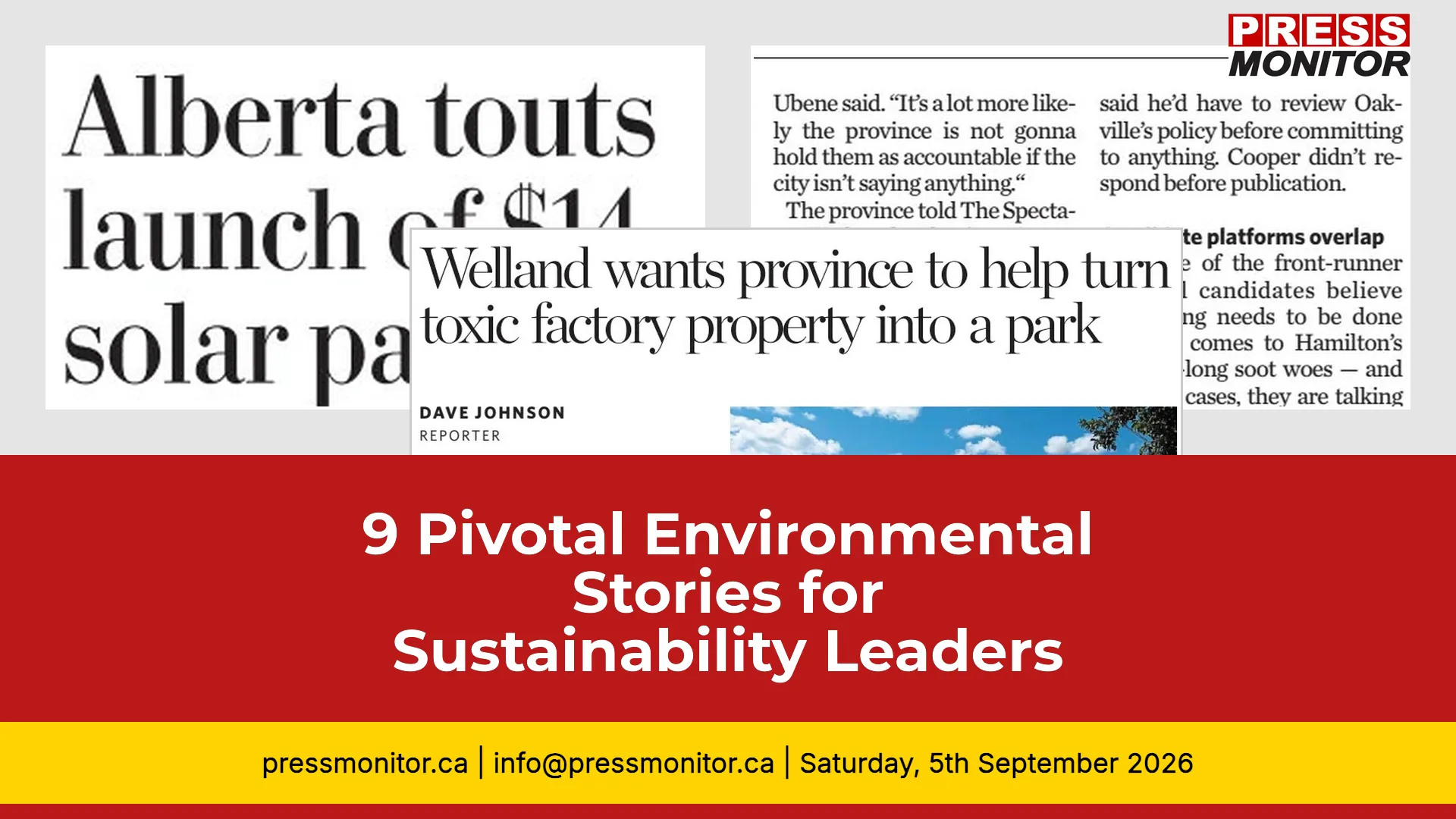
Environmental policy shifts and sustainability mandates are accelerating across Canada. Tracking these developments requires precise media monitoring. This press review distills today’s most impactful developments across print publications into actionable insights. Whether you’re navigating regulatory changes or tracking green tech adoption, this media intelligence briefing covers what matters. Here are nine defining stories shaping the landscape.
1. Alberta Imposes $14 Solar Panel Recycling Fee
Times Colonist reports that Alberta Environment Minister Grant Hunter announced a ban on landfill disposal for solar panels and a $14 recycling fee per panel beginning October 1. Hunter said the move will protect municipalities and taxpayers from future costs estimated at nearly 73,000 tons of material by 2045, but industry advocates called the fee punitive and lacking clear accounting. Independent research commissioned by the Canadian Renewable Energy Association put the cost of recycling a solar module at about $5, while Hunter said shipping old panels to the United States for processing costs $40 per panel.
Why it matters: New provincial waste regulations directly impact renewable energy project economics and municipal landfill capacity.
Key detail: Minister Grant Hunter announced a ban on landfill disposal for solar panels starting October 1, alongside a $14 recycling fee per unit. Industry advocates warn the fee could add roughly $1 million to average utility-scale projects, while independent research suggests module recycling costs closer to $5.
Source: Times Colonist
Next step: Review updated procurement contracts and factor end-of-life recovery costs into Q4 capital planning.
2. Birla Faces Mayoral Scrutiny Over Hamilton Soot
{source_name} reports that mayoral candidates Loomis, Horwath, and Cooper are proposing stricter measures against Birla and industrial emissions amid Hamilton's decade-long soot crisis. The MECP investigation into Birla continues, while past councils allocated funds for air monitors and the city's mobile monitors are being replaced. Candidates discussed a bylaw similar to Oakville's Health Protection Air Quality Bylaw and broader decarbonization efforts.
Why it matters: Industrial air quality disputes are escalating into municipal election platforms, signaling tighter future enforcement.
Key detail: Mayoral candidates are proposing stricter bylaws modeled after Oakville’s Health Protection Air Quality Bylaw as the MECP investigation into Birla Carbon continues. The city is also upgrading mobile air monitors to track decade-long soot fallout.
Source: The Hamilton Spectator
Next step: Monitor candidate policy announcements and prepare compliance documentation for ongoing emissions reporting.
3. Welland Seeks Province Help For Toxic Site Park
{source_name} reports that Welland wants the provincial government to help clean up a contaminated former automotive plastics plant on Major Street and transform the property into a neighbourhood park. During the Association of Municipalities of Ontario conference, the city asked the Ministry of the Environment, Conservation and Parks for help finding funds and programs to remediate the land, buy the property and turn it into public greenspace. A memo from chief administrative officer Jessica Ruddell noted the site has long-standing environmental and property management challenges including significant tax arrears and an unsuccessful tax sale process.
Why it matters: Municipal brownfield remediation efforts highlight growing pressure to convert industrial liabilities into public assets.
Key detail: Welland officials requested Ministry funding and programs to purchase and clean a contaminated former automotive plastics plant on Major Street, aiming to transform it into neighborhood greenspace despite significant tax arrears.
Source: The Standard (st. Catharines)
Next step: Track provincial grant cycles for environmental remediation and assess partnership opportunities.
4. Platinum Solutions Seeks Railcar Washing Approval
Calgary Herald reports that Platinum Solutions Ltd. has applied to Alberta Environment and Protected Areas for approval to operate a mobile railcar washing facility across multiple locations in Alberta. The application permits cleaning up to one hundred railcars monthly at sites in cities including Edmonton, Calgary, Red Deer, and Lethbridge, as well as several surrounding counties. Affected residents may submit written statements of concern within thirty days for regulatory review.
Why it matters: Mobile industrial cleaning operations face heightened scrutiny over water runoff and site-specific environmental approvals.
Key detail: Calgary-based Platinum Solutions Ltd. applied to clean up to 100 railcars monthly across Edmonton, Calgary, Red Deer, and Lethbridge. Residents have 30 days to submit statements of concern before regulatory review.
Source: Calgary Herald
Next step: Engage with local municipal planning committees and review draft approval conditions.
5. Chernobyl Wildlife Behavior Changed During War
The Hamilton Spectator reports that research published in Science shows Russian military occupation of the Chernobyl Exclusion Zone in early 2022 significantly altered wild animal activity patterns. Dr. Svitlana Kudrenko, a doctoral student at the University of Freiburg, analysed footage from wildlife cameras installed across the 2,600-square-kilometer zone and found complex responses among species including gray wolves and Eurasian lynxes.
Why it matters: Global conflict zones demonstrate how rapid human displacement alters ecosystem dynamics, offering parallels for conservation planning.
Key detail: Research published in Science reveals Russian military occupation significantly shifted activity patterns for gray wolves and Eurasian lynxes across the 2,600-square-kilometer exclusion zone.
Source: The Hamilton Spectator
Next step: Integrate conflict-impact data into long-term biodiversity risk assessments.
6. FireGuardian Wildfire Software Seeks Canadian Partners
The Chronicle Herald reports that 3D Wave Design, an Indigenous company co-founded by Barry Stevens and his son Noah, has developed FireGuardian wildfire simulation software to help Canadian municipalities model fire risks. The software, tested by the federal government, uses real-life data to simulate days or weeks of wildfire behaviour in seconds. Stevens said the company is actively seeking partners and joint ventures to scale FireGuardian across Canada.
Why it matters: Indigenous-led climate adaptation tech is scaling rapidly to meet increasing wildfire modeling demands.
Key detail: 3D Wave Design’s FireGuardian simulation software processes real-life data to model weeks of fire behavior in seconds. The company is actively pursuing joint ventures to deploy the tool across Canadian municipalities.
Source: The Chronicle Herald
Next step: Evaluate pilot program eligibility and coordinate with federal innovation funding streams.
7. Man Arrested for Arson in B.C. Fires
Times Colonist reports that a 29-year-old man has been arrested for arson after three suspicious fires along Highway 99 in British Columbia. The fires occurred in the early hours of Aug. 22 on the west side of the highway between Whistler and Squamish. RCMP investigators worked with the B.C. Conservation Officer Service, Natural Resource Officers, and the wildfire service to conduct the ongoing investigation.
Why it matters: Criminal investigations into suspicious wildfires underscore the intersection of public safety and environmental protection agencies.
Key detail: RCMP arrested a 29-year-old suspect following three suspicious fires along Highway 99 between Whistler and Squamish. Joint operations with Conservation Officers and Natural Resource Officers remain active.
Source: Times Colonist
Next step: Align internal emergency response protocols with regional wildfire service updates.
8. Air Quality Health Index Forecast For Victoria
The Times Colonist reports that Environment Canada has issued an Air Quality Health Index forecast for Saturday with peak levels across the region. Victoria and Saanich are expected to reach a moderate risk level of four, while the West Shore, Duncan, Nanaimo, Parksville, Kelowna, and Kamloops are forecast to hit a low risk level of two. Vancouver, Comox Valley, and Nanaimo/Parksville show higher readings near the moderate range, and officials warn that the higher the number, the greater the health risk from air pollution.
Why it matters: Regional air pollution forecasting drives public health advisories and operational adjustments for outdoor industries.
Key detail: Environment Canada forecasts moderate risk levels (AQHI 4) for Victoria and Saanich, while surrounding regions like Kamloops and Kelowna expect low risk (AQHI 2). Officials emphasize that higher indices correlate directly with increased respiratory exposure.
Source: Times Colonist
Next step: Update workforce scheduling and issue health guidance for vulnerable populations.
9. Canadian Brands Prioritize Repairable Clothing
The Globe And Mail (ottawa/quebec Edition) reports that almost five hundred thousand tonnes of textile waste enter Canadian landfills annually, prompting apparel companies to adopt circular business models. Major labels including Patagonia, Canada Goose, and Arc'teryx are expanding resale initiatives, garment repair services, and durable design processes to divert clothing from waste systems. This strategic shift extends product lifecycles while generating additional revenue through secondhand markets.
Why it matters: Circular economy initiatives are reshaping retail supply chains and diverting hundreds of thousands of tonnes of textile waste annually.
Key detail: Patagonia, Canada Goose, and Arc’teryx are expanding garment repair services and resale markets. This strategic pivot extends product lifecycles while capturing revenue from secondhand consumers.
Source: The Globe And Mail
Next step: Audit current product lifecycle management practices and explore take-back program integrations.
These stories reflect the complex interplay between regulation, industry adaptation, and ecological stewardship. Tracked via print media monitoring across national and regional outlets, these insights ground your strategy in verified reporting. How is your organization adjusting its environmental strategy ahead of upcoming provincial mandates?