9 Pivotal Geopolitics Stories for Policy Leaders


Navigating today’s complex international landscape requires sharp media intelligence. According to Press Monitor's tracking of Canadian publications, nine pivotal developments are reshaping global alliances, trade dynamics, and security protocols. Here is your essential press review of the day’s critical geopolitical shifts.
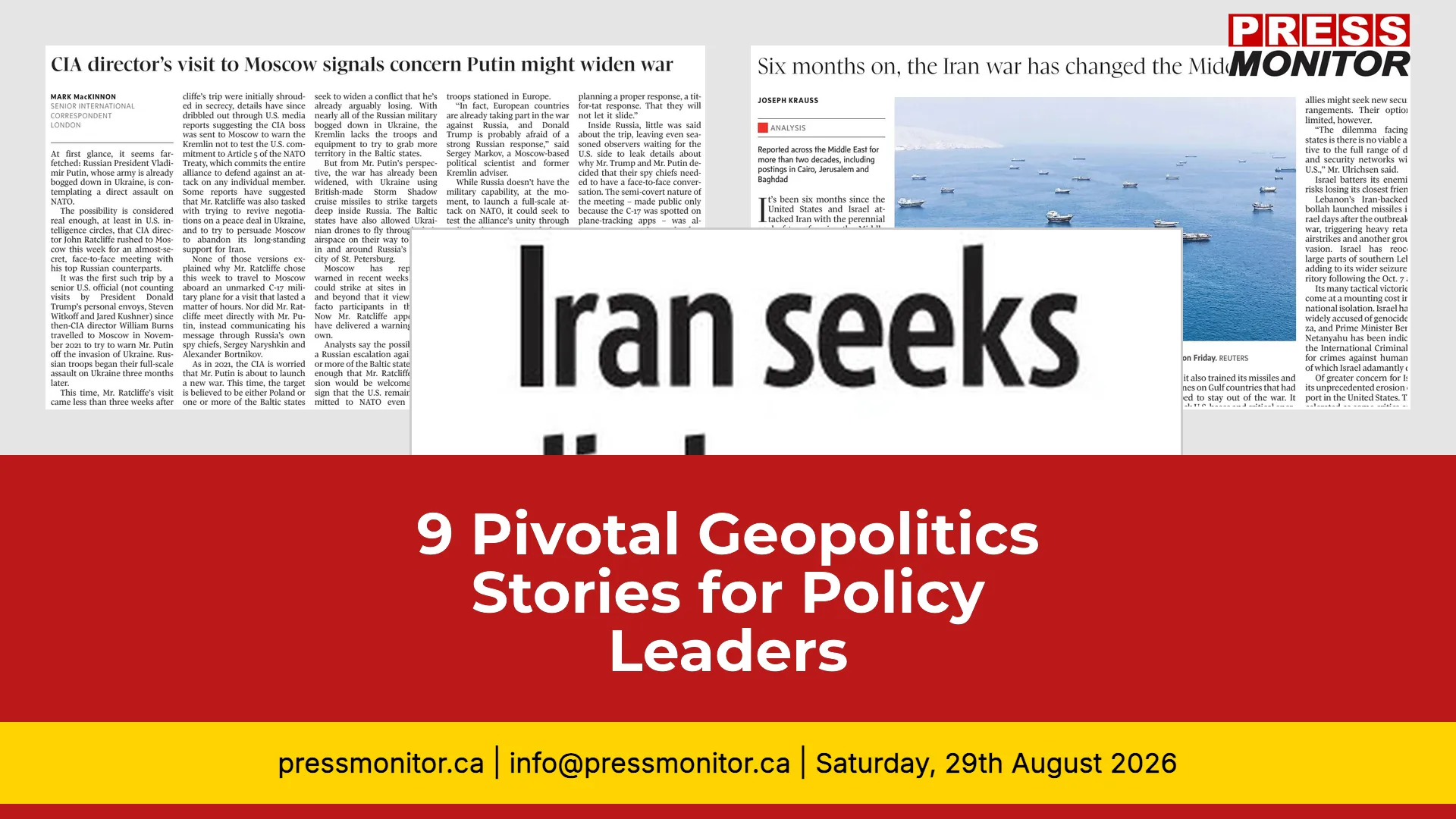
1. CIA Director Warns Putin Over Potential NATO Expansion
A front-page report in The Globe And Mail reports that CIA Director John Ratcliffe traveled to Moscow for a covert meeting with Russian intelligence officials to warn against potential hostile actions against NATO members. The White House seeks to deter expanding Russian military actions toward the Baltic states or Poland, while analysts suggest the visit and NATO's commitment despite U.S. troop reductions in Europe could stem the tide in this regional crisis. No details were publicized about negotiations around the Ukraine peace process or Iran policy
Why it matters: Direct high-level deterrence signals a hardened Western stance against Baltic and Polish border incursions.
Key detail: CIA Director John Ratcliffe conducted a covert Moscow meeting to explicitly warn Russian intelligence against hostile moves toward NATO members.
Source: The Globe And Mail (ottawa/quebec Edition)
Next step: Monitor allied defense spending adjustments and Baltic state military readiness reports.
2. Iran War: Six Months In, Region Redefined
"Selon The Globe And Mail, après six mois de guerre en Iran, la région du Moyen-Orient a changé, mais pas de la manière escomptée par les États-Unis et Israël. L'Iran a survécu à des attaques massives et a pris le contrôle du détroit d'Ormuz, créant des inquiétudes pour les États-arabes. Israël a mené des offensives sans parvenir à vaincre ses ennemis, tandis que les espoirs de normalisation des relations avec l'Arabie saoudite se sont évanouis. L'administration Biden a initialement espéré renverser le régime iranien, mais il semble désormais ‘hardi et radical’, ce qui rendra la gestion des relations exceptionnellement difficile. Les États-Unis ont conclu un cessez-le-feu avec l'Iran, mais cet accord a rapidement échoué, renforçant la détermination iranienne à contrôler le détroit d'Ormuz et à poursuivre son programme nucléaire, malgré les sanctions américaines."
Why it matters: The prolonged conflict has fundamentally altered Middle Eastern power balances and energy routes.
Key detail: Despite massive strikes, Iran retained operational capacity, seized control of the Strait of Hormuz, and shattered regional normalization hopes.
Source: The Globe And Mail (ottawa/quebec Edition)
Next step: Track global oil futures and shipping insurance premiums closely.
3. Iran Diplomacy Offer Amid US-Iran War
The Montreal Gazette reports that Iran has left the door open to diplomacy six months into a war with the United States that has upended the Middle East, but only if Washington abandons its pressure campaign. Iranian Foreign Minister Abbas Araghchi posted on X on Friday that putting diplomacy back on track isn’t impossible. It hinges on U.S. understanding of one simple fact: pressure doesn’t work.
Why it matters: Diplomatic off-ramps remain possible but require immediate shifts in Washington’s leverage strategy.
Key detail: Foreign Minister Abbas Araghchi stated negotiations hinge on Washington abandoning its economic pressure campaign, noting “pressure doesn’t work.”
Source: Montreal Gazette
Next step: Watch for Qatari or Pakistani mediation breakthroughs.
4. Trump Threatens Auto Tariff Chance
Toronto Star reports that reacting to Canada’s trade negotiation rebuff, U.S. President Donald Trump threatened a fifty percent tariff on vehicles and parts from Canada, an escalation of the trade war.
Why it matters: Escalating trade friction directly impacts North American manufacturing supply chains and consumer pricing.
Key detail: A proposed fifty percent tariff on Canadian vehicles and parts follows Ottawa’s recent trade negotiation rebuff.
Source: Toronto Star
Next step: Assess automotive sector compliance costs and potential retaliatory measures.
5. Canada's Defiance Against Trump's Trade Tactics
The Globe And Mail (ottawa/quebec Edition) reports that Canada has formally abandoned its strategy of appeasing Donald Trump to fend off his aggressive trade policies and has opted for defiance instead. The country now faces potential escalation from the Trump administration, including new tariffs and unconventional trade war tactics.
Why it matters: Ottawa’s strategic pivot from appeasement to defiance marks a new era in bilateral economic relations.
Key detail: Canada formally abandoned concession-based strategies, opting instead for multilateral partnerships and sovereign trade defenses.
Source: The Globe And Mail (ottawa/quebec Edition)
Next step: Review updated CUSMA compliance frameworks and export diversification plans.
6. Canada Launches Foreign Influence Registry Amidst Concerns
The Canadian registry joins schemes to address foreign influence activities already present in the United States, Australia and the United Kingdom. The US regime is the oldest, dating back to 1938. The U.K’s is the most recent, having come into force in July 2025, while Australia introduced its system in December 2018. Canada, in constructing its new registry, had lots of lessons to draw on. We placed our bet on the Australian model. The reason for this has never been clear, especially in light of criticisms as to that model's ineffectiveness and tendency toward overreach. Anton Boegman, the Canadian registry’s first commissioner, has plainly stated it will neither ‘solve foreign interference in Canada’ nor identify overt foreign influence or acts of transnational repression. Those tasks will remain within the purview of CSIS and other elements of our national-security system. Instead, the registry will, as Boegman put it, increase transparency ‘around legitimate activities.’ In other words, it will mostly catch the good guys. The foreign influence registry is not targeted specifically against identified malicious foreign state actors such as Russia and China. It is — in a polite, Canadian way — country-agnostic, not a blacklist of the sort that had once so concerned officials in the public safety ministry. The Canadian scheme failed to adopt the UK’s two-tiered approach, which allows the British government to designate foreign states of concern and. focus the registry’s attention on them. Instead, the scope of the registry is very broad, arguably too broad. If you go to its new website, for instance, you are greeted with a simple questionnaire to help you determine whether you need to register. It asks: ‘Are you or your entity undertaking activities to influence a political or governmental process in Canada at the federal, provincial, territorial, or municipal level?’ Your choices: yes, no, not sure. I suspect many first-time visitors will check the ‘not sure’ box. Ifyou do, you'll be asked whether you are an exempt official or have an ‘arrangement’ with any foreign entity or government. (An arrangement can be almost anything; it need not be formalized or documented. Then you get to the final, key question about your activities, which may include communicating with Canadian public office holders at any level of government, ‘organizing public meetings or advocacy efforts,’ sharing or publishing information ‘related to a political or governmental process’ (including on social media) and providing services. That's a very broad, problematic, speech-chilling and vexatious net the government has cast, one that needn't have anything to do with malicious foreign influence or activities contrary to Canada’s interests. Any kind of harms test is missing. Say [hada conversation with a visiting NATO delegation and decided to write something in favour of a particular defence policy that I believed Canada should adopt — or say I'd had discussions with the Ukrainian ambassador to Canada and decided to advocate that Canada provide more assistance to Ukraine. Registration would await me. And if I failed to register, I might face a steep fine. There is a case to be made, and it’s been made in other jurisdictions, that foreign influence registries can deter malign activity. It’s just a hard case to prove. The new UK scheme also argues that it will provide informational openings for targeted action by security agencies. Again, it’s hard to say whether this will prove true. What is certain is that Canada’s influence registry will be a costly and resource-intensive bureaucratic machine. The money allotted to it could arguably have been better spent on bolstering the capabilities of CSIS and the RCMP, enhancing public education (the very best deterrent) and improving outreach to and engagement with those communities in Canada that have been most affected by foreign interference. And one other thing is certain: changes to the registry will be required at some point down the road. Even Boegman has acknowledged this fact: ‘It will need to be tweaked, and it will need to be updated as it is implemented, as we see how it ... covers the activities that are supposed to be covered.’ That’s honest talk, and a lot more of it will be necessary to convince Canadians of the real — not merely symbolic — value of this new registry. WESLEY WARK IS A SENIOR FELLOW AT THE CENTRE FOR INTERNATIONAL GOVERNANCE INNOVATION AND AN EXPERT ON NATIONAL-SECURITY AND INTELLIGENCE ISSUES. Minister of Public Safety Gary Ananda-sangaree announced the registry this month. JUSTIN TANG/ THE CANADIAN PRESS
Why it matters: New transparency mechanisms aim to counter transnational interference while balancing civil liberties.
Key detail: Modeled loosely on Australia’s system, the registry faces criticism for broad scope and potential overreach, though Commissioner Anton Boegman emphasizes transparency over enforcement.
Source: Toronto Star
Next step: Evaluate registration requirements for NGOs, advocacy groups, and academic institutions.
7. Canada Redefines Global Identity
According to a front-page report in The Globe And Mail it says: In response to U.S. trade collapse Canada asserted unprecedented sovereignty while expanding global partnerships under Prime Minister Mark Carney's leadership. The article notes shifting geopolitical dynamics following President Trump's aggressive policies with NATO members adapting strategies and Canada emerging as a key player through multilateral agreements like joining Eurovision.
Why it matters: Shifting national positioning reflects broader realignments in multilateral diplomacy and sovereignty.
Key detail: Under Prime Minister Mark Carney’s leadership, Canada is expanding global partnerships beyond traditional US-centric frameworks.
Source: The Globe And Mail (ottawa/quebec Edition)
Next step: Analyze new bilateral agreements and diplomatic appointment trends.
8. Israeli Strikes Kill Five in Gaza as Finland Cuts Aid to UNRWA
Toronto Star reports that Israeli strikes in Gaza have killed five people as hospital officials report casualties including two brothers and another relative killed in a strike outside Khan Younis. Meanwhile, Finland has decided not to extend a deal to provide humanitarian aid to the United Nations agency for Palestinian refugees, UNRWA. Israel's Foreign Ministry accused the UN agency of being a hotbed of terrorism.
Why it matters: Humanitarian corridors face mounting political and logistical pressures amid ongoing hostilities.
Key detail: Hospital officials report civilian casualties outside Khan Younis, while Finland halts UNRWA funding following Israeli terrorism allegations.
Source: Toronto Star
Next step: Monitor humanitarian aid distribution channels and European parliamentary responses.
9. Joint Drills Amidst North Korean Threats
The Globe And Mail reports that South Korea, the U.S. and Japan will proceed with a trilateral military drill next month in response to North Korean nuclear threats.
Why it matters: Trilateral military cooperation underscores escalating deterrence strategies in East Asia.
Key detail: South Korea, the U.S., and Japan will conduct coordinated exercises next month in direct response to Pyongyang’s nuclear advancements.
Source: The Globe And Mail (ottawa/quebec Edition)
Next step: Track naval deployment schedules and joint command structure updates.
These nine developments illustrate why rigorous media monitoring remains essential for anticipating market and policy shifts. Which of these geopolitical pivots demands your immediate strategic attention?