11 Essential Supply Chain Stories for Procurement Leaders


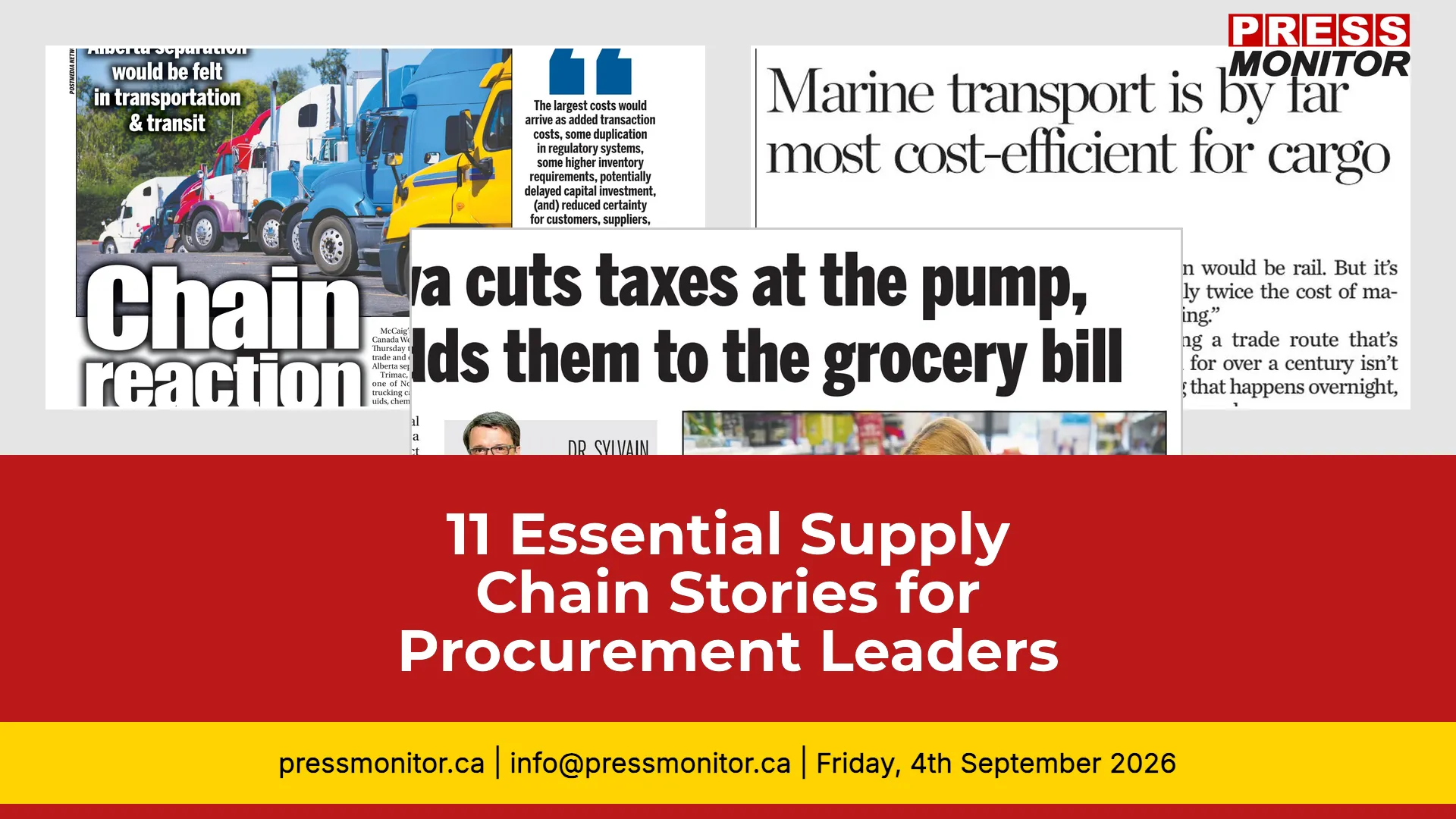
From Alberta separation friction to Welland Canal trade risks, this roundup covers 11 stories shaping Canadian supply chain and procurement today. According to Press Monitor's tracking of Canadian publications, these developments offer critical media intelligence for every supply chain professional navigating news on supply chain disruption. The print media monitoring data below reflects coverage across Canada's national and regional newspapers.
1. Alberta Separation Drives Up Transport Costs
Edmonton Sun reports that an Alberta separation would trigger significant supply chain redesign and regulatory duplication rather than halting trade, according to Jeff McCaig of Trimac Transportation Group. A new Canada West Foundation analysis warns that trucking and aviation sectors face heightened transaction costs, inventory requirements, and operational uncertainty. The report cites Brexit as a precedent, noting how accumulated friction typically increases business expenses and delays investment. Alberta's separation from Canada would trigger significant supply chain redesign and regulatory duplication rather than halting trade. Jeff McCaig of Trimac Transportation Group warns that trucking and aviation sectors face heightened transaction costs, inventory requirements, and operational uncertainty. The Canada West Foundation analysis cites Brexit as a precedent, noting how accumulated friction typically increases business expenses and delays investment. For procurement teams, this means contingency planning for cross-border logistics is no longer theoretical.
2. Welland Canal Dispute Risks Trade
Toronto Star reports that a potential Canadian counter‑tariff dispute could block American access to the Welland Canal, a key Great Lakes transport route, and could shift U.S. grain, steel and other freight to more expensive rail or trucking options. The professor Fraser Johnson warns that such a disruption would raise supply‑chain costs for both countries and could trigger maritime tensions. A potential Canadian counter-tariff dispute could block American access to the Welland Canal, a key Great Lakes transport route, shifting U.S. grain, steel and other freight to more expensive rail or trucking options. Professor Fraser Johnson warns that such a disruption would raise supply-chain costs for both countries and could trigger maritime tensions. This underscores why media monitoring of trade policy is essential for procurement strategy.
3. Canada Food Insecurity Rate Doubles to 10.5%
Calgary Sun reports that Canada's food insecurity rate more than doubled from 5.1 per cent to 10.5 per cent between 2017 and 2025, reaching the sixth-highest level among comparable G20 nations. Bank of Canada research found retaliatory tariffs pushed tariffed products up by roughly six per cent, adding about 0.3 percentage points to consumer inflation, as Ottawa's trade retaliation significantly impacted household grocery affordability despite a more focused policy approach this year. Canada's food insecurity rate more than doubled from 5.1 per cent to 10.5 per cent between 2017 and 2025, reaching the sixth-highest level among comparable G20 nations. Bank of Canada research found retaliatory tariffs pushed tariffed products up by roughly six per cent, adding about 0.3 percentage points to consumer inflation. Ottawa's trade retaliation significantly impacted household grocery affordability despite a more focused policy approach this year.
4. Carney Announces $4.7 Billion Via Rail Investment
The Calgary Sun reports that Prime Minister Mark Carney announced a $4.7 billion government investment in Thunder Bay on Thursday to help Via Rail acquire 313 new, made-in-Canada rail cars. Carney acknowledged the shift towards protectionist policies like the Buy Canadian Policy amid ongoing tariff disputes with the United States. Prime Minister Mark Carney announced a $4.7 billion government investment in Thunder Bay to help Via Rail acquire 313 new, made-in-Canada rail cars. The move reflects a broader shift toward protectionism aimed at shielding domestic industries from U.S. tariffs, even as Canadian leaders continue calling for an end to American trade barriers. The Buy Canadian Policy signals a procurement landscape that prioritizes domestic sourcing.
5. Ottawa Cuts Fuel Tax, Risking Grocery Costs
The Edmonton Sun reports that Ottawa has decided to extend federal diesel excise tax relief just days before 25 per cent to 50 per cent counter-tariffs on 27.6 billion Canadian dollars of American goods take effect, saving motorists 1.5 cents per litre on gasoline and roughly 1 cent per litre on diesel until January 31, 2027. The federal excise tax will remain suspended until January 31, 2027, saving motorists 1.5 cents per litre on gasoline and roughly 1 cent per litre on diesel, though the relief halves its normal rate for February 1 before being fully restored by July 18, 2026. Dalhousie University's Dr. Sylvain Charlebois argues this targeted approach is more coherent than the 25 per cent counter-tariffs on American foods and other consumer goods imposed on February 4, 2025, which the Agri-Food Analytics Lab warned would function as a tax on Canadians. Ottawa has decided to extend federal diesel excise tax relief just days before 25 per cent to 50 per cent counter-tariffs on 27.6 billion Canadian dollars of American goods take effect. The federal excise tax will remain suspended until January 31, 2027, saving motorists 1.5 cents per litre on gasoline and roughly 1 cent per litre on diesel. Dr. Sylvain Charlebois argues this targeted approach is more coherent than the 25 per cent counter-tariffs on American foods imposed on February 4, 2025.
6. Ottawa Pledges 3 Billion for Food Terminals
The Globe And Mail (ottawa/quebec Edition) reports that British Columbia and Manitoba terminal proposals aim to strengthen supply chains and boost competition in response to Ottawa's National Food Security Strategy launched in June. The strategy pledged 3 billion over 10 years to expand domestic processing and production, make supply chains more efficient and improve grocery competition amid rising food costs and trade tensions with the U.S. James Donaldson, chief executive officer at BC Food & Beverage, said the B.C. concept, dubbed the Pacific Gateway, could become a regional trade hub leveraging international trade. British Columbia and Manitoba terminal proposals aim to strengthen supply chains and boost competition in response to Ottawa's National Food Security Strategy launched in June. The strategy pledged 3 billion over 10 years to expand domestic processing and production. James Donaldson, CEO at BC Food & Beverage, said the B.C. concept, dubbed the Pacific Gateway, could become a regional trade hub leveraging international trade.
7. C$14 Million for N.S. Businesses
The Chronicle Herald reports that Sean Fraser, the federal minister responsible for the Atlantic Canada Opportunities Agency, announced funding for Nova Scotia businesses affected by U.S. tariffs during a media event at Ace Machinery in Dartmouth. The Regional Tariff Response Initiative is providing a total of $3.45 billion to help businesses boost productivity and strengthen supply chain resilience. The government is investing $14 million across Nova Scotia, with more than $400,000 going to Ace Machining for a new CNC machine. Sean Fraser, the federal minister responsible for the Atlantic Canada Opportunities Agency, announced funding for Nova Scotia businesses affected by U.S. tariffs. The Regional Tariff Response Initiative is providing a total of $3.45 billion to help businesses boost productivity and strengthen supply chain resilience. The government is investing $14 million across Nova Scotia, with more than $400,000 going to Ace Machining for a new CNC machine.
8. Canadians Defend Alberta Oil Amid Trade War
The Globe And Mail (ottawa/quebec Edition) reports that Canadian readers respond to ongoing trade tensions with the United States, defending Alberta's economic position while criticizing federal policy on oil exports. Contributors argue that eastern provinces should not condemn Alberta Premier Danielle Smith and Scott Moe when Ottawa failed to secure new markets. Additional letters cover historical slavery reflections, Pete Hegseth's conduct toward Canadian cadets, and infrastructure concerns regarding Canadian National Railway and port logistics. Canadian readers respond to ongoing trade tensions with the United States, defending Alberta's economic position while criticizing federal policy on oil exports. Contributors argue that eastern provinces should not condemn Alberta Premier Danielle Smith and Scott Moe when Ottawa failed to secure new markets. Additional letters cover infrastructure concerns regarding Canadian National Railway and port logistics.
9. Carney Defence Pick Quits
The Globe And Mail (ottawa/quebec Edition) reports that Doug Guzman, the CEO of the Defence Investment Agency hand-picked by Prime Minister Mark Carney, is leaving his job after less than a year due to frustration with Ottawa bureaucracy. Guzman, a former Goldman Sachs colleague of Carney, was tasked with reforming defence procurement but found the government's complex processes and politics insurmountable. His departure highlights challenges in implementing the government's revolutionary defence industrial policy and planned spending increases from 2 per cent to 4 per cent of GDP by 2030. Doug Guzman, the CEO of the Defence Investment Agency hand-picked by Prime Minister Mark Carney, is leaving his job after less than a year due to frustration with Ottawa bureaucracy. Guzman was tasked with reforming defence procurement but found the government's complex processes and politics insurmountable. His departure highlights challenges in implementing the government's defence industrial policy and planned spending increases.
10. Canada Teachers Question Staples Portal Discounts
The Ottawa Citizen reports that Ontario elementary teachers now have access to an online portal run by Staples for purchasing school supplies, but some found items cost more there than on Staples' main website. Education Minister Paul Calandra defended the portal, stating that 221 essential items are priced at the lowest available, while acknowledging some initial mistakes may have occurred. Ontario elementary teachers now have access to an online portal run by Staples for purchasing school supplies, but some found items cost more there than on Staples' main website. Education Minister Paul Calandra defended the portal, stating that 221 essential items are priced at the lowest available, while acknowledging some initial mistakes may have occurred. This procurement oversight issue matters for any organization managing vendor relationships.
11. C$214,000 Guinness Theft Stuns Liverpool Depot
The Globe And Mail reports that British police are searching for two trailer truckloads of stolen Guinness stout valued at C$214,000. The beer was taken from a depot near Liverpool in northwest England on Monday night by two drivers who hauled away about 800 barrels. The theft comes weeks after a similar beer heist in the United States saw roughly 34,000 cans of Pabst Blue Ribbon stolen from a Southern California warehouse. British police are searching for two trailer truckloads of stolen Guinness stout valued at C$214,000. The beer was taken from a depot near Liverpool in northwest England by two drivers who hauled away about 800 barrels. The theft comes weeks after a similar beer heist in the United States saw roughly 34,000 cans of Pabst Blue Ribbon stolen from a Southern California warehouse. Supply chain security extends beyond borders.
What will be the next disruption to test Canadian supply chain resilience? Share your outlook in the comments.