11 Essential Supply Chain Stories for Procurement Leaders


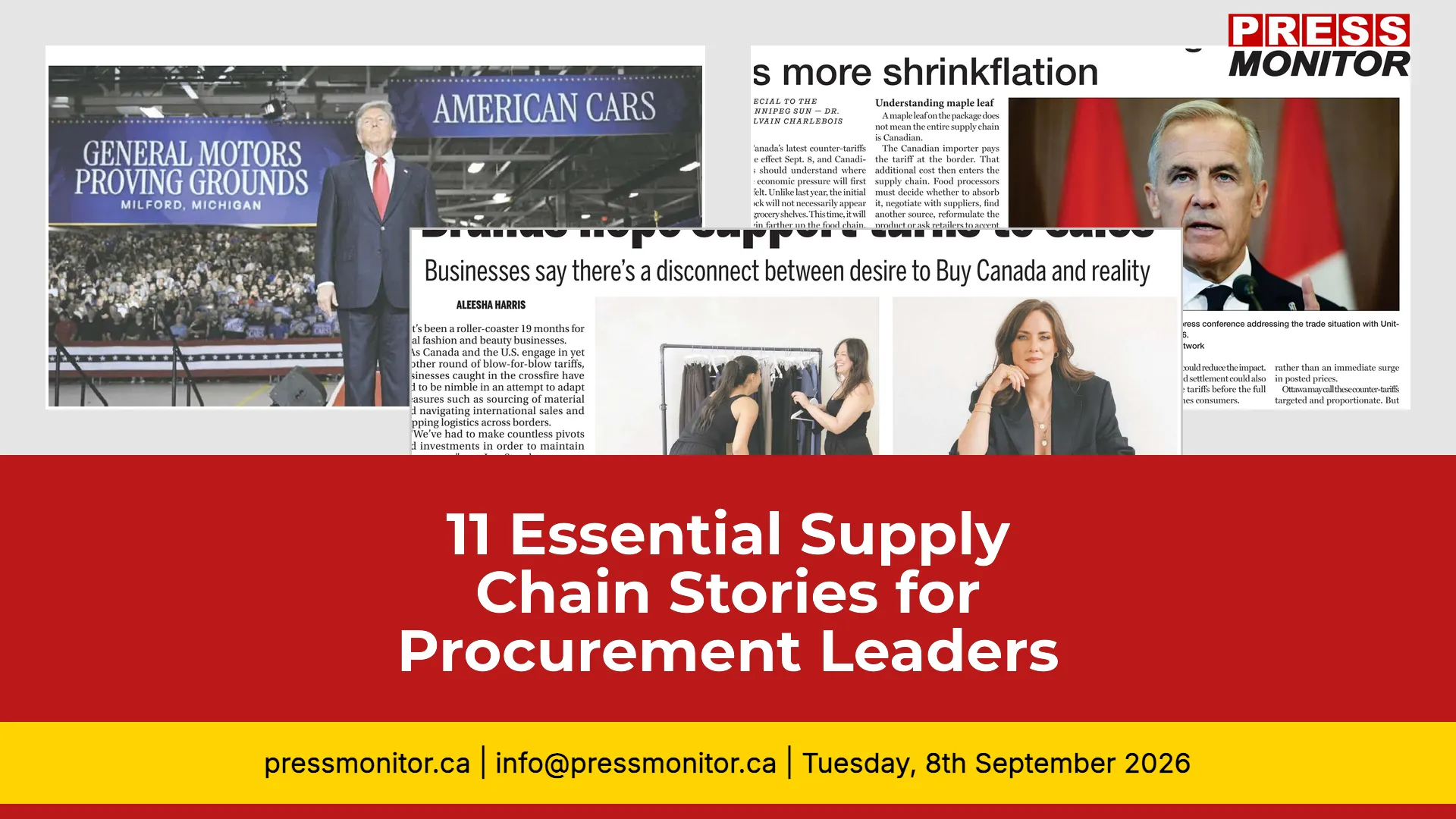
According to Press Monitor's tracking of Canadian publications, this media monitoring and media intelligence review covers 11 essential stories shaping today's supply chain and procurement landscape. From retaliatory tariffs to border logistics chaos, this press review delivers the news on supply chain disruption that procurement leaders need now.
1. Michigan Faces Heaviest Retaliatory Tariff Impact
Vancouver Sun reports that Michigan could take the hardest hit from Canada's retaliatory tariffs, as the state ships about $1.5 billion in tariff-listed products to Canada each year and 36 percent of its goods exports go to Canada. Analysts say the Canadian tariff package is broader in scope than the U.S. measures it responds to, and the earliest pain may show up in wholesale margins and inventory decisions rather than on factory payrolls.
Why it matters: Michigan ships $1.5 billion in tariff-listed products to Canada annually, with 36 percent of its goods exports heading north. The Canadian counter-tariff package is broader than the U.S. measures it responds to, hitting wholesalers and retailers before factory payrolls.
Key detail: Analysts warn that uncertainty around tariff levels is already freezing business planning and could drive retailers to source from China and Vietnam instead.
Source: Vancouver Sun, Edmonton Journal, Calgary Herald, National Post, Ottawa Citizen, Montreal Gazette
Next step: Procurement teams should map their cross-border exposure and model tariff scenarios for Q1 2027.
2. Canada's Counter-Tariffs Cover $27.6 Billion in U.S. Goods
Winnipeg Sun reports that Canada's counter-tariffs took effect Sept. 8, covering more than 700 categories of American goods worth approximately $27.6 billion in imports. Tariffs of 15% and 50% will affect food-related ingredients such as milk powders, whey, honey and cheeses, as well as packaging materials like plastic bags, glass bottles and aluminum foil. The measures could add up to 0.3 percentage points to grocery inflation by April or May 2027, with costs spreading through supply chains before reaching consumers.
Why it matters: Canada's counter-tariffs took effect Sept. 8, covering over 700 categories of American goods worth approximately $27.6 billion. Tariffs of 15 percent and 50 percent target food-related ingredients including milk powders, whey, honey, and cheeses, as well as packaging materials.
Key detail: The measures could add up to 0.3 percentage points to grocery inflation by April or May 2027, with costs spreading through supply chains before reaching consumers.
Source: Winnipeg Sun
Next step: Food processors and retailers should assess ingredient cost exposure and explore domestic alternatives.
3. Canadian Fashion Brands Struggle Under 50 Percent Tariffs
The Province reports that Canadian fashion and beauty businesses are struggling to adapt amid escalating trade tariffs between Canada and the United States. Despite a growing consumer push to buy local, brands including Free Label, Leah Yard Designs, and Sangra de Fruta experience a disconnect between shopper sentiment and actual sales growth due to rising costs and complicated supply chains. Business owners state that new tariffs hitting domestic production and imports have severely disrupted daily operations, forcing many to halt American shipping and overhaul international sourcing plans.
Why it matters: Despite a growing consumer push to buy local, Canadian fashion and beauty businesses including Free Label, Leah Yard Designs, and Sangra de Fruta face rising costs and complicated supply chains that disconnect shopper sentiment from actual sales growth.
Key detail: Business owners report halting American shipping and overhauling international sourcing plans as new tariffs hit domestic production and imports.
Source: The Province
Next step: Fashion brands should diversify sourcing and communicate value propositions to justify local premium pricing.
4. Canadian Wool Industry Faces Severe U.S. Tariff Disruption
Times Colonist reports that Canadian wool producers are facing severe challenges from United States tariffs, including a 50 percent extra tariff and the cancellation of the de minimis exemption for imports under 800 United States dollars. Anna Hunter of Long Way Homestead in Ste. Genevieve, Manitoba, says the tariffs combined with COVID-19 supply chain disruptions have devastated the Canadian wool market. Industry leaders are calling for expanded domestic mill capacity and greater consumer support for local wool products to build a resilient textile industry.
Why it matters: Canadian wool producers face a 50 percent extra tariff and the cancellation of the de minimis exemption for imports under 800 U.S. dollars. Anna Hunter of Long Way Homestead says the tariffs combined with COVID-19 supply chain disruptions have devastated the Canadian wool market.
Key detail: Industry leaders are calling for expanded domestic mill capacity and greater consumer support for local wool products to build a resilient textile industry.
Source: Times Colonist
Next step: Wool producers should explore domestic processing partnerships and direct-to-consumer channels to bypass tariff exposure.
5. 50 Percent Cement Tariff Threatens Jefferson Concrete and Cross-Border Supply
Financial Post Magazine reports that Jefferson Concrete Corp. in Watertown, New York, faces a fifty percent tariff on Canadian cement imports under new United States trade duties affecting approximately twenty billion United States dollars in annual trade. Nick Rhoad of the National Precast Concrete Association says Canadian cement accounts for nearly half of the cement used in New York and New England. Mark Thompson, co-owner of Jefferson Concrete, warns the tariffs threaten jobs and the longstanding economic relationship with Canada.
Why it matters: Jefferson Concrete Corp. in Watertown, New York, faces a 50 percent tariff on Canadian cement imports under new U.S. trade duties affecting approximately 20 billion U.S. dollars in annual trade. Nick Rhoad of the National Precast Concrete Association says Canadian cement accounts for nearly half of the cement used in New York and New England.
Key detail: Mark Thompson, co-owner of Jefferson Concrete, warns the tariffs threaten jobs and the longstanding economic relationship with Canada.
Source: Financial Post Magazine
Next step: Construction firms should evaluate alternative sourcing and factor tariff costs into project bidding.
6. Canadian Customs Brokers Face Surging Tariff Demand
The Globe And Mail reports that Canadian customs brokers are facing surging demand for their services as businesses navigate complex new tariff regimes and administrative hurdles. Brokers must now help clients classify goods using harmonized system codes, confirm country of origin, and adapt to the CARM federal online payment system, which shifted duty payment responsibility to individual clients requiring their own surety bonds. Companies like AG Care in Coquitlam face fifty per cent levies on imported ingredients if Canadian counter tariffs take effect, forcing many brokers to hire more staff and operate around the clock.
Why it matters: Canadian customs brokers are facing surging demand as businesses navigate complex new tariff regimes and administrative hurdles. Brokers must now help clients classify goods using harmonized system codes, confirm country of origin, and adapt to the CARM federal online payment system, which shifted duty payment responsibility to individual clients requiring their own surety bonds.
Key detail: Companies like AG Care in Coquitlam face 50 percent levies on imported ingredients if Canadian counter-tariffs take effect, forcing many brokers to hire more staff and operate around the clock.
Source: The Globe And Mail
Next step: Businesses should engage brokers early to avoid delays in cross-border shipments.
7. Trump Tariffs Spur Customs Broker Demand Across Canada
The Globe And Mail reports that customs brokers in Canada are seeing a surge in clients seeking advice as United States President Donald Trump's shifting tariffs on Canadian goods create new layers of complexity. Lisa McEwan of Hemisphere Freight and Brokerage Services Inc. in Toronto describes the rapidly evolving levy landscape as a worst-case scenario for businesses moving goods across the border.
Why it matters: Customs brokers in Canada are seeing a surge in clients seeking advice as shifting tariffs on Canadian goods create new layers of complexity. Lisa McEwan of Hemisphere Freight and Brokerage Services Inc. describes the rapidly evolving levy landscape as a worst-case scenario for businesses moving goods across the border.
Key detail: The CARM system has shifted duty payment responsibility to individual clients requiring their own surety bonds.
Source: The Globe And Mail
Next step: Companies should establish relationships with experienced brokers before the next tariff wave hits.
8. U.S. Tariffs Drive Vancouver Freight Demand Surge
The Globe And Mail (ottawa/quebec Edition) reports that Lisa McEwan of the family-owned Hemisphere Freight and Brokerage Services Inc has noted a sharp increase in demand for freight services following a second wave of United States tariffs introduced this summer. Her Vancouver-based operations are directly benefiting from shifting cross-border trade patterns caused by the new federal restrictions.
Why it matters: Lisa McEwan of Hemisphere Freight and Brokerage Services has noted a sharp increase in demand for freight services following a second wave of U.S. tariffs introduced this summer. Her Vancouver-based operations are directly benefiting from shifting cross-border trade patterns.
Key detail: The changing trade dynamics are reshaping freight flows along the Pacific corridor.
Source: The Globe And Mail
Next step: Logistics providers should prepare for sustained volume increases on Canada-U.S. freight routes.
9. Pimco's C$19B Fund Shifts Focus to Asian AI Supply-Chain Stocks
Financial Post Magazine reports that Pimco's flagship 60/40 Balanced Income and Growth Fund, with assets of about C$19 billion, is shifting its focus to Asian AI supply‑chain stocks, including equipment suppliers, financials and healthcare, as its manager Emmanuel Sharef sees better value outside crowded U.S. tech giants. Sharef, who oversees the fund, notes that high AI spending is driving debt and valuation concerns in U.S. hyperscalers, prompting the fund to overweight Asia and biotech while underweighting major U.S. tech firms.
Why it matters: Pimco's flagship 60/40 Balanced Income and Growth Fund, with assets of about C$19 billion, is shifting its focus to Asian AI supply-chain stocks, including equipment suppliers, financials, and healthcare. Manager Emmanuel Sharef sees better value outside crowded U.S. tech giants.
Key detail: High AI spending is driving debt and valuation concerns in U.S. hyperscalers, prompting the fund to overweight Asia and biotech while underweighting major U.S. tech firms.
Source: Financial Post Magazine
Next step: Supply chain investors should monitor Asian AI infrastructure plays as a growing allocation theme.
10. CBRM Tender Notices Move Online in Nova Scotia
The Cape Breton Post reports that bidders must monitor the Nova Scotia Procurement Portal for Cape Breton Regional Municipality tender notices and any issued addenda. Submissions are accepted only by email with scanned mandatory checklist documentation, and vendor listings are no longer utilized. For inquiries, the CBRM Procurement Department can be contacted at their Sydney office.
Why it matters: Cape Breton Regional Municipality has moved tender notices to the Nova Scotia Procurement Portal, requiring bidders to monitor the portal for notices and addenda. Submissions are accepted only by email with scanned mandatory checklist documentation.
Key detail: Vendor listings are no longer utilized, signaling a shift toward digital procurement in public sector supply chains.
Source: Cape Breton Post
Next step: Suppliers to CBRM should update their monitoring processes and ensure digital submission readiness.
11. Golf Carts Classified as EVs Trigger $500,000 Tariff Bills
National Post reports that an Ontario company faces a $500,000 retroactive tax bill after its Chinese-made golf carts were classified as electric vehicles by the Canada Border Services Agency. At least one other Canadian company, Axglo Inc., has received a similar large tax bill, threatening small businesses already struggling with thin margins and uncertainty from the Canada-U.S. trade war. The tax bills stem from a 17-month window in 2024-25 when Ottawa imposed a 100 per cent tariff on Chinese-made EVs, which ended after a deal with Beijing allowed 49,000 Chinese EVs at a 6.1 per cent rate.
Why it matters: An Ontario company faces a $500,000 retroactive tax bill after its Chinese-made golf carts were classified as electric vehicles by the Canada Border Services Agency. At least one other Canadian company, Axglo Inc., has received a similar large tax bill.
Key detail: The tax bills stem from a 17-month window in 2024-25 when Ottawa imposed a 100 percent tariff on Chinese-made EVs, which ended after a deal with Beijing allowed 49,000 Chinese EVs at a 6.1 percent rate.
Source: National Post
Next step: Businesses should review product classifications and ensure customs compliance to avoid retroactive tariff exposure.
Closing: Which of these 11 developments will most affect your procurement strategy in the coming quarter? Share your thoughts in the comments.