11 Key Infrastructure Stories for CFOs


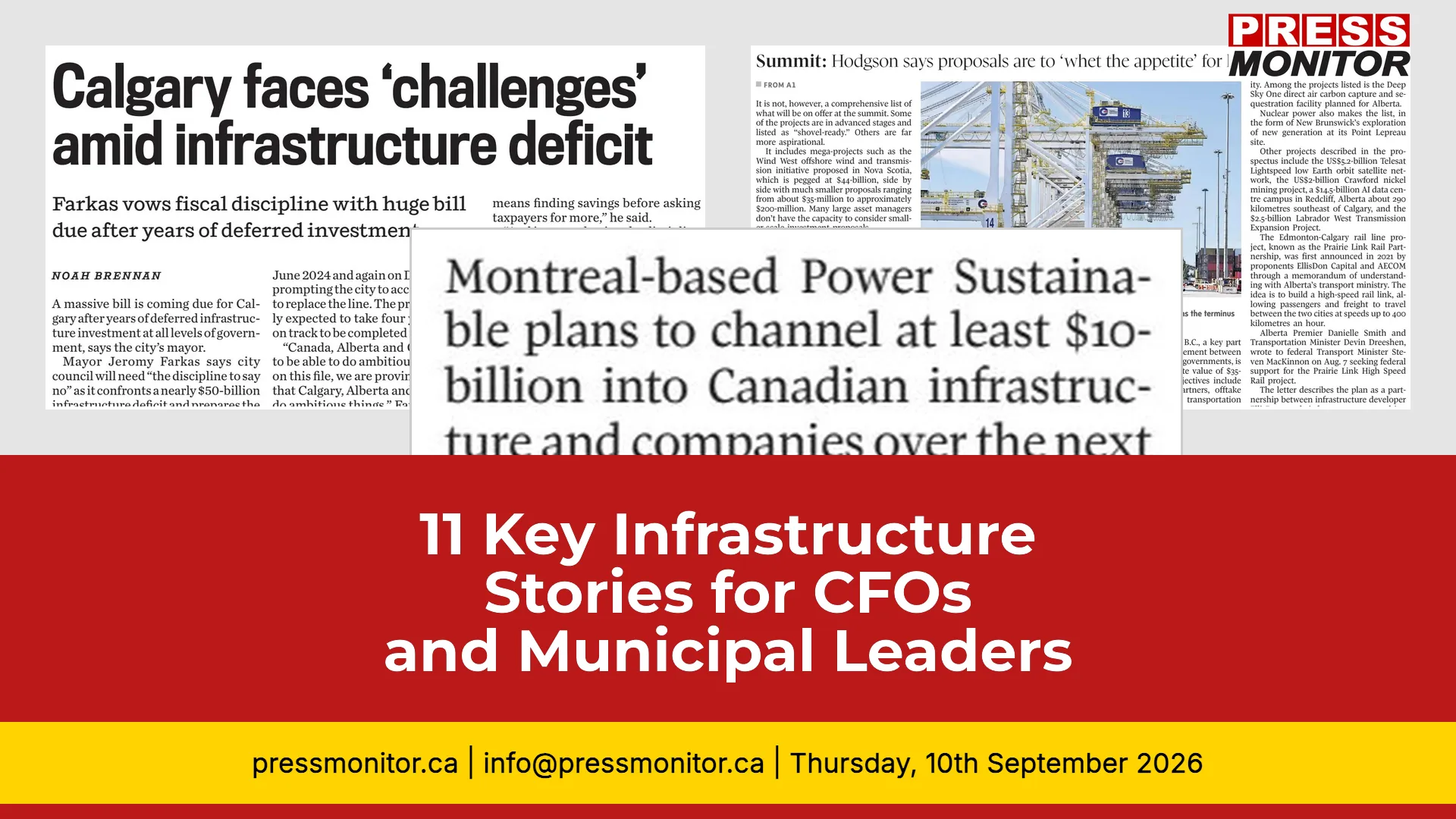
Welcome to today’s essential media monitoring briefing. According to Press Monitor's tracking of Canadian publications, infrastructure spending and policy remain at the forefront of national economic strategy. From municipal funding gaps to billion-dollar federal portfolios, here is your daily briefing on news on infrastructure.
1. Calgary Faces C$50 Billion Infrastructure Deficit
Calgary Herald reports that Mayor Jeromy Farkas warned city council will confront a nearly C$50 billion infrastructure deficit over the next decade due to years of deferred investment and rapid population growth. He urged elected officials to exercise strict fiscal discipline and prioritize essential upgrades like water mains and roads over discretionary projects during upcoming budget deliberations. The mayor also clarified that recent reports of steep property tax increases for twenty twenty seven reflect a comprehensive funding wishlist rather than finalized municipal allocations.
Why it matters: Mayor Jeromy Farkas warns that deferred maintenance and rapid population growth demand strict fiscal discipline from city leadership.
Key detail: The city faces a nearly C$50 billion shortfall over the next decade, urging prioritization of water mains and roads over discretionary projects.
Source: Calgary Herald
Next step: Council must finalize the 2027 budget without triggering steep property tax hikes.
2. Ottawa Pitches C$500B Investment Portfolio
The Globe and Mail reports that officials organizing Prime Minister Mark Carney’s showcase Canada Investment Summit have identified more than 160 projects open for investment, aiming to bring in at least C$500 billion in new private-sector capital over five years. The September 14-15 event in Toronto will feature proposals across energy, transportation, and technology to soften the impact of an expanding tariff war with the United States. A detailed prospectus outlining these opportunities was shared with global executives and major pension funds ahead of the conference.
Why it matters: Federal officials are leveraging a major summit to attract private capital and soften the economic impact of expanding US tariff policies.
Key detail: More than 160 projects spanning energy, transportation, and technology are open for investment, targeting C$500 billion over five years.
Source: The Globe and Mail
Next step: Pension funds and global executives must evaluate prospectus proposals before the Toronto conference.
3. Power Sustainable to Invest $10 Billion in Canadian Infrastructure
{source_name} reports that Montreal-based Power Sustainable plans to channel at least $10 billion into Canadian infrastructure and companies over the next five years, aiming to capture a surge in investor interest in Canada by pivoting further toward its home market. The sustainability-focused asset manager, a subsidiary of financial services giant Power Corp. of Canada, plans to invest from its own funds, draw in capital from co-investors, and tap debt markets to finance a growing pipeline of potential projects. Meeting the $10-billion target would roughly double Power Sustainable's total investing activity since it launched its first energy infrastructure strategy in 2021.
Why it matters: A major domestic asset manager is pivoting heavily toward home-market projects, signaling strong institutional confidence in Canadian clean tech.
Key detail: Power Sustainable plans to deploy at least $10 billion over five years, doubling its total investing activity since 2021.
Source: The Globe and Mail
Next step: Co-investors and debt market participants should monitor pipeline announcements.
4. Calgary Green Line Picks Surface Route
Calgary Herald reports that Calgary city councillors endorsed a downtown alignment for the Green Line, favouring a surface-level track along 10th Avenue, to be built at grade between 1st and 2nd Street Southwest. The decision, made in a 12‑vote executive committee meeting, was expected to move the project toward completion, with projected ridership of 11,000 passengers per day.
Why it matters: The decision to build the downtown transit corridor at grade resolves a long-standing alignment debate and accelerates completion timelines.
Key detail: Councillors endorsed a surface-level track along 10th Avenue, projecting 11,000 daily passengers.
Source: Calgary Herald
Next step: Project teams will shift focus to engineering approvals and contractor bidding.
5. Via Rail’s $6.6 Billion Investment Questioned
The Globe And Mail reports that Ottawa is investing $6.6 billion in new rail cars and locomotives for Via Rail’s long-distance routes, prompting questions about the wisdom of spending on lines that carry less than 5 per cent of ridership and lose over $150 million annually. Critics suggest cheaper alternatives like used equipment or privatizing the Toronto-Vancouver route, while advocacy for high-speed rail through Alto argues the project could eventually be self-sustaining and save taxpayer money.
Why it matters: Critics argue that heavy federal spending on low-ridership long-distance routes strains taxpayer resources compared to high-speed alternatives.
Key detail: Ottawa is funding new rail cars and locomotives despite routes carrying less than 5 percent of ridership and losing over $150 million annually.
Source: The Globe and Mail
Next step: Advocacy groups will push for privatization trials or high-speed rail feasibility studies.
6. B.C. Ferries Funding Rally Launched
Times Colonist reports that rallies across Vancouver Island are calling for fairer federal funding for B.C. Ferries, with Courtenay-Alberni MP Gord Johns leading the effort. The federal government covers forty-three per cent of ferry costs on the East Coast but just three per cent in British Columbia, creating a significant funding gap. British Columbia Ferries CEO Nicolas Jimenez has warned of fare increases exceeding thirty per cent by twenty twenty eight without a sustainable long-term funding model.
Why it matters: A stark disparity in federal cost-sharing between East and West Coast ferry systems is driving organized advocacy for sustainable pricing models.
Key detail: The federal government covers 43 percent of ferry costs in Atlantic Canada but only 3 percent in British Columbia, prompting warnings of 30 percent fare hikes by 2028.
Source: Times Colonist
Next step: MPs and industry leaders will coordinate provincial rallies to pressure Transport Canada.
7. Port Of Los Angeles Sets Volume Record
The Globe And Mail (ottawa/quebec Edition) reports that the Port of Los Angeles set a new three-month volume record during June, July, and August after retailers rushed in goods to avoid new tariffs and higher fuel costs. Waterfront workers handled 955,907 twenty-foot equivalent units in August, bringing the three-month total to 2.9 million units and beating the previous record set during the COVID-19 shipping boom.
Why it matters: Import surges driven by tariff avoidance and fuel cost hedging are testing global supply chain resilience and port capacity limits.
Key detail: Waterfront workers handled 955,907 TEUs in August alone, pushing the three-month total to 2.9 million units.
Source: The Globe and Mail
Next step: Logistics firms must secure warehousing and drayage contracts ahead of peak season.
8. Cape Breton Counties Lift Emergencies
Times Colonist reports that two Cape Breton counties lifted their local states of emergency after a slow-moving storm dropped more than two hundred millimetres of rain, while Richmond County remains in emergency, restricting travel and keeping schools closed. The storm caused washed-out roads, damaged bridges, and stranded residents, prompting ongoing infrastructure assessments and repair work on Route four and other areas.
Why it matters: Extreme weather events continue to expose vulnerabilities in regional road networks and bridge infrastructure, requiring accelerated repair funding.
Key detail: Over 200 millimetres of rain caused washed-out roads and damaged bridges, though emergency restrictions are now easing.
Source: Times Colonist
Next step: Municipal engineers will conduct structural assessments on Route 4 and secondary highways.
9. Winnipeg Projects C$29 Million Deficit
Winnipeg Sun reports that the City of Winnipeg projects a C$28.9-million operating deficit for 2026, driven by higher road maintenance, transit fuel costs, and police overtime expenses. The shortfall increases the general revenue fund gap by 8.5 million compared to first-quarter forecasts, prompting potential use of the citys financial stabilization reserve. Administration anticipates generating 55.1 million Canadian dollars in savings through efficiency measures and vacancy management to help close the gap.
Why it matters: Rising operational costs in road maintenance, transit fuel, and emergency services are forcing municipalities to tap stabilization reserves.
Key detail: The city anticipates generating $55.1 million in savings through efficiency measures and vacancy management to close the gap.
Source: Winnipeg Sun
Next step: Finance committees will review austerity measures before final budget adoption.
10. Calgary Seeks Corporate Sponsor for Free Fare Zone
Why it matters: Public transit agencies are increasingly relying on private partnerships to maintain accessibility programs amid tightening municipal budgets.
Key detail: Calgary Transit is accepting sponsorship bids until October 16 to extend the downtown CTrain free fare zone into 2027.
Source: Calgary Herald
Next step: Corporate partners will negotiate branding rights and service extension terms.
11. Maine Gets Tariff Relief
The Edmonton Journal reports that the Trump administration has announced the removal of Canadian road salt and cement from import tariffs as of September 15, earning the gratitude of Maine Republican Senator Susan Collins. Collins had lobbied for exemptions on these two products, citing potential cost increases of 10000 US dollars for a small town and 150000 US dollars monthly for a cement company. The administration agreed to swap the exemptions for new duties on all-terrain vehicles, certain cheeses, and motorboats, while Collins also praised Canada's decision to remove seafood and fish products from its retaliatory tariff list.
Why it matters: Cross-border trade exemptions on construction materials directly impact Canadian municipal procurement costs and infrastructure project timelines.
Key detail: The Trump administration removed road salt and cement from import tariffs, offsetting duties on ATVs and motorboats.
Source: Edmonton Journal
Next step: Provincial procurement officers will reassess material sourcing strategies.
This print media monitoring roundup captures the decisive shifts shaping Canadian public works. How should municipalities balance immediate repair needs against long-term capital investments? Share your perspective below.