13 Essential Real Estate Stories for Industry Leaders


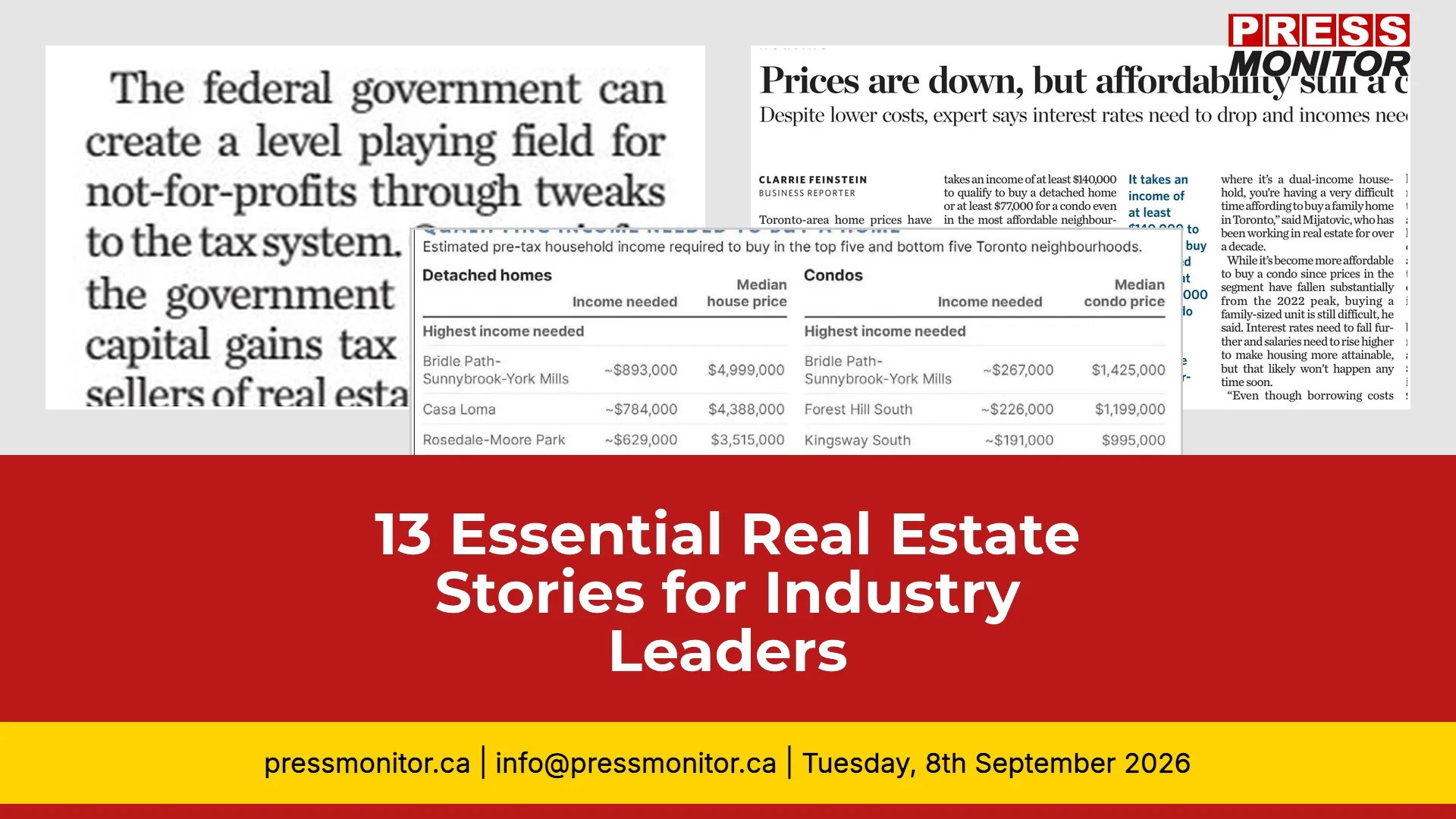
From Toronto's 25 percent home price decline to non-profit housing tax reforms, this press review covers the stories shaping Canada's real estate landscape. According to Press Monitor's tracking of Canadian publications, these 13 stories deliver essential media intelligence for professionals navigating a rapidly shifting market.
1. Non-Profit Housing Tax Reform Proposed
The Hamilton Spectator reports that the federal government can create a level playing field for not-for-profits by giving a full capital gains tax exemption to sellers of real estate assets sold to accredited non-profit housing developers, municipalities, or Crown corporations. This follows precedents like Canada's Ecological Gifts Program, which has recorded over 2,000 donations worth more than $13 billion since 1995. The article also highlights the need to prevent youth access to unauthorized nicotine products and enforce rules against illicit sellers. The Hamilton Spectator reveals a bold proposal to level the playing field for not-for-profits through a full capital gains tax exemption on real estate sales to accredited developers. This move, modeled on Canada's Ecological Gifts Program which has logged over 2,000 donations worth more than $13 billion, could unlock significant affordable housing supply. Why it matters: this reform could reshape the affordable housing landscape across Canada. Key detail: over 2,000 donations worth $13 billion since 1995 through the Ecological Gifts Program. Source: The Hamilton Spectator, Adam Mongrainis and Mike Moffatt. Next step: watch for parliamentary debate on the proposal.
2. Toronto Home Prices Drop 25 Per Cent
The Toronto Star reports that Toronto-area home prices have dropped by almost 25 per cent since the pandemic peak, but experts warn affordability remains a challenge as interest rates stay high and incomes lag. Real estate data expert Christian Mijatovic calculated that buyers need at least $140,000 in income for a detached home or $77,000 for a condo even in the most affordable neighbourhoods. Higher borrowing costs and stagnant salaries continue to push buyers toward suburbs, potentially harming the local economy. Toronto-area home prices have fallen nearly 25 percent since the pandemic peak, yet affordability remains elusive. Real estate data expert Christian Mijatovic calculates that buyers need at least $140,000 in income for a detached home or $77,000 for a condo in the most affordable neighbourhoods. Why it matters: even with significant price drops, the market remains out of reach for many. Key detail: $140,000 income needed for detached homes, $77,000 for condos. Source: Toronto Star, Clarrie Feinstein. Next step: monitor whether price declines continue as rates hold steady.
3. Toronto Neighbourhoods Income Gap
Toronto Star reports that estimated pre-tax household income required to buy a detached home in Toronto ranges from one hundred forty-one thousand dollars in Beechborough-Greenbrook to eight hundred ninety-three thousand dollars in Bridle Path-Sunnybrook-York Mills. The data also reveals condo affordability gaps, with income needed ranging from seventy-seven thousand dollars in Black Creek to two hundred sixty-seven thousand dollars in Bridle Path-Sunnybrook-York Mills. Median home prices vary dramatically across neighbourhoods, from seven hundred sixty-five thousand dollars to nearly five million dollars. The income gap between Toronto neighbourhoods is stark: pre-tax household income needed to buy a detached home ranges from $141,000 in Beechborough-Greenbrook to $893,000 in Bridle Path-Sunnybrook-York Mills. Condo affordability gaps are equally dramatic, from $77,000 in Black Creek to $267,000 in Bridle Path. Median home prices span from $765,000 to nearly $5 million. Why it matters: the data reveals deep divides that policy must address. Key detail: nearly $750,000 gap between lowest and highest income requirements. Source: Toronto Star. Next step: consider how neighbourhood-level data should inform housing policy.
4. Toronto Home Prices Drop To Just Under $1 Million
The Toronto Star reports that home prices in Toronto edged lower in July and fell further in August, dropping to just under C$1 million for the first time since January, according to the Toronto Regional Real Estate Board. Jamie David of Ratehub.ca noted price changes were the biggest driver of improved affordability, while Mijatovic analyzed income requirements across neighbourhoods and John Pasalis highlighted that monthly carrying costs have not improved significantly despite lower prices. Home prices in Toronto fell to just under C$1 million for the first time since January, according to the Toronto Regional Real Estate Board. Jamie David of Ratehub.ca noted that price changes were the biggest driver of improved affordability, while Mijatovic analyzed income requirements and John Pasalis highlighted that monthly carrying costs have not improved significantly despite lower prices. Why it matters: lower prices do not automatically mean more affordable monthly payments. Key detail: prices at their lowest since January 2026. Source: Toronto Star, TRREB, Ratehub.ca. Next step: track whether carrying cost improvements follow price declines.
5. Toronto Rental Supply Not a Boon for All Tenants
Toronto Star reports that a massive influx of rental apartments has arrived in Toronto, but two recent reports raise questions over whether this supply is actually creating more affordability throughout the rental market. CoStar Group and CMHC findings show higher vacancy rates in new luxury buildings while lower-priced segments continue to face pressure, suggesting limited downward filtering of new supply. A massive influx of rental apartments has arrived in Toronto, but CoStar Group and CMHC findings show higher vacancy rates in new luxury buildings while lower-priced segments continue to face pressure. This suggests limited downward filtering of new supply, meaning the rental boom may not translate into broader affordability gains. Why it matters: supply alone is not solving the rental crisis. Key detail: luxury vacancy rising while affordable segments remain tight. Source: Toronto Star, Manuela Vega, CoStar Group, CMHC. Next step: advocate for policies that ensure new supply reaches lower-priced segments.
6. Toronto Construction Costs Surge 60 Percent
The Toronto Star reports that newly constructed rental buildings in Toronto are taking an average of 21 months to reach a five percent vacancy rate following a recent surge in completions. Real estate experts and tenant advocates highlight that while construction costs have jumped by roughly 60 percent since the pandemic, family incomes have only risen marginally, worsening the city's affordability crisis. Advocates argue that expanding housing supply alone will not resolve these challenges without enforcing stricter rent control on new developments. Construction costs in Toronto have jumped roughly 60 percent since the pandemic, while family incomes have only risen marginally. Newly constructed rental buildings take an average of 21 months to reach a five percent vacancy rate. Tenant advocates argue that expanding housing supply alone will not resolve affordability challenges without stricter rent control on new developments. Why it matters: the cost of building is pricing out both developers and renters. Key detail: 60% cost increase vs. marginal income growth. Source: Toronto Star. Next step: support rent control measures that keep new developments affordable.
7. Workforce Housing Projects Expand Near B.C. Job Hubs
Business in Vancouver reports that developers are increasingly orienting housing projects to the needs of workers, touting the benefit of sites close to employment nodes in the entitlement process. Projects near hospitals, military bases and industrial areas target workers squeezed by housing costs, including a 135-unit rental project on Vancouver Island and a 39-unit building near Kelowna General Hospital. Business in Vancouver reports that developers are increasingly orienting housing projects to worker needs, with sites close to employment nodes in the entitlement process. Projects include a 135-unit rental project on Vancouver Island and a 39-unit building near Kelowna General Hospital, targeting workers squeezed by housing costs. Why it matters: proximity to jobs is becoming a key development criterion. Key detail: 135 units on Vancouver Island, 39 units near Kelowna hospital. Source: Business in Vancouver, Peter Mitham. Next step: watch for more worker-oriented developments in other provinces.
8. South Britannia Surf Park Breaks Ground
{source_name} reports that developers have broken ground on South Britannia, a mixed-use resort-like development along the Sea-to-Sky Highway south of Britannia Beach, British Columbia. The project, undertaken by Tiger Bay Development, features a six-acre man-made surf park, the first of its kind in Canada, and includes 900 homes. Construction began after the project was approved in 2025 following revisions to address local concerns. Tiger Bay Development has broken ground on South Britannia, a mixed-use resort-like development along the Sea-to-Sky Highway south of Britannia Beach, British Columbia. The project features Canada's first six-acre man-made surf park and includes 900 homes, approved in 2025 after revisions to address local concerns. Why it matters: unique recreational infrastructure is driving mixed-use development. Key detail: 900 homes, first surf park of its kind in Canada. Source: The Globe and Mail, Howard Chai. Next step: monitor community impact as construction progresses.
9. Surrey Tops Vancouver-Area Renter Ranking
The Globe And Mail (ottawa/quebec Edition) reports that Surrey has topped the Vancouver-area renter-friendly ranking in its 2026 edition, scoring highest in affordability, availability, stability, and livability. The ranking covers fourteen communities in the Vancouver Census Metropolitan Area, including Vancouver itself. Realtor Manraj Dosanjh attributes the trend to new transit-oriented developments, while Rentals.ca notes that average rents across the region have dropped to some of their lowest levels in years. Surrey has topped the Vancouver-area renter-friendly ranking in its 2026 edition, scoring highest in affordability, availability, stability, and livability across fourteen communities. Realtor Manraj Dosanjh attributes the trend to new transit-oriented developments, while Rentals.ca notes average rents across the region have dropped to some of their lowest levels in years. Why it matters: Surrey's approach offers a model for other municipalities. Key detail: highest scores in affordability, availability, stability, and livability. Source: The Globe and Mail, Olivia Grandy. Next step: study Surrey's transit-oriented development strategy for replication.
10. 400 Jobs Planned at Surrey Auto Loop
Business in Vancouver reports that Surrey city council has approved a rezoning application for the Surrey Auto Loop, a multi-tenant mixed-use auto mall planned on the former Mountain Equipment Company distribution centre on a sixteen acre site. OpenRoad Auto Group through its holding company Multiland Pacific Holdings will develop the project expected to employ more than four hundred people. Construction is set to begin in two thousand twenty seven with completion expected in early two thousand twenty eight. Surrey city council approved a rezoning application for the Surrey Auto Loop, a multi-tenant mixed-use auto mall on the former Mountain Equipment Company distribution centre. OpenRoad Auto Group through Multiland Pacific Holdings will develop the project, expected to employ more than 400 people, with construction starting in 2027. Why it matters: major commercial redevelopment is creating significant employment. Key detail: 400+ jobs, construction begins 2027. Source: Business in Vancouver, Peter Mitham. Next step: track economic impact as the project develops.
11. Victoria Voter Demands Eight Reforms
The Times Colonist reports that voters in Victoria are demanding eight basic reforms ahead of the municipal election. Key demands include improved accountability and transparency at City Hall, protection of human rights for homeless people, and increased financial assistance rates from the province. Voters also call for non-profit rental housing mandates, support for downtown businesses, and meaningful engagement of young people in the civic process. Voters in Victoria are demanding eight basic reforms ahead of the municipal election, including improved accountability at City Hall, protection of human rights for homeless people, and increased financial assistance rates. Voters also call for non-profit rental housing mandates and meaningful engagement of young people in the civic process. Why it matters: voter priorities signal where policy should focus. Key detail: eight reforms demanded, including housing mandates. Source: Times Colonist, Bruce Moore and Judy Lightwater. Next step: candidates should address these demands in their platforms.
12. Vaughan Home Sale Highlights Real Estate Dilemma
Financial Post Magazine reports that would-be sellers who can continue carrying their property instead of listing may wait for its value to recover. One of realtor Tim Yew's clients sold his Vaughan home after accepting a job elsewhere, illustrating the difficult choices some homeowners face. Financial Post Magazine reports that would-be sellers who can continue carrying their property instead of listing may wait for its value to recover. One of realtor Tim Yew's clients sold his Vaughan home after accepting a job elsewhere, illustrating the difficult choices some homeowners face in a softening market. Why it matters: the decision to sell or hold has become more complex. Key detail: homeowners choosing to carry rather than list. Source: Financial Post Magazine. Next step: evaluate personal financial circumstances before making listing decisions.
13. Knowlton Inn Lists For C$1.95 Million
Montreal Gazette reports that Lois Hardacker presents a selection of Eastern Townships real estate listings including the historic inn Le Relais in Knowlton for C$1.95 million and a Brome Lake condominium for C$659,000. The portfolios span properties in Knowlton, Lac Brome, and surrounding communities such as Sutton and Dunham. Montreal Gazette reports that the historic inn Le Relais in Knowlton has been listed for C$1.95 million, alongside a Brome Lake condominium for C$659,000. The portfolios span properties in Knowlton, Lac Brome, Sutton, and Dunham, highlighting continued activity in Quebec's Eastern Townships real estate market. Why it matters: historic properties and luxury condos remain active in Quebec's market. Key detail: $1.95M inn listing, $659K condo. Source: Montreal Gazette, Lois Hardacker. Next step: monitor Eastern Townships market trends through fall.
As print media monitoring continues to reveal the depth of Canada's real estate shifts, the question remains: will policy reforms and new supply be enough to close the affordability gap? Follow Press Monitor for ongoing news on real estate across Canadian publications.