13 Pivotal Trade Stories for Executives


Welcome to your daily press review. According to Press Monitor's tracking of Canadian publications, today's trade landscape is shifting rapidly as retaliatory levies approach and economic forecasts update. This media intelligence briefing distills the highest-impact developments so you can act before markets adjust.
1. Carney Tariff Deadline & Retaliation Warning
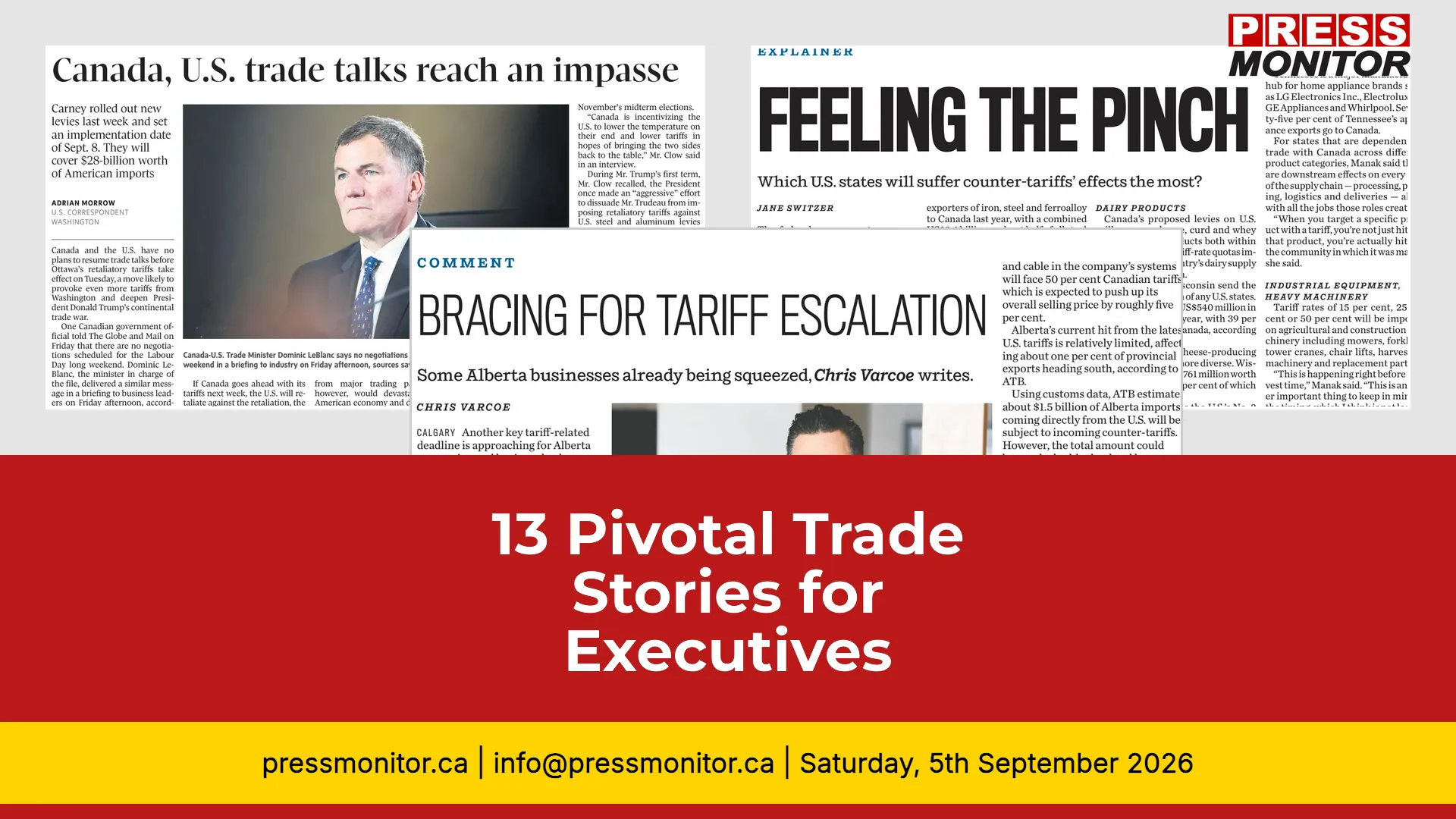
The Globe and Mail reports that Canada and the U.S. have no plans to resume trade talks before Ottawa’s retaliatory tariffs take effect on Tuesday, a move likely to provoke even more tariffs from Washington and deepen President Donald Trump’s continental trade war. Prime Minister Mark Carney rolled out the new levies last week and set an implementation date of Sept. 8, covering $28-billion worth of U.S. imports, while the Trump administration has warned it will retaliate against the retaliation no later than Wednesday.
Why it matters: Ottawa and Washington are not resuming talks before Tuesday's deadline, raising the risk of escalated continental friction.
Key detail: Prime Minister Mark Carney set September 8 as the implementation date for $28-billion in new levies, while the Trump administration warns of immediate counter-retaliation.
Source: The Globe and Mail
Next step: Review contingency plans for cross-border logistics and currency hedging.
2. Counter-Tariffs Target Michigan, Ohio, Iowa
Saskatoon Starphoenix reports that Canada's new counter-tariffs on U.S. goods are primarily designed to protect Canadian companies' domestic market share, but with November's U.S. midterm elections looming, the levies will have economic and political effects south of the border, particularly in battleground states such as Michigan, Ohio and Iowa. The federal government says the C$27.6 billion in counter-tariffs set to take effect in less than a week will target industries including steel, aluminum, motor vehicles, dairy products, appliances and industrial equipment.
Why it matters: Provincial and federal strategies are deliberately concentrated on politically sensitive U.S. manufacturing hubs ahead of midterm elections.
Key detail: The C$27.6-billion package targets steel, aluminum, motor vehicles, dairy, and industrial equipment, amplifying pressure on Midwest supply chains.
Source: Saskatoon Starphoenix
Next step: Assess exposure to auto parts and heavy machinery export routes.
3. Alberta Imports Face C$1.5B in Levies
Saskatoon Starphoenix reports that Canadian counter-tariffs are expected to kick in on Tuesday unless a Canada-United States trade deal is reached soon. The Mark Carney government announced retaliatory tariffs on more than 600 items, including steel, agriculture, and electronics, in response to US tariffs on over $27 billion of Canadian products. Alberta businesses, including Saturn Oil & Gas and RAM Elevators and Lifts, are bracing for increased costs, with ATB Financial estimating C$1.5 billion in Alberta imports subject to the new tariffs.
Why it matters: Western Canadian businesses are bracing for direct cost increases as retaliatory measures expand beyond traditional sectors.
Key detail: ATB Financial estimates C$1.5-billion in Alberta imports subject to new tariffs, impacting firms like Saturn Oil & Gas and RAM Elevators and Lifts.
Source: Saskatoon Starphoenix
Next step: Audit procurement contracts and renegotiate supplier terms.
4. U.S. Manufacturers Unfazed by Canadian Retaliation
The Globe And Mail reports that the Canadian countertariffs expected to take effect next week represent an existential threat for some businesses north of the U.S. border, but many American manufacturers south of the 49th parallel expect only pain rather than suffering. Owners of companies such as US Bowling and fishing rod makers in Woodland, Washington indicate that Canada is not a big market for most of them, with some even unaware of the new tariffs. While stripping US-made alcohol from provincial shelves has acutely stung makers of Kentucky bourbon and California wine, and Northern U.S. towns have seen a decline in cross-border travel business, the insouciance of some U.S. manufacturers offers a striking reality check for those hoping Ottawa's measures will spark a revolt.
Why it matters: Many American producers view Canada as a secondary market, suggesting Ottawa's political leverage may fall short of expectations.
Key detail: Woodland, Washington-based fishing rod and bowling manufacturers note minimal revenue exposure, though bourbon and wine makers feel acute shelf-stripping pain.
Source: The Globe and Mail
Next step: Identify which U.S. competitors lack diversified export channels.
5. Deloitte: CUSMA Exit Costs Canada $4.02B
Saskatoon Starphoenix reports that a U.S. withdrawal from the Canada-United States-Mexico Agreement would cause a severe but not cataclysmic impact on Canada’s economy, with GDP falling 1.6 percent by 2036 and $4.02 billion lost, while employment could shrink by 1.63 million jobs. The report also warns that manufacturing could see a 28 percent drop in GDP, and other export‑heavy sectors such as electronics, machinery, rubber, plastics and chemicals would suffer 21, 20 and 13 percent losses.
Why it matters: A worst-case scenario modeling shows severe but manageable macroeconomic damage, with manufacturing facing a 28 percent GDP contraction.
Key detail: Employment could shrink by 1.63 million jobs over the decade, while electronics, machinery, rubber, plastics, and chemicals suffer double-digit losses.
Source: Saskatoon Starphoenix
Next step: Stress-test domestic production capacity against potential border closures.
6. Best-Case Scenario Projects $141B Gain
Saskatoon Starphoenix reports that Deloitte Canada forecasts a best-case scenario where Canada maintains existing free-trade deals and negotiates new ones, predicting GDP growth of 0.6 per cent by 2036, representing C$141 billion and the creation of 53,000 jobs a year. Matthew Stewart, a partner at Deloitte Canada, told National Post that while the numbers are relatively easy to calculate, the future is hard to predict due to increased protectionism across both parties in the United States.
Why it matters: Maintaining existing free-trade frameworks while negotiating new partnerships could unlock substantial long-term growth.
Key detail: Deloitte Canada forecasts 0.6 percent annual GDP growth by 2036, translating to C$141-billion and 53,000 new jobs yearly.
Source: Saskatoon Starphoenix
Next step: Align capital expenditure with emerging market openings in Asia.
7. Senator Collins Faces Re-Election Test Over Tariffs
Regina Leader-post reports that Maine Senator Susan Collins faces a challenging re-election race as Democratic challenger Troy Jackson leads in recent polls. Collins has worked to distance herself from President Donald Trump and Vice-president JD Vance, actively opposing proposed tariffs and urging resumed trade talks with Canada. Political analysts warn that shifting voter sentiment and affordability concerns tied to the tariff dispute may significantly impact her ability to secure crossover votes this November.
Why it matters: Maine Republican Susan Collins is distancing herself from federal tariff policies, risking her crossover vote base amid affordability concerns.
Key detail: Polls show Democrat Troy Jackson leading as voters weigh trade tensions against local economic stability.
Source: Regina Leader-post
Next step: Monitor U.S. Senate race outcomes for future trade legislation signals.
8. Lutnick Accuses Ottawa of Sabotaging Talks
The Chronicle Herald reports that United States Commerce Secretary Howard Lutnick said a Canadian minister did not deny being asked whether Canadian negotiators were trying to blow up trade talks. The dispute centers on Ottawa negotiations that ended late Friday, August 21, with only Canada United States trade minister Dominic LeBlanc present, while Carney and United States Trade Representative Jameson Greer defended their governments' positions. Canadian officials accused the United States of adding last minute conditions on auto tariffs, language and culture protections, and sovereignty, while United States officials blamed Canada for political reasons.
Why it matters: U.S. Commerce Secretary Howard Lutnick claims Canadian negotiators attempted to derail August discussions, complicating diplomatic recovery.
Key detail: Disputes center on last-minute U.S. demands regarding auto tariffs, language protections, and sovereignty clauses.
Source: The Chronicle Herald
Next step: Track official statements from Dominic LeBlanc and Jameson Greer for negotiation resets.
9. July Trade Surplus Narrows Sharply
Saskatoon StarPhoenix reports that Canada's trade surplus sharply narrowed to C$769 million in July from C$4.2 billion in June, driven by a decrease in gold exports to the United States. Total exports decreased 2.3 per cent in July, the first decline in six months, while total imports rose 2.2 per cent, led by a record high increase in motor vehicles and parts.
Why it matters: Export momentum is cooling as gold shipments decline and import volumes surge, signaling near-term growth headwinds.
Key detail: The surplus fell to C$769-million from C$4.2-billion, driven by a record rise in motor vehicle and parts imports.
Source: Saskatoon Starphoenix
Next step: Adjust inventory forecasting and monitor Bank of Canada rate implications.
10. Household Income Projected to Drop C$1,015 Annually
Ottawa Citizen reports that the Canada-US trade war has mixed effects on housing development. While tariffs on softwood lumber and steel may lower material costs for Canadian builders, they also restrict manufactured goods choices and cause shipping delays. A report by Oxford Economics estimates Canada's GDP difference at 1.9 percent and average household income loss at C$1,015 annually over ten years.
Why it matters: Consumer purchasing power faces sustained erosion as material costs and shipping delays compound housing development expenses.
Key detail: Oxford Economics models a 1.9 percent GDP divergence over ten years, directly impacting builder margins and buyer affordability.
Source: Ottawa Citizen
Next step: Evaluate real estate investment timelines and construction material alternatives.
11. Global Food Prices Surge Amid Supply Disruptions
{source_name} reports that global food prices reached their highest level since late 2022 in August, driven by extreme weather, drought, and disruptions in the Black Sea region. The United Nations Food and Agriculture Organization said its Food Price Index averaged 133.3 points, with rising costs across cereals, vegetable oils, sugar, meat, and dairy as supply risks grow. The agency also cut its 2026 global cereal production forecast by 3.4 million tonnes to 2.98 billion tonnes, marking the largest annual decline since 2018.
Why it matters: Climate volatility and Black Sea bottlenecks are driving cereal, oil, and dairy costs to three-year peaks, affecting retail margins.
Key detail: The FAO cut its 2026 global cereal production forecast by 3.4-million tonnes, marking the steepest annual decline since 2018.
Source: The Globe and Mail
Next step: Secure forward contracts for staple commodities and diversify sourcing regions.
12. Nanos Survey: Widespread Canadian Anxiety Over Tariffs
The Globe And Mail reports that a late August survey of more than one thousand Canadians reveals widespread concern over proposed United States tariffs. Approximately two-thirds of respondents expressed worry about the financial impact on their families, while three-quarters questioned whether Washington remains a reliable ally. Despite these anxieties, most participants remain cautiously optimistic about potential improvements in bilateral trade relations within five years.
Why it matters: Public sentiment is shifting rapidly, with two-thirds of respondents fearing financial strain and questioning U.S. alliance reliability.
Key detail: Despite concerns, most Canadians remain cautiously optimistic about bilateral trade normalization within five years.
Source: The Globe and Mail
Next step: Prepare stakeholder communications addressing consumer confidence and policy transparency.
13. Free Trade Theory Collapses Under Protectionism
The Chronicle Herald reports that economic analyses have been lost in a dense fog of incoherent tariff war theories following US President Donald Trump's nationalist trade actions. Terence Corcoran argues that the automobile industry exemplifies the collapse of free trade theory, as government intervention attempts to shore up a declining sector that contributes less than one per cent of Canada's gross domestic product.
Why it matters: Government intervention in declining sectors like automotive manufacturing is distorting market efficiency and resource allocation.
Key detail: Analysts warn that protectionist subsidies fail to address structural competitiveness gaps while inflating consumer prices.
Source: The Chronicle Herald
Next step: Prioritize innovation investments and interprovincial barrier reduction.
This print media monitoring digest captures the critical shifts shaping North American commerce. How will your organization adapt its supply chain strategy before the September 8 implementation window closes?