15 Essential Human Resources Stories for HR Leaders


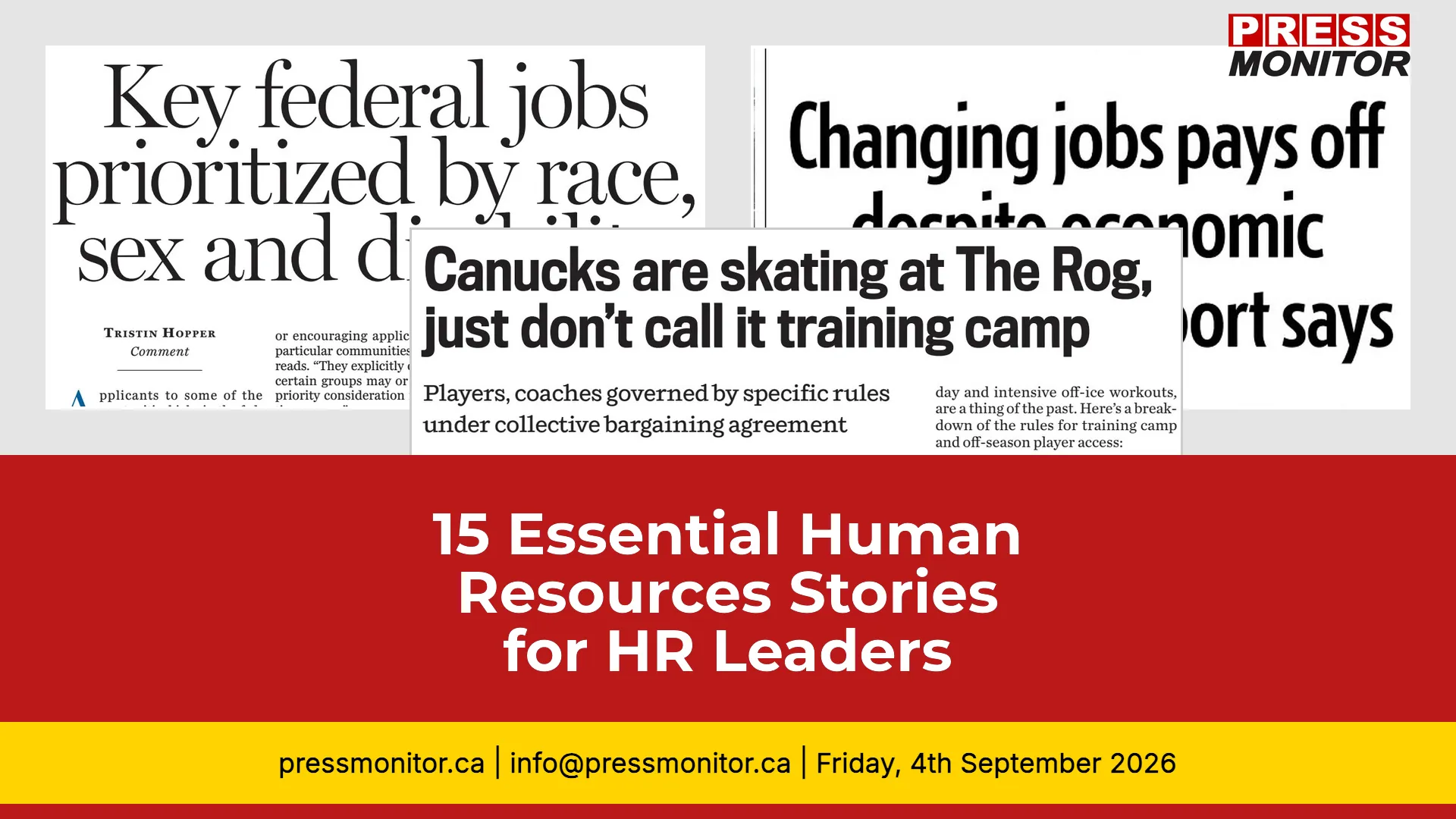
From wage shifts to labour disputes, today's human resources landscape in Canada demands constant attention. According to Press Monitor's tracking of Canadian publications, this press review delivers the essential news on human resources that HR leaders need to act on today. These stories on media monitoring and media intelligence reveal where talent markets are tightening, where labour tensions are rising, and where policy shifts will reshape workforce strategy across the country.
1. Federal Hiring Quotas Under Scrutiny
Regina Leader-post reports that a new report by the Aristotle Foundation for Public Policy found 42 per cent of 301 government job openings advertised between February and July were subject to explicit or potential prioritization based on group identity. Three departments, Fisheries and Oceans Canada, Agriculture and Agri-Food Canada, and the National Research Council, had lOO per cent of their postings prioritize candidates based on race, gender, or ability. Critical roles including safety inspectors and intelligence agents are now being told they might be rejected if they do not fit within an equity-deserving identity category.
Why it matters: Identity-based selection practices in federal hiring are under the microscope, raising questions about merit-based staffing and workforce integrity.
Key detail: 42 percent of 301 government job openings were subject to explicit or potential prioritization based on group identity, with three departments at 100 percent.
Source: Regina Leader-post, Aristotle Foundation for Public Policy report.
Next step: HR leaders should review their own hiring practices for unintended bias and prepare for potential policy changes.
2. Job Changers Earn 5.6% Wage Premium
National Post reports that Canadians who stayed at their current workplace for the past 12 months saw a three per cent year-over-year wage hike, while job changers' pay rose 5.6 per cent, a report says. ADP chief economist Nela Richardson noted the modest bump for job changers and emphasized the importance of base pay in understanding labour market tightness. Royal Bank of Canada assistant chief economist Nathan Janzen said wage growth differences between job stayers and job changers are a measure not explored in other Canadian statistics, and warned that wage growth could track lower than inflation amid a softer labour market and trade tensions with the United States.
Why it matters: The growing pay gap between job switchers and stayers signals a tighter labour market than traditional metrics suggest.
Key detail: Median base pay for job changers climbed 5.6 percent year-over-year in August, compared to 3 percent for stayers, per ADP's report on 1.6 million workers.
Source: National Post, ADP Canada Pay Insights.
Next step: Employers should benchmark retention strategies against the 5.6 percent churn premium to reduce voluntary turnover.
3. Canucks Captain Skates Under CBA Rules
Vancouver Sun reports that the Vancouver Canucks had most of their expected National Hockey League roster skating at Rogers Arena in Vancouver, two weeks before official training camp begins in Penticton. Injured goalie Thatcher Demko was absent, and players were observed by Canucks coaches during captain's skates, the traditional final informal tune-up before roster members become contractually obligated to attend team activities. The session is governed by the collective bargaining agreement, which allows teams to keep facilities open but prohibits them from forcing players to use them during the off-season.
Why it matters: Off-season workplace access rules for professional athletes mirror broader HR questions about employee availability and collective agreements.
Key detail: The Vancouver Canucks held captain's skates at Rogers Arena governed by CBA rules that prohibit forced off-season participation.
Source: Vancouver Sun, Patrick Johnston.
Next step: HR teams in sports and entertainment should audit their own off-season policies for compliance with collective agreements.
4. Lamèque Fishery Workers Demand Aid
Radio-canada Info reports that about a hundred unemployed workers from the Association coopérative des pêcheurs de l'Île in Lamèque held their first major meeting since the seafood processing plant went into receivership. The plant is drowning in 25 million dollars in debt, leaving employees worried about government assistance, a possible spring reopening, and surviving the winter on employment insurance benefits alone.
Why it matters: The collapse of a seafood processing plant leaves about a hundred workers unemployed and anxious about winter survival.
Key detail: The cooperative is drowning in 25 million dollars in debt, with workers gathering to demand extended unemployment benefits.
Source: Radio-canada Info, Lamèque, July 18, 2026.
Next step: Regional HR leaders should coordinate with Employment Insurance offices to prepare for extended benefit demand.
5. C$3.9 Billion Transmission Line Construction Begins
Times Colonist reports that construction is underway on the North Coast Transmission Line expansion, linking Prince George to Terrace in British Columbia's north. The C$3.9 billion project, supported by federal and provincial governments, is expected to create close to 10,000 direct jobs and power major initiatives including the Ksi Lisims LNG facility and mining in the Golden Triangle. Premier David Eby and federal Energy Minister Tim Hodgson attended the groundbreaking event in Prince George on Thursday.
Why it matters: A major infrastructure project will create close to 10,000 direct jobs, reshaping the labour market in British Columbia's north.
Key detail: The North Coast Transmission Line links Prince George to Terrace, powering the Ksi Lisims LNG facility and Golden Triangle mining operations.
Source: Times Colonist, The Canadian Press.
Next step: HR departments in BC should prepare for a surge in construction-sector hiring and skills demands.
6. USMMA Collapse Threatens Canadian Economy
The Globe And Mail (ottawa/quebec Edition) reports that a new Deloitte Canada study warns dissolving the United States-Mexico-Canada Agreement would severely impact the domestic economy, potentially reducing real gross domestic product by 1.6 per cent and shedding an average of 163,000 jobs annually over the next decade. While expanding international trade partnerships offers some mitigation, researchers emphasize that eliminating interprovincial barriers and fostering new industries are essential to offsetting financial losses, particularly for manufacturing and energy sectors.
Why it matters: Dissolving the trade agreement could reduce GDP by 1.6 percent and shed 163,000 jobs annually, devastating manufacturing and energy sectors.
Key detail: A Deloitte Canada study warns that eliminating interprovincial barriers and fostering new industries are essential to offsetting losses.
Source: The Globe and Mail, Lauren Krugel.
Next step: HR leaders in affected sectors should develop contingency workforce plans for potential trade disruption scenarios.
7. Vancouver Sees Population Decline in 2025
Vancouver Sun reports that Vancouver's population dropped in 2025, mirroring declines in Richmond, while Surrey saw the region's largest growth of 13,372 people—though far more subdued than previous years. David van Hemmen of the Greater Vancouver Board of Trade attributed the decline to Ottawa's new rules on temporary residents affecting students and workers, but said Vancouver remains the province's economic core. Andy Yan of Simon Fraser University's city program noted it's too early to determine if the decline is a temporary blip or a trend, while underscoring the unevenness of growth across the region without matching infrastructure.
Why it matters: Shifting population patterns affect talent pools, housing demand, and workforce availability in Canada's largest west coast city.
Key detail: Vancouver's population dropped in 2025 while Surrey saw the region's largest growth of 13,372 people, attributed to Ottawa's new rules on temporary residents.
Source: Vancouver Sun.
Next step: HR teams in metro Vancouver should reassess recruitment strategies as the talent pool shifts toward Surrey and surrounding areas.
8. Volkswagen Board Approves 50,000 Job Cuts
Times Colonist reports that Volkswagen's board has approved a sweeping cost-cutting plan involving the elimination of 50,000 jobs and the closure of four manufacturing facilities in Germany. Chief Executive Officer Oliver Blume introduced the strategy to counter low-cost competition and rising trade barriers, successfully overcoming resistance from employee representatives. The restructuring will slash the company's model lineup by 50 percent and addresses significant excess production capacity across Europe.
Why it matters: A major global manufacturer's restructuring signals broader automotive sector upheaval with implications for Canadian auto workers.
Key detail: CEO Oliver Blume's plan eliminates 50,000 jobs and closes four German manufacturing facilities, slashing the model lineup by 50 percent.
Source: Times Colonist, Frankfurt, Germany.
Next step: Canadian auto parts suppliers should monitor VW's restructuring for potential supply chain and workforce impacts.
9. Ontario Invests C$17 Million in Forestry Modernization
Radio-canada Info reports that Ontario is investing more than C$17 million in four forestry-sector modernization projects in Northern Ontario, protecting existing jobs and supporting indirect employment. The funding will go to GreenFirst Forest Products in Chapleau, Interfor in Elk Lake, and Atlantic Power in Calstock, with Kevin Holland, associate minister of Forests and Forest Products, saying the investments advance the province's forestry protection plan.
Why it matters: Government investment in forestry-sector modernization protects existing jobs and supports indirect employment in Northern Ontario.
Key detail: Funding goes to GreenFirst Forest Products in Chapleau, Interfor in Elk Lake, and Atlantic Power in Calstock, advancing the province's forestry protection plan.
Source: Radio-canada Info, Désiré Kafunda.
Next step: HR leaders in the forestry sector should align training programs with modernization technology requirements.
10. MLB Salary Cap Labor Dispute Looms
Le Journal de Quebec reports that the chances of major league baseball starting the next season on time are slim due to an impending labor conflict. Owners want a salary cap while players resist, despite the luxury tax already costing teams like the Dodgers 169.4 million dollars last year. The author argues that without a cap, wealthy markets dominate championships, and suggests players should consider accepting a cap in exchange for better minimum salaries and revenue guarantees.
Why it matters: An impending labour conflict in Major League Baseball highlights the complexities of salary caps, revenue sharing, and player associations.
Key detail: Owners want a salary cap while players resist, with the luxury tax already costing teams like the Dodgers 169.4 million dollars last year.
Source: Le Journal de Quebec, Jean-Nicolas Blanchet.
Next step: HR professionals in sports management should study the MLB dispute as a case study in labour negotiation strategy.
11. Dyancare Workers Reject Offer, Strike Possible
Radio-canada Info rapporte que les négociations pour le renouvellement de la convention collective chez Dynacare n'ont pas abouti malgré la médiation depuis juillet. Le syndicat a rejeté la dernière offre et pourrait déclencher une grève si aucun accord n'est trouvé d'ici le 8 septembre.
Why it matters: Manitoba healthcare workers' rejection of a collective bargaining offer could lead to a strike affecting medical diagnostics services.
Key detail: Negotiations have not yielded an agreement despite mediation since July, with a strike deadline of September 8.
Source: Radio-canada Info, Josh Crabb and Justin Fiacconi.
Next step: Healthcare HR leaders should prepare strike contingency plans including temporary staffing and service continuity protocols.
12. 6,000 Montreal Blue Collars Announce Strike
Radio-canada Info reports that Montreal's over 6,000 blue-collar workers have filed a one-week strike notice for September 22 to 28. The work stoppage would coincide with the highly anticipated UCI Road Cycling World Championships in the metropolis. The union is negotiating a new collective agreement expired since December 2024, while the employer side reportedly lacks a clear mandate on monetary issues.
Why it matters: A major public sector strike coinciding with the UCI Road Cycling World Championships will test Montreal's labour relations infrastructure.
Key detail: Over 6,000 blue-collar workers filed a one-week strike notice for September 22 to 28, with the union negotiating a new collective agreement expired since December 2024.
Source: Radio-canada Info, Philippe Robitaille-Grou.
Next step: Montreal-area HR leaders should coordinate with municipal services to prepare for potential disruptions during the cycling championships.
13. Dynacare Union Accuses Manitoba Government of Interference
Radio-canada Info reports that the Manitoba Association of Health Care Professionals accuses the provincial government of interfering in ongoing collective bargaining with medical diagnostics provider Dynacare. With a strike potentially looming next week, union leaders claim the minister of labour’s demand for an essential services assessment violates workers’ rights under the Canadian Charter of Rights and Freedoms. This follows an agreement made in March stating that no such arrangement was necessary for the province’s twenty-two laboratories.
Why it matters: Allegations of government interference in collective bargaining raise fundamental questions about workers' rights under the Canadian Charter.
Key detail: The Manitoba Association of Health Care Professionals claims the minister of labour's demand for an essential services assessment violates workers' rights.
Source: Radio-canada Info, Maggie Wilcox.
Next step: Labour relations professionals should monitor this case for implications on government involvement in collective bargaining across provinces.
14. PCQ Proposes $100 Weekly Childcare Payment
Le Journal de Quebec reports that Éric Duhaime's Parti conservateur du Québec proposes ending expansion of the CPE network to give parents $100 per child per week for home care. The plan would cost approximately 280 million Canadian dollars annually and total 1.4 billion Canadian dollars over five years, shifting funds from subsidized daycare expansion to a tax credit improvement while drawing criticism from Premier Christine Fréchette over potential impacts on women's workforce participation.
Why it matters: Quebec's conservative party childcare proposal could reshape workforce participation, particularly for women, across the province.
Key detail: The plan would cost approximately 280 million Canadian dollars annually, shifting funds from subsidized daycare expansion to a tax credit improvement.
Source: Le Journal de Quebec.
Next step: HR leaders in Quebec should assess how childcare policy changes may affect employee retention and workforce participation rates.
15. TES Canada Mobilizes 300 Partners for Local Hiring
Radio-canada Info reports that the Groupe Madysta launched an online tool to prequalify regional companies for TES Canada contracts, aiming to maximize local hiring for the controversial 4 billion dollar project. Over 300 partners registered in six days for the portal that also helps draft submissions for the environmental public hearing office. TES Canada estimates the project will generate 5.6 billion dollars in economic benefits and create more than 3,700 construction jobs.
Why it matters: A new prequalification tool aims to maximize local hiring for a controversial 4 billion dollar project, setting a precedent for community-focused recruitment.
Key detail: Over 300 partners registered in six days, with the project expected to generate 5.6 billion dollars in economic benefits and 3,700 construction jobs.
Source: Radio-canada Info, Jonathan Roberge.
Next step: HR teams involved in major infrastructure projects should adopt similar local hiring platforms to strengthen community workforce integration.
Closing: With wage trends shifting, labour disputes escalating, and policy changes reshaping the hiring landscape, what will be your first move as an HR leader? Follow Press Monitor for the latest news on human resources, powered by Canadian print media monitoring and media intelligence.